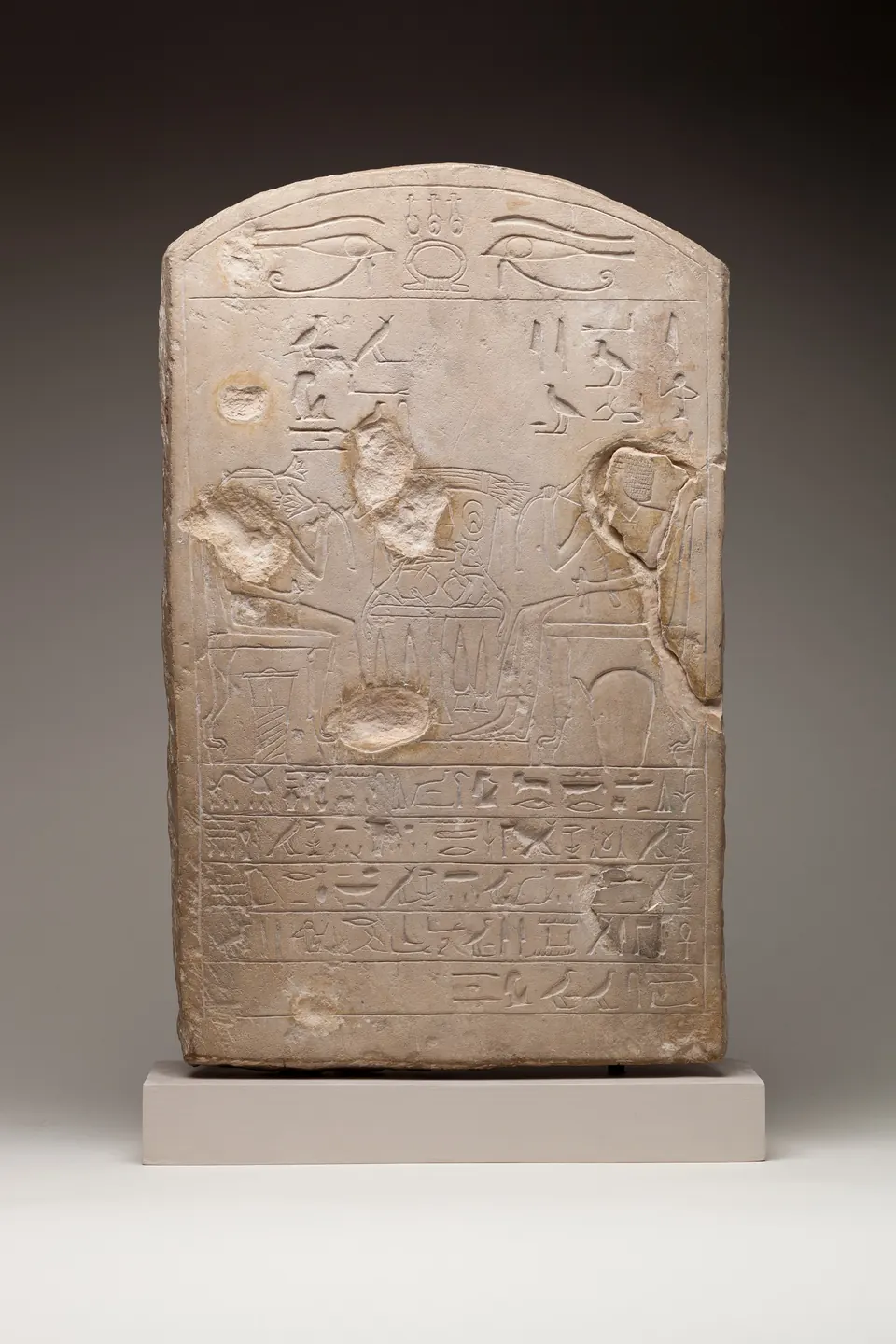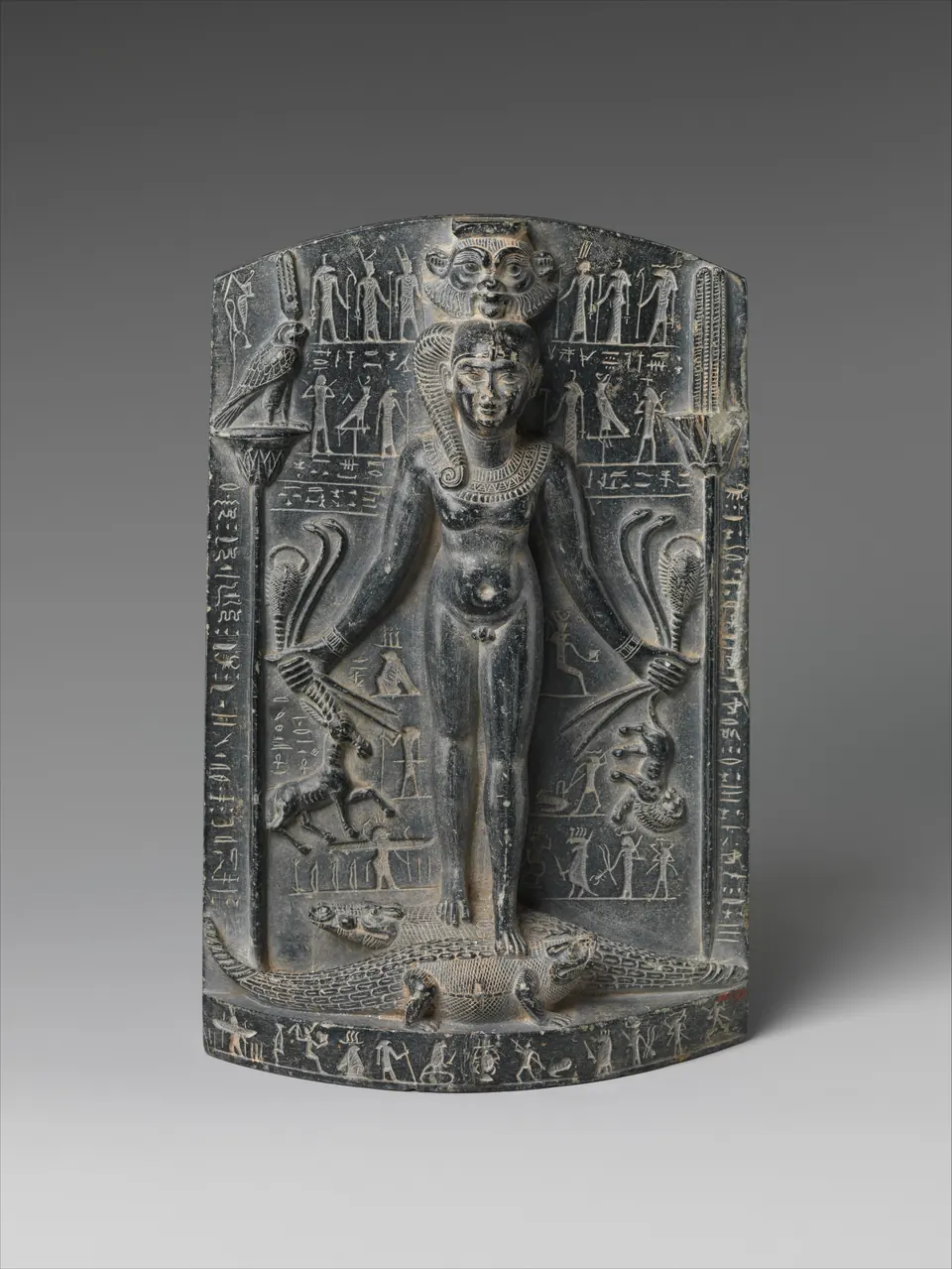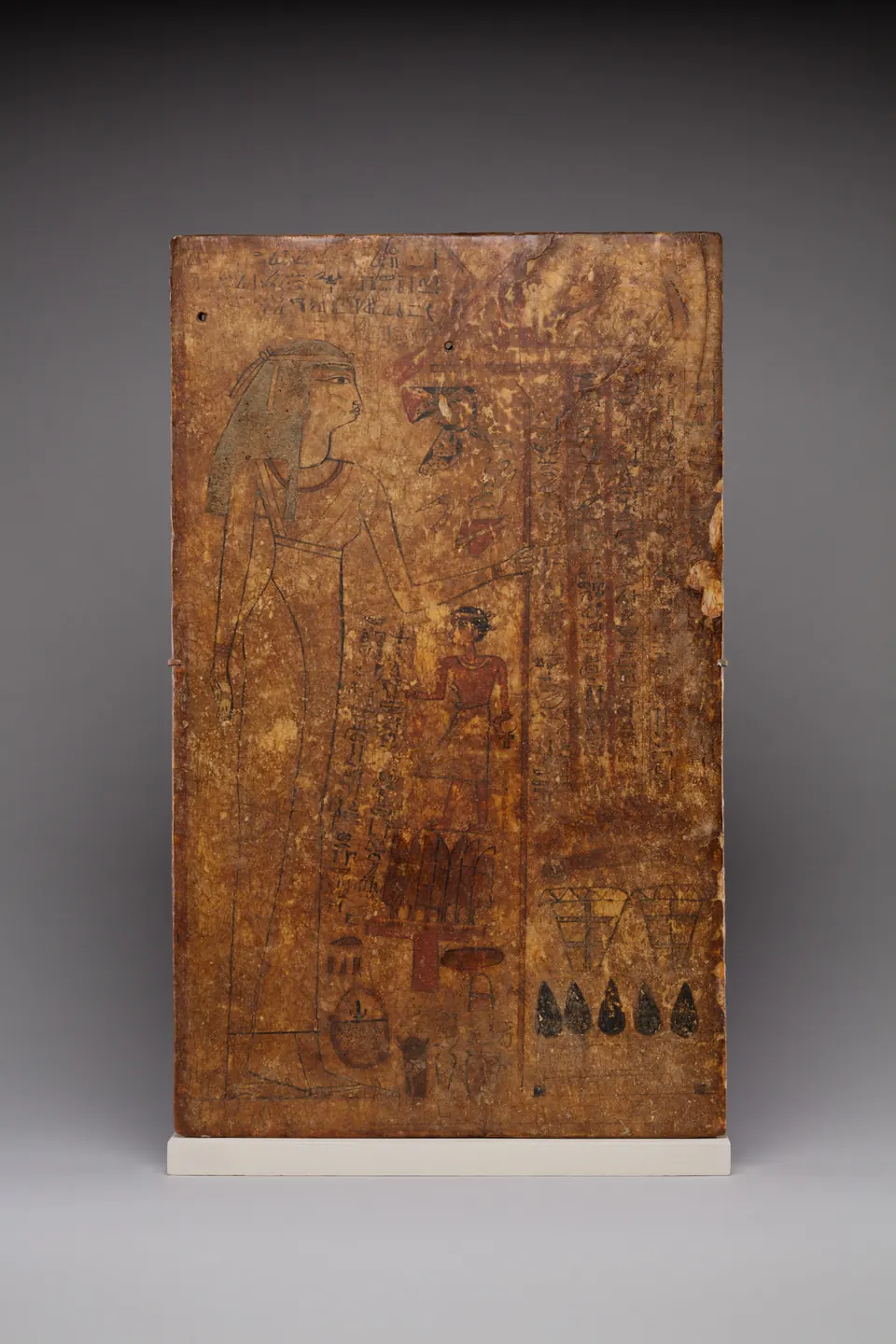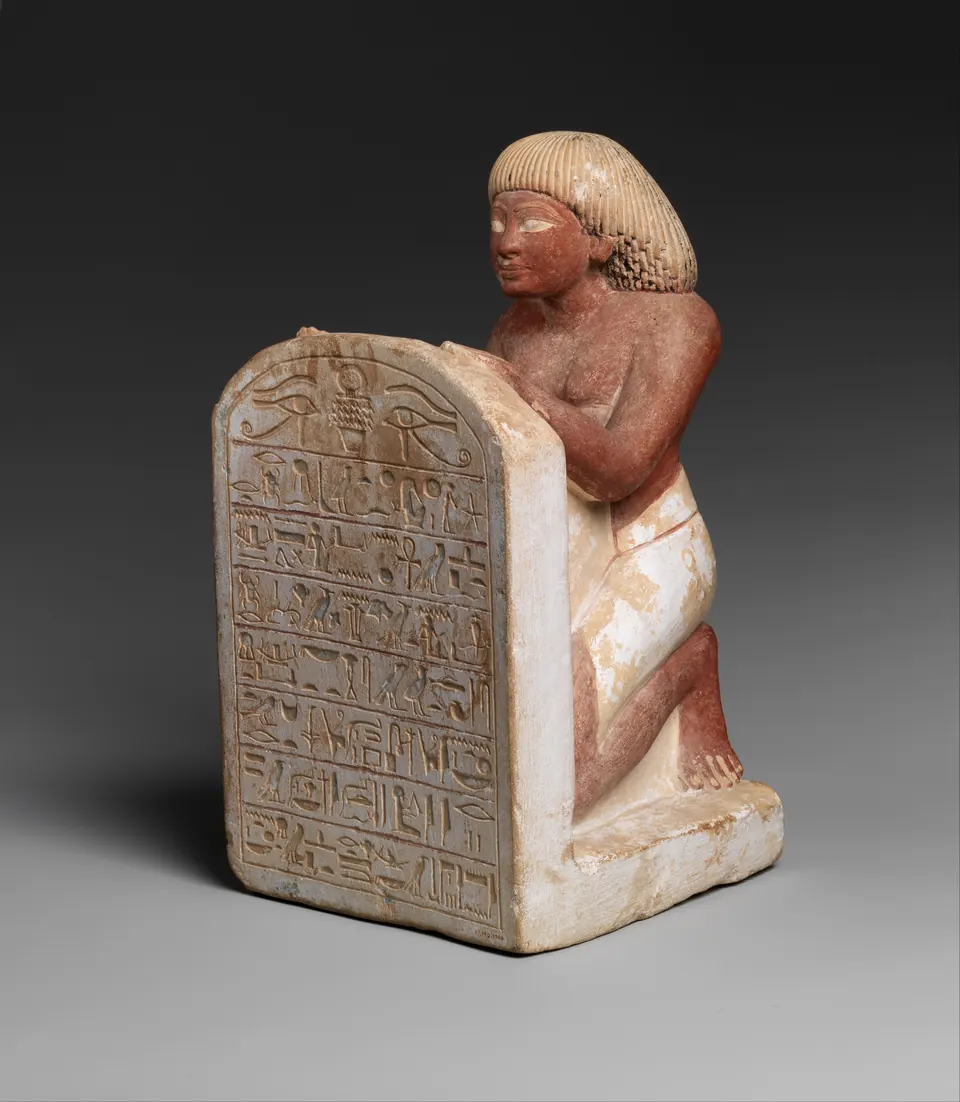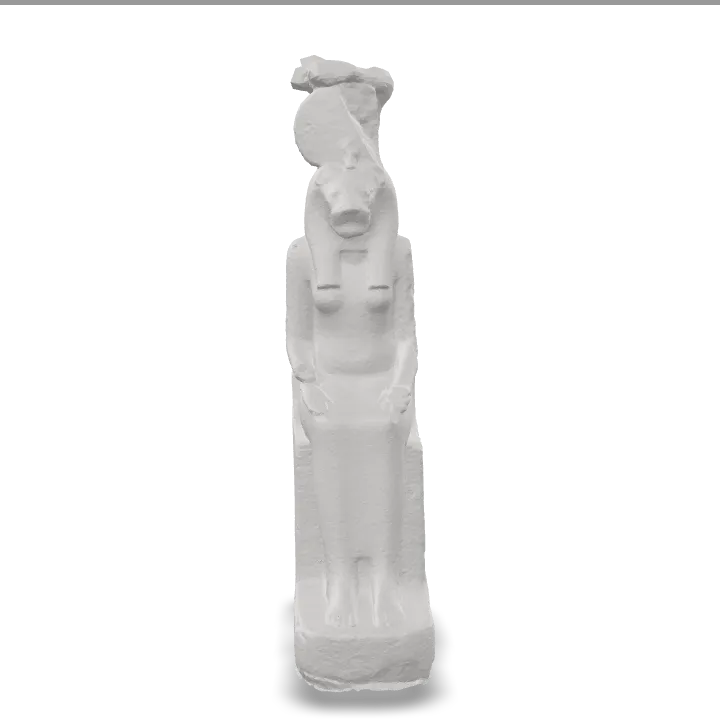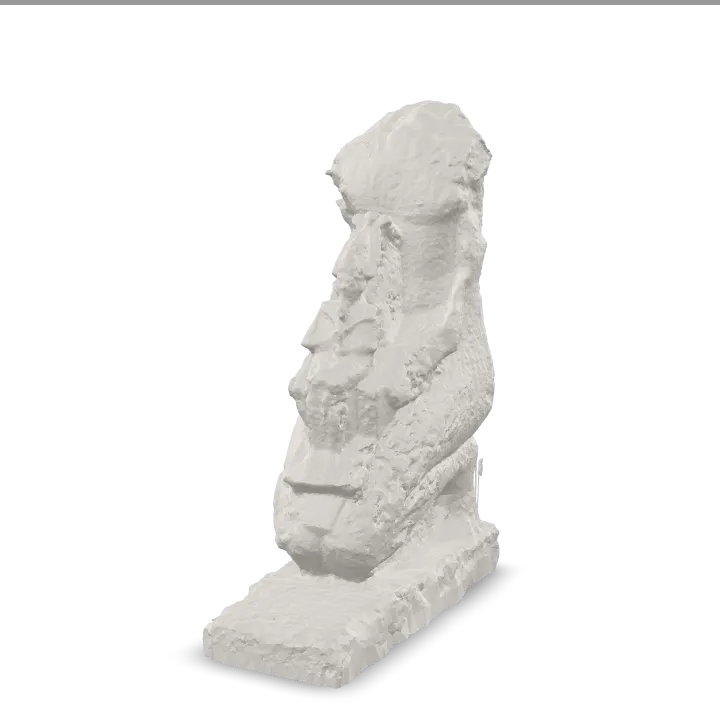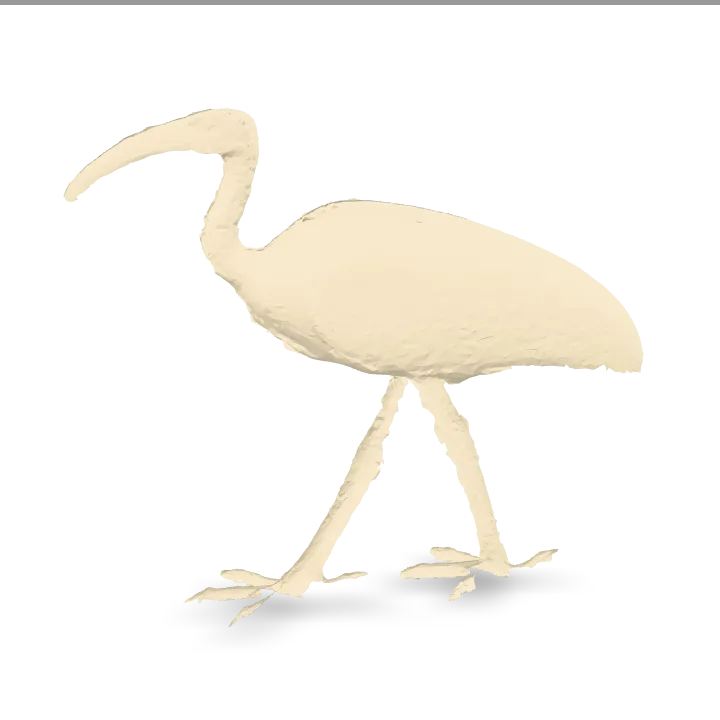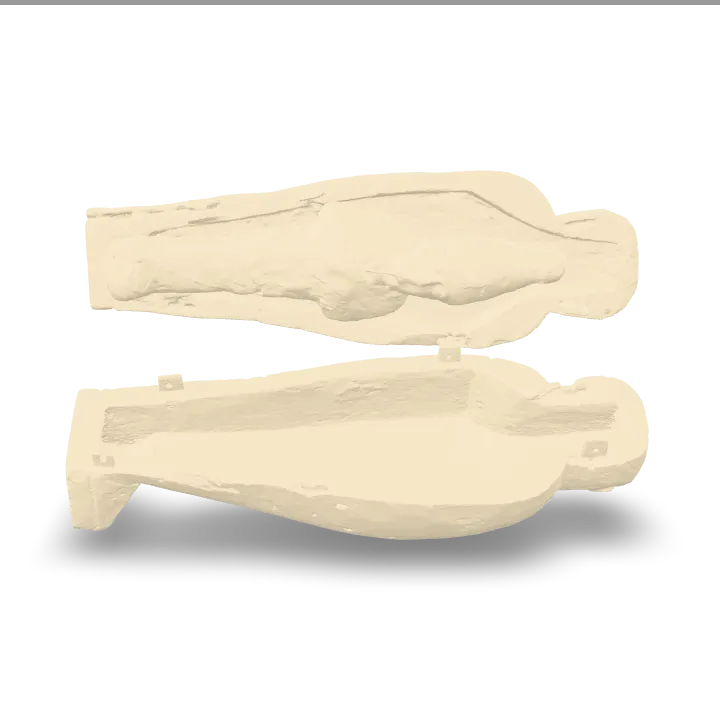
HAM’S LEGACY

Ancient Egypt Writing • Atrium

HAM’S LEGACY · DIGITAL MUSEUM

Ancient Egypt
WritingThe land of Mizraim, in its own words and works

Hieroglyphs, papyri and stelae; pyramids, temples and obelisks; vessels, gold and sculpture you can turn in 3D. Walk the halls, open any object, and see what it says, what it shows and why it matters.

Atrium photograph — Photo: KennyOMG · CC BY-SA 4.0 · source

Floor plan

Choose a hall, or begin at Hall I and follow “Next room”. Inside each hall, walk the wall with the arrows or by swiping; open any object for the full label, zoom, 3D and audio guide.

Hall I · 40 objects

The Scribes’ Hall

Egypt wrote for more than three thousand years, in four scripts that are one language: hieroglyphic for stone and sacred walls, hieratic for everyday ink on papyrus, demotic for business and law, and finally Coptic, written with Greek letters. This hall follows that story from the first royal names to the stone that let us read them again.

EG-I.01

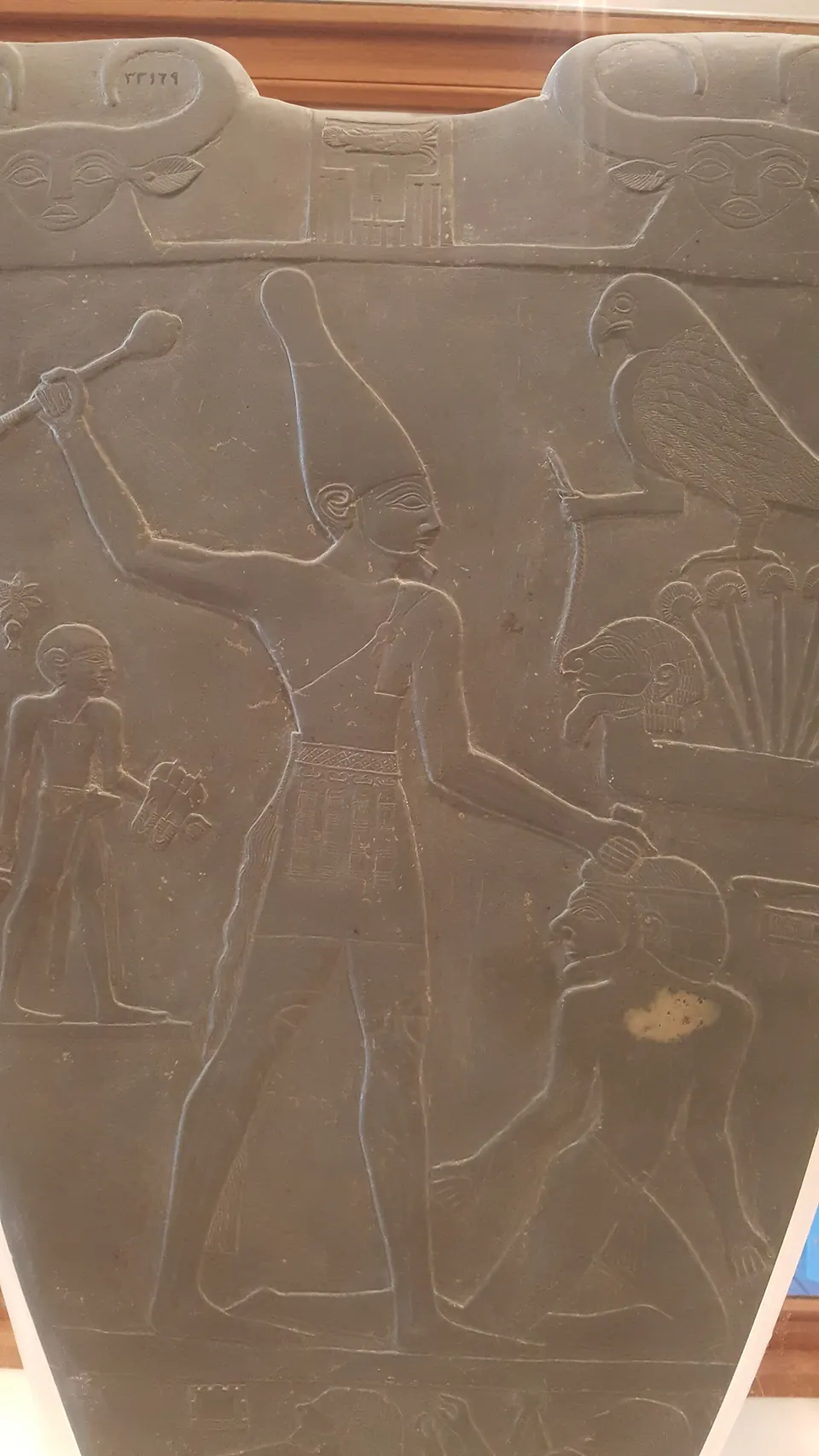
The Narmer Palette

c. 3100 BC (Early Dynastic, 1st Dynasty)SiltstoneFound: Hierakonpolis (Nekhen), Upper EgyptEgyptian Museum, CairoInv. JE 32169 / CG 14716

A ceremonial palette, shaped like the stone slabs used to grind eye paint, but far too large for daily use. It was found in the temple deposit at Hierakonpolis in 1897–98.

What it says and shows

The king, named by a catfish and a chisel inside a palace-façade frame (read Narmer), wears the White Crown of the south on one face and the Red Crown of the north on the other. These are among the earliest hieroglyphic inscriptions known.

Why it matters

It is one of the earliest depictions of an Egyptian king, and it already uses the conventions Egyptian art kept for three thousand years. Many Egyptologists read it as a picture of rule over both Upper and Lower Egypt.

Connects to the book

Sources & dating

Dates are approximate and follow the sources below.

Photo: Ovedc · CC BY-SA 4.0 · source

Photo: Ovedc · CC BY-SA 4.0 · source

Photo: Ovedc · CC BY-SA 4.0 · source
EG-I.02

Hieroglyphic: the sacred carvings

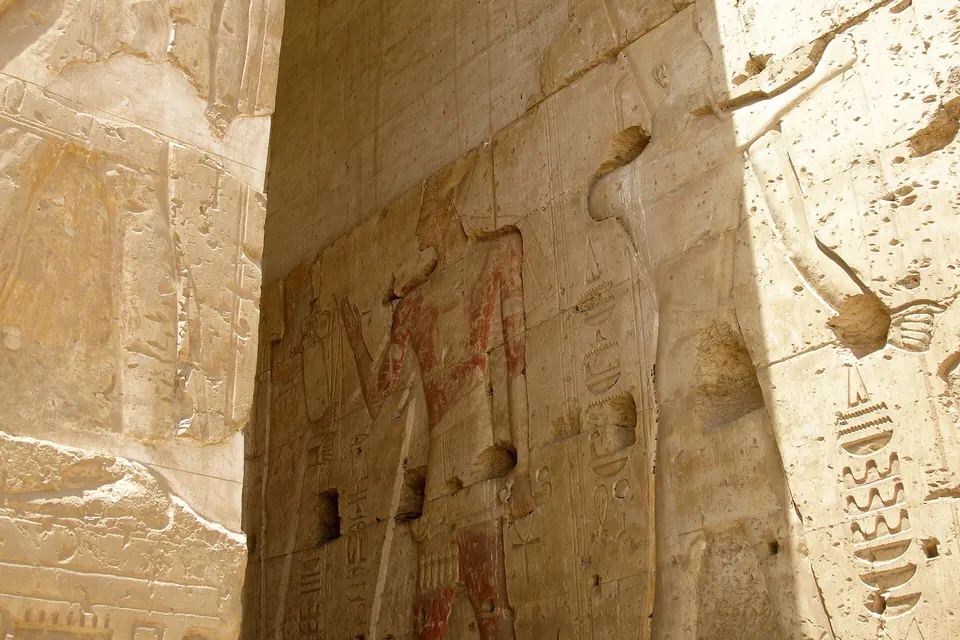
c. 3200 BC – AD 394Carved and painted stone (this wall: limestone)Found: Temple of Seti I, AbydosIn situ

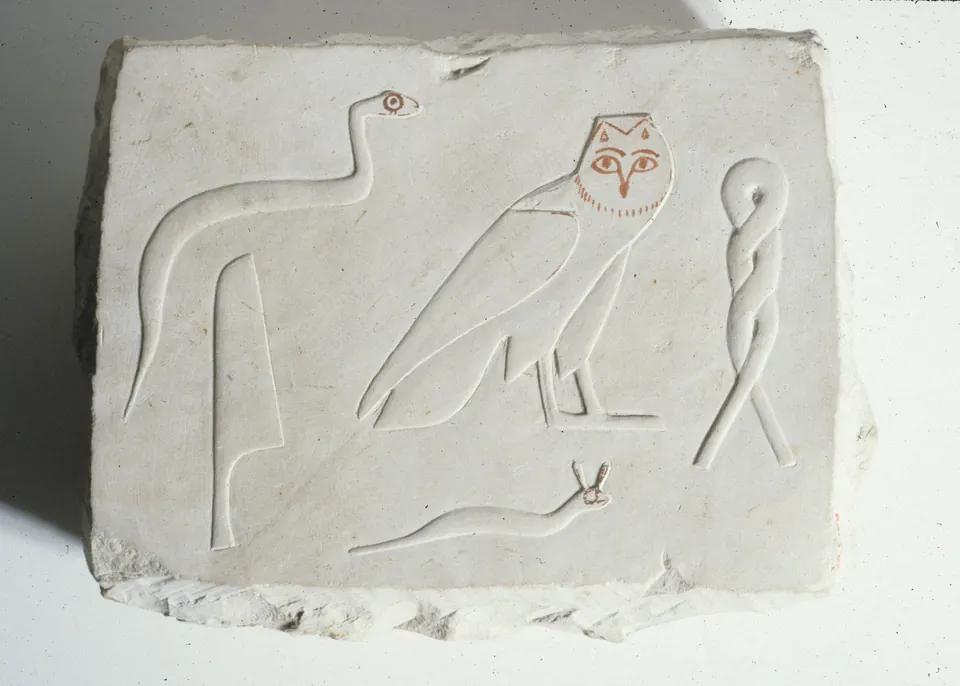
The picture-script the Greeks called hieroglyphs, “sacred carvings”. Each sign can stand for a sound, a group of sounds, or a meaning; most words mix sound signs with a final picture (a “determinative”) that shows the word’s category.

What it says and shows

This wall from the temple of Seti I (c. 1290–1279 BC) shows the script at its most refined: signs carved in raised relief, arranged in columns and read toward the faces of the people and animals.

Why it matters

Hieroglyphs were used for over 3,500 years. The last dated hieroglyphic inscription was carved at Philae in AD 394.

Connects to the book

Sources & dating

Dates are approximate and follow the sources below.

Photo: Vyacheslav Argenberg · CC BY 4.0 · source

Photo: Vyacheslav Argenberg · CC BY 4.0 · source

EG-I.03

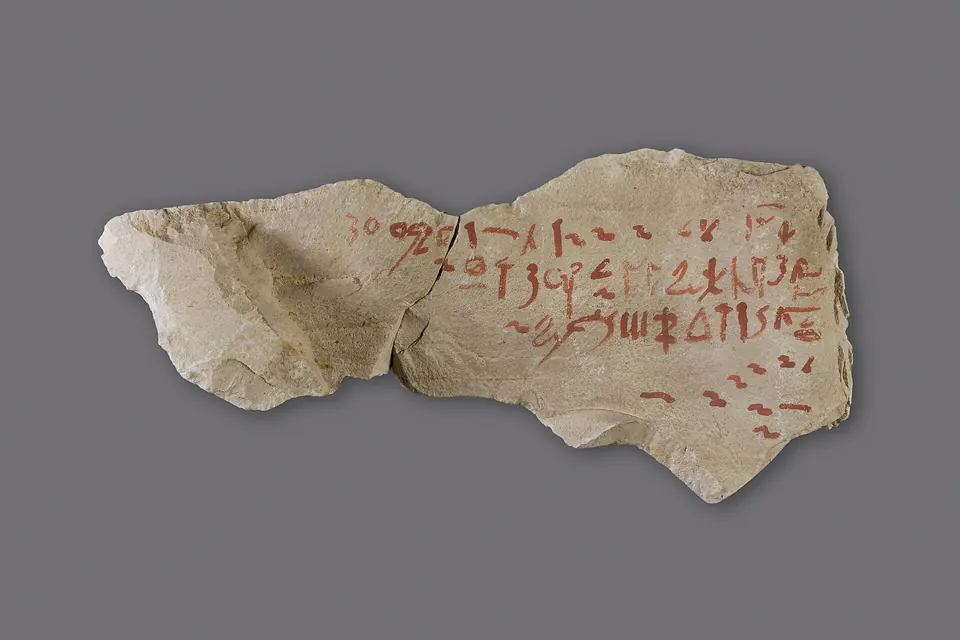
Hieratic: the scribe’s hand — and the Wisdom of Amenemope

525–404 BC (Persian period, 27th Dynasty); the Instruction itself was composed in the New KingdomLimestone flake with inkFound: Thebes, Deir el-Bahri: tomb of Nespakashuty (TT 312); Met excavations 1922–23The Metropolitan Museum of Art, New YorkInv. 26.3.165

Hieratic is the joined-up, ink form of hieroglyphs that scribes wrote with a reed brush. This ostracon (a flake of stone used like a notepad) carries the opening of the Instruction of Amenemope, a book of thirty chapters of advice from a father to his son.

What it says and shows

The beginning of the Instruction of Amenemope, copied out in hieratic, as a student or scribe would practise it.

Why it matters

Scholars have long noted that Proverbs 22:17–24:22 closely parallels the Instruction of Amenemope, one of the best-known links between Egyptian and biblical wisdom writing.

Connects to the book

Sources & dating

Dates are approximate and follow the sources below.

Photo: Unknown author · CC0 · source

Photo: Unknown author · CC0 · source

EG-I.04

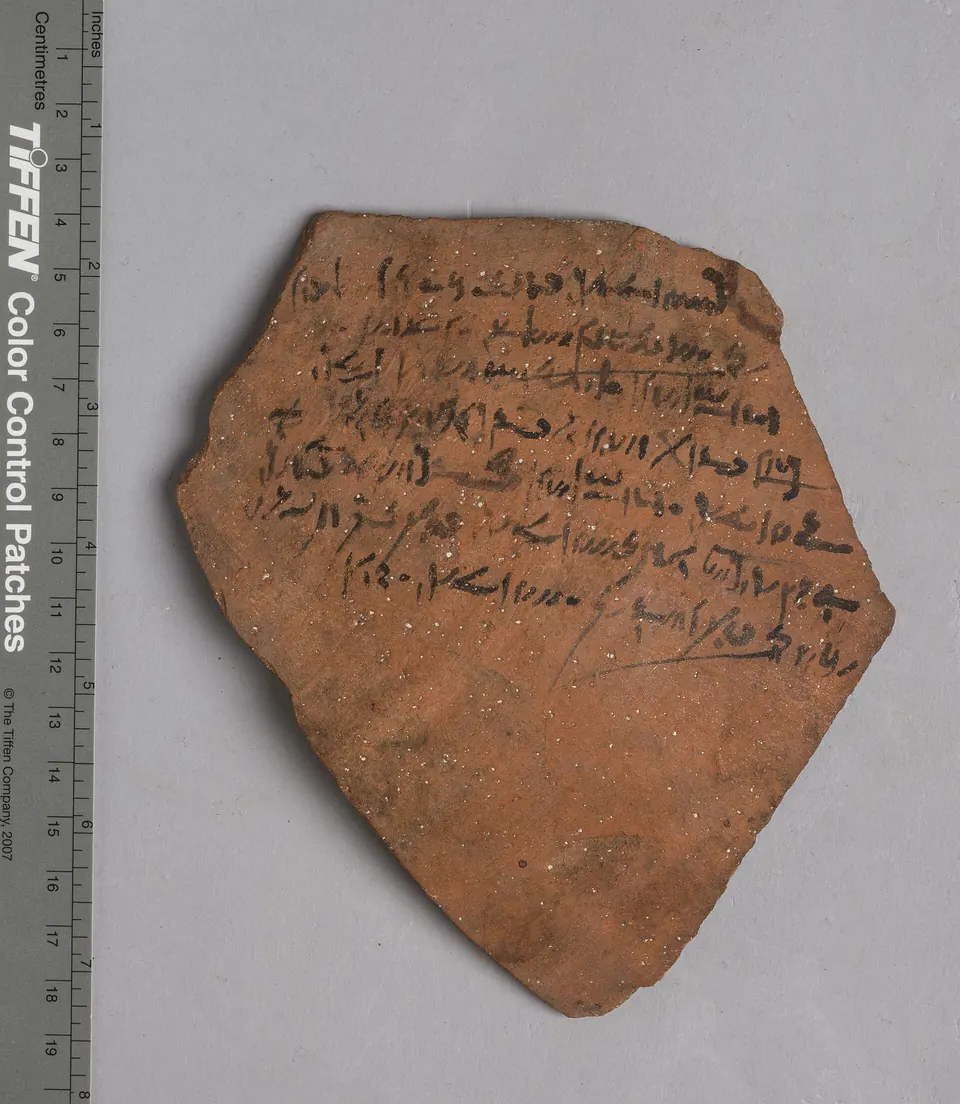
Demotic: the people’s script

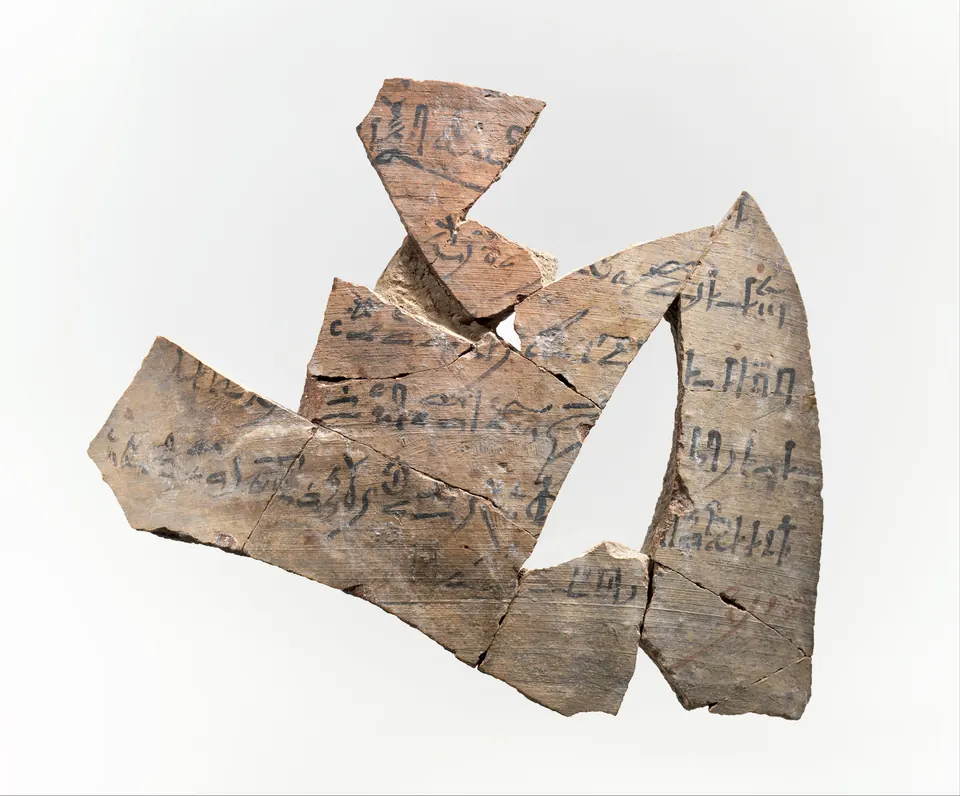
98 BC (Ptolemaic period)Clay ostracon (potsherd) with inkFound: Gebelein, Upper Egypt (Ptolemaic garrison); excavated by Schiaparelli, 1910Museo Egizio, TurinInv. Suppl. 12685

Demotic, the “popular” script, developed from hieratic in about the 7th century BC and became the everyday writing of contracts, letters and tax receipts.

What it says and shows

A “temple oath”: a record of a sworn statement made before a god in a legal dispute, written on a broken pot.

Why it matters

Demotic is the middle script on the Rosetta Stone. The last known demotic inscription was carved at Philae in AD 452.

Connects to the book

Sources & dating

Dates are approximate and follow the sources below.

Photo: Unknown author · CC0 · source

Photo: Unknown author · CC0 · source

EG-I.05

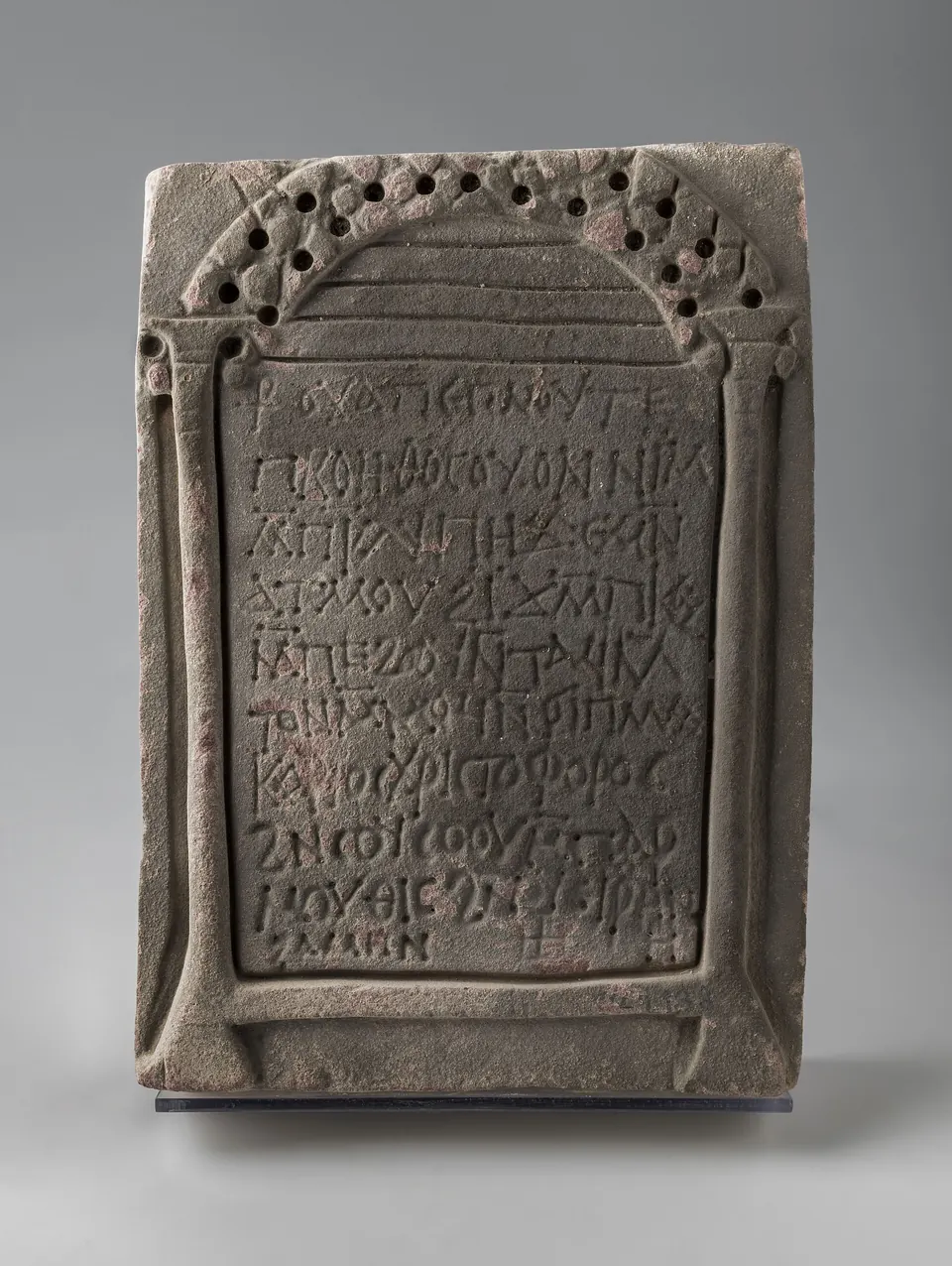
Coptic: Egyptian in Greek letters

AD 395 (date given by the Museo Egizio)SandstoneFound: Sakinya, Nubia (Egypt)Museo Egizio, TurinInv. Suppl. 18158

Coptic is the last stage of the Egyptian language, written with the Greek alphabet plus several letters taken from demotic.

What it says and shows

The funerary stela of a Christian named Christopher, written in Coptic.

Why it matters

Coptic is still the liturgical language of the Coptic Orthodox Church. Champollion’s knowledge of Coptic was a key to reading hieroglyphs: it let him recognise Egyptian words once he had their sounds.

Connects to the book

Sources & dating

Dates are approximate and follow the sources below.

Photo: Unknown author · CC0 · source

Photo: Unknown author · CC0 · source

EG-I.06

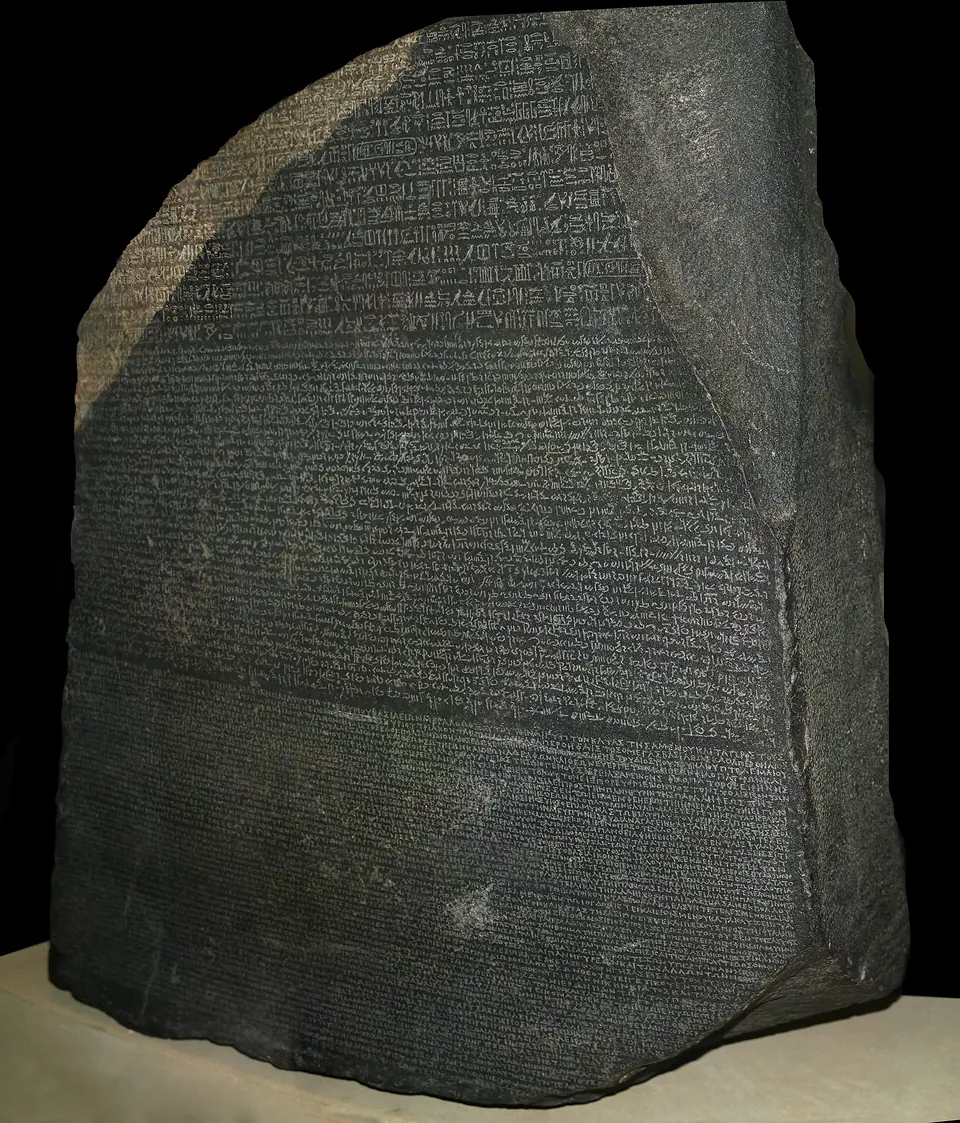
The Rosetta Stone

196 BC (Ptolemaic)GranodioriteFound: Rashid (Rosetta), Nile DeltaBritish Museum, LondonInv. EA 24

A broken stela carrying one decree, issued at Memphis in 196 BC in honour of King Ptolemy V, written three times: in hieroglyphic, in demotic, and in ancient Greek. French soldiers found it in July 1799.

What it says and shows

The decree ends by ordering that it be set up in temples written in “sacred characters, native characters and Greek characters”, which is why one text appears in three scripts.

“to be inscribed … in sacred and native and Greek characters”

Rosetta Stone, Greek text, closing clause

Why it matters

Because the Greek could be read, the stone gave scholars a key. Thomas Young identified the sound signs of a royal name; Jean-François Champollion announced the decipherment of hieroglyphs in 1822.

Connects to the book

Sources & dating

Dates are approximate and follow the sources below.

Photo: Hans Hillewaert · CC BY-SA 4.0 · source
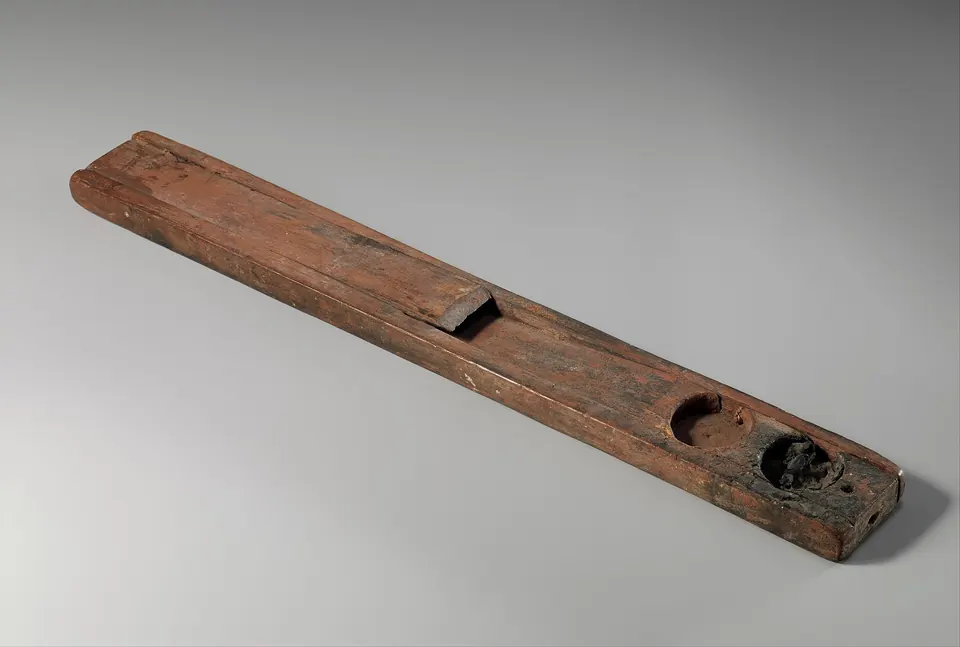
Photo: Hans Hillewaert · CC BY-SA 4.0 · source
EG-I.07

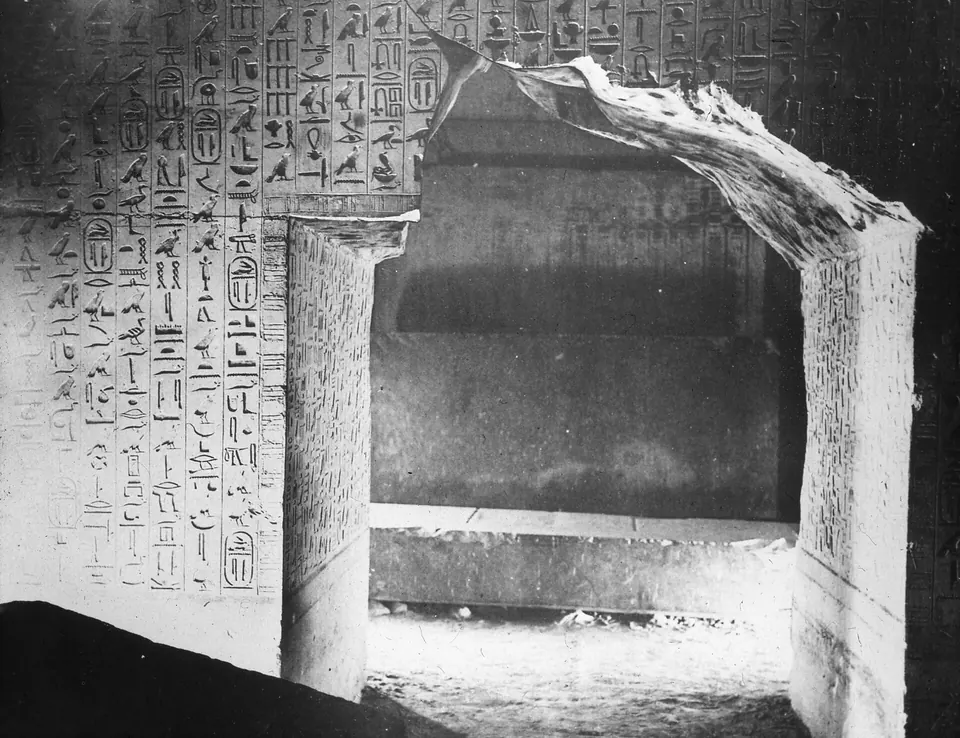
The Pyramid Texts of Unas

c. 2350 BC (Old Kingdom, 5th Dynasty)Limestone walls, signs filled with blue pigmentFound: Pyramid of Unas, SaqqaraIn situ

The oldest large body of religious writing from Egypt: spells carved on the inner walls of the pyramid of King Unas, last king of the 5th Dynasty.

What it says and shows

Hundreds of “utterances” meant to protect the king and help him rise to the sky and join the gods after death.

Why it matters

Unas’s pyramid is the first known to carry such texts; later pyramids continued the practice, and the spells evolved into the Coffin Texts and the Book of the Dead.

Connects to the book

Sources & dating

Dates are approximate and follow the sources below.

Photo: Brooklyn Museum · Public domain · source

Photo: Aidan McRae Thomson · CC BY-SA 2.0 · source

Photo: Brooklyn Museum · Public domain · source

EG-I.08

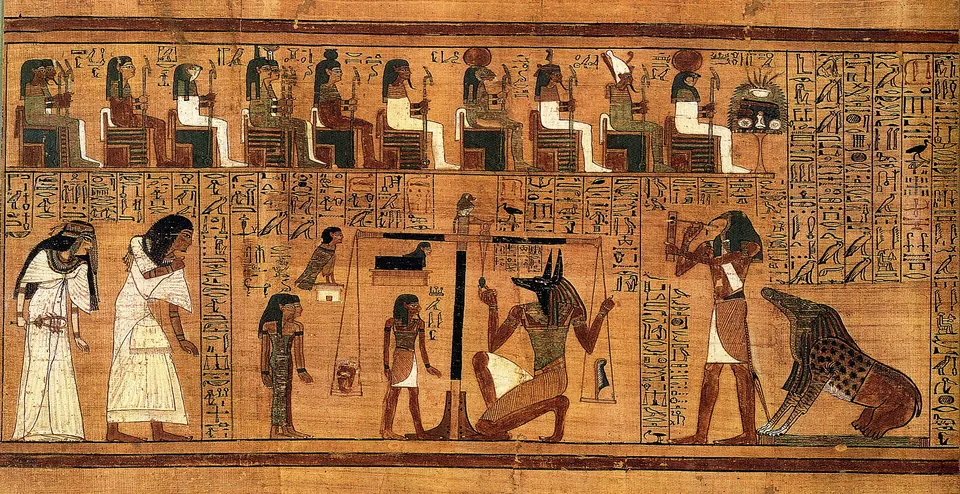
The Book of the Dead: the Papyrus of Ani

c. 1250 BC (New Kingdom, 19th Dynasty)Papyrus, ink and paintFound: ThebesBritish Museum, LondonInv. EA 10470

A beautifully illustrated scroll of spells made for the scribe Ani. The “Book of the Dead” is a modern name; the Egyptians called it the Spells for Going Out by Day.

What it says and shows

The judgement scene: the heart of the dead is weighed against the feather of Maat (truth and right order). In Spell 125 the deceased declares a list of wrongs they did not commit, such as “I have not stolen” and “I have not killed”.

Why it matters

It shows how Egyptians linked the afterlife to a moral life, and it is one of the finest illustrated manuscripts to survive from the ancient world.

Connects to the book

Sources & dating

Dates are approximate and follow the sources below.

Photo: Photographed by the British Museum; original artist unknown · Public domain · source

Photo: Photographed by the British Museum; original artist unknown · Public domain · source

EG-I.09

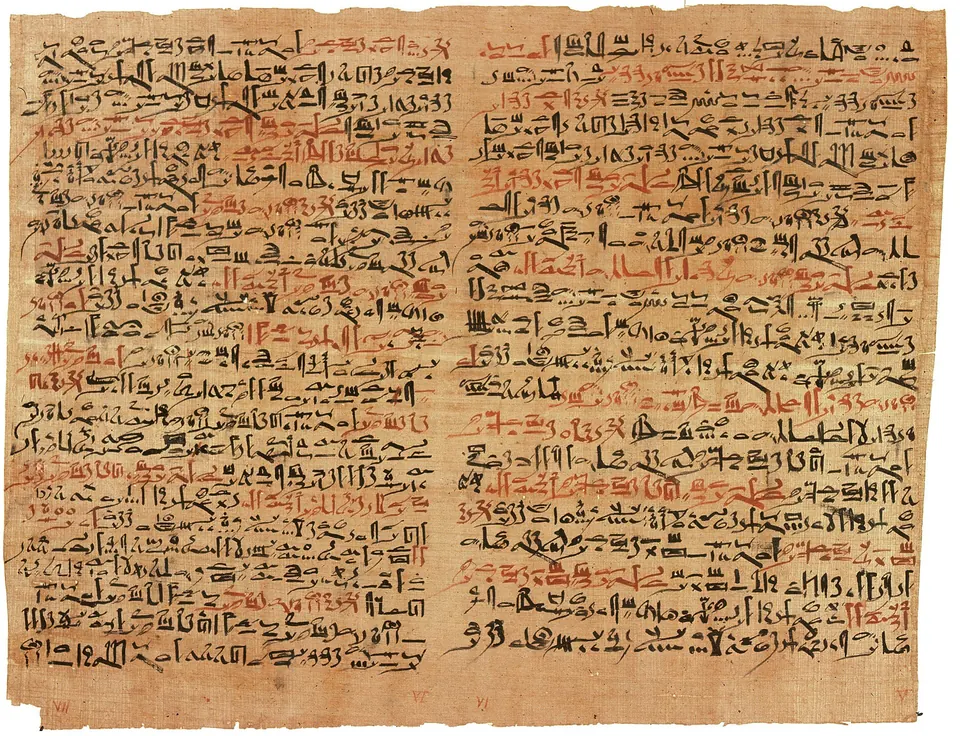
The Edwin Smith Surgical Papyrus

Copy c. 1600 BC; original possibly Old KingdomPapyrus, inkFound: Thebes (bought at Luxor in 1862)New York Academy of Medicine

The oldest known surgical treatise on trauma, describing 48 cases of injuries, fractures, wounds, dislocations and tumours, from the head downward.

What it says and shows

Each case follows a clear order: title, examination, diagnosis, and a verdict — an ailment “I will treat”, “I will contend with”, or one “not to be treated”.

Why it matters

It approaches injury with observation rather than spells, and it contains some of the earliest written descriptions of the brain and its coverings.

Connects to the book

Sources & dating

Dates are approximate and follow the sources below.

Photo: Jeff Dahl · Public domain · source

Photo: Jeff Dahl · Public domain · source

EG-I.10

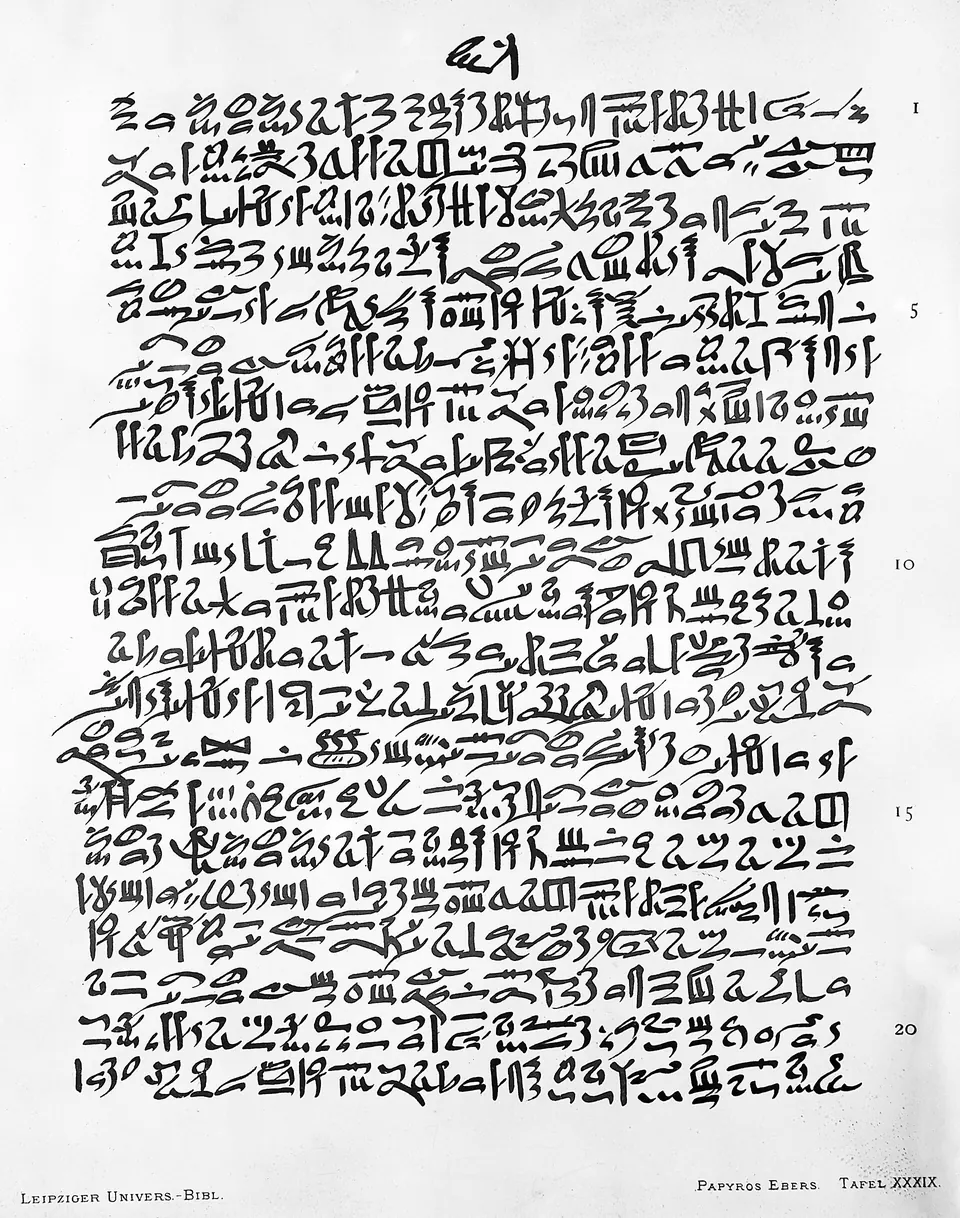
The Ebers Papyrus

c. 1550 BCPapyrus, inkFound: Thebes (bought at Luxor, 1873–74)Leipzig University LibraryInv. Papyrus Ebers

One of the oldest and most important medical papyri of ancient Egypt: a long scroll of remedies and medical knowledge.

What it says and shows

Hundreds of prescriptions, incantations and descriptions of disease, including a section on the heart and the vessels of the body.

Why it matters

It shows the range of Egyptian medicine and pharmacy more than 3,500 years ago.

Connects to the book

Sources & dating

Dates are approximate and follow the sources below.

Photo: Unknown author · CC BY 4.0 · source

Photo: Unknown author · CC BY 4.0 · source

EG-I.11

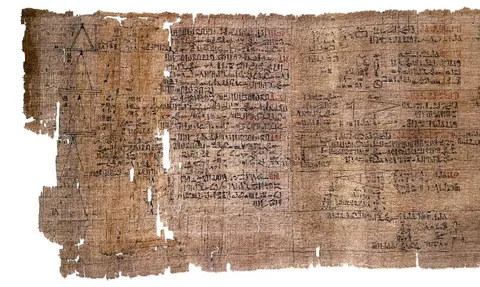
The Rhind Mathematical Papyrus

c. 1550 BC, copied from an older originalPapyrus, inkFound: ThebesBritish Museum, LondonInv. EA 10057–10058

A scribe named Ahmes copied this handbook of 84 problems in arithmetic and geometry from an older work of the Middle Kingdom.

What it says and shows

Problems on fractions, dividing loaves, the volumes of granaries, the areas of fields and the slope of pyramids.

“Accurate reckoning for inquiring into things, and the knowledge of all things, mysteries … all secrets”

Opening of the Rhind Papyrus (trans. A. B. Chace, 1927)

Why it matters

It is one of the best-known sources for Egyptian mathematics, the practical science behind surveying, building and administration.

Connects to the book

Sources & dating

Dates are approximate and follow the sources below.

Photo: unknown (c. 2000 B.C) · Public domain · source

Photo: unknown (c. 2000 B.C) · Public domain · source

EG-I.12

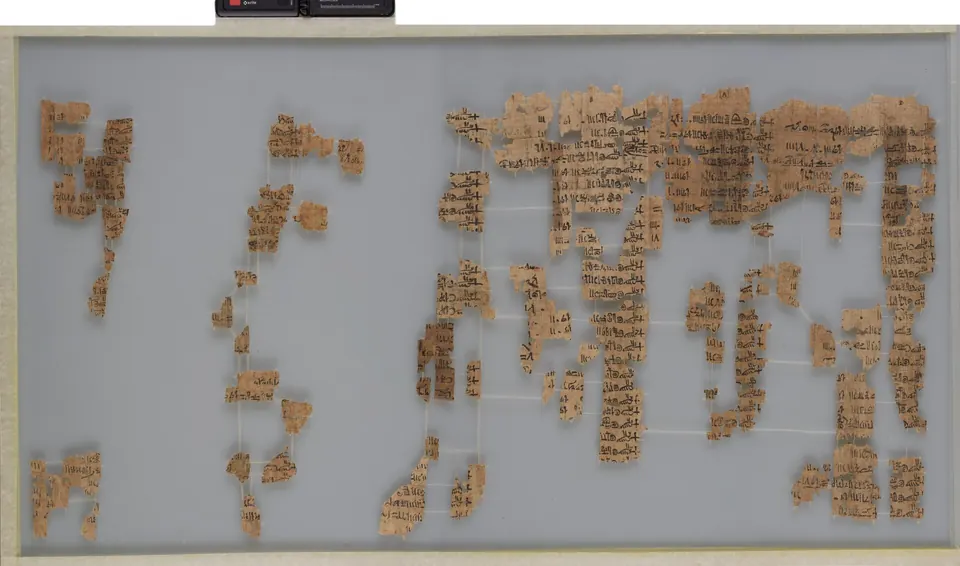
The Turin King List

1279–1213 BC (reign of Ramesses II)Papyrus, inkFound: Thebes, probably Deir el-Medina (museum record: “Deir el-Medina (?)”; acquisition: purchase from Bernardino Drovetti, 1842 per Museo Egizio)Museo Egizio, TurinInv. Cat. 1874

A hieratic papyrus listing the kings of Egypt with the length of their reigns, written on the back of a tax register.

What it says and shows

It originally named some 270 rulers, from the gods and the first kings down to the 17th Dynasty, grouped and totalled; many fragments are lost.

Why it matters

It is the most extensive king list compiled by the Egyptians themselves and a foundation of Egyptian chronology before Ramesses II.

Connects to the book

Sources & dating

Dates are approximate and follow the sources below.

Photo: Unknown author · CC0 · source

Photo: Unknown author · CC0 · source

EG-I.13

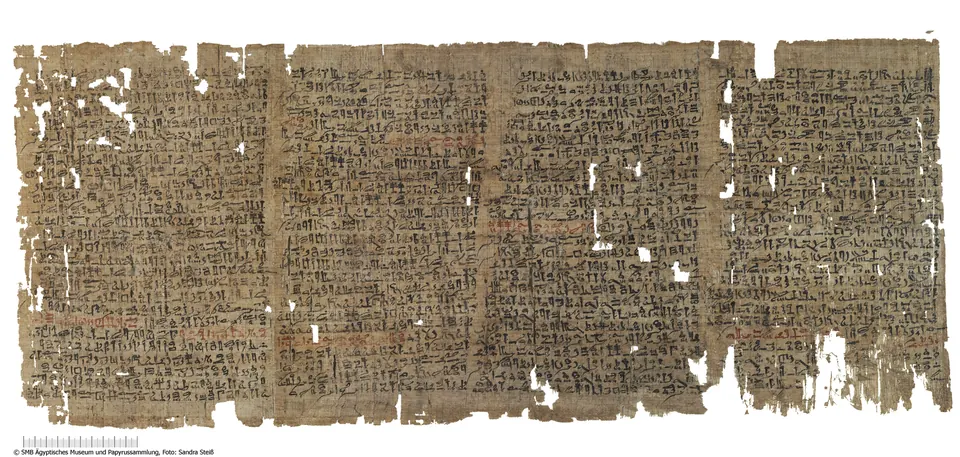
The Westcar Papyrus

Copy of the 17th Dynasty (c. 1650–1550 BC)Papyrus, inkFound: EgyptÄgyptisches Museum und Papyrussammlung, BerlinInv. P. 3033

Twelve columns of hieratic with five stories of wonders performed by priests and magicians.

What it says and shows

The tales are told at the court of King Khufu, builder of the Great Pyramid, by his sons.

Why it matters

It is a classic of Middle Egyptian literature and one of the few narratives set in the age of the pyramid builders.

Connects to the book

Sources & dating

Dates are approximate and follow the sources below.

Photo: Unknown author · CC BY-SA 4.0 · source
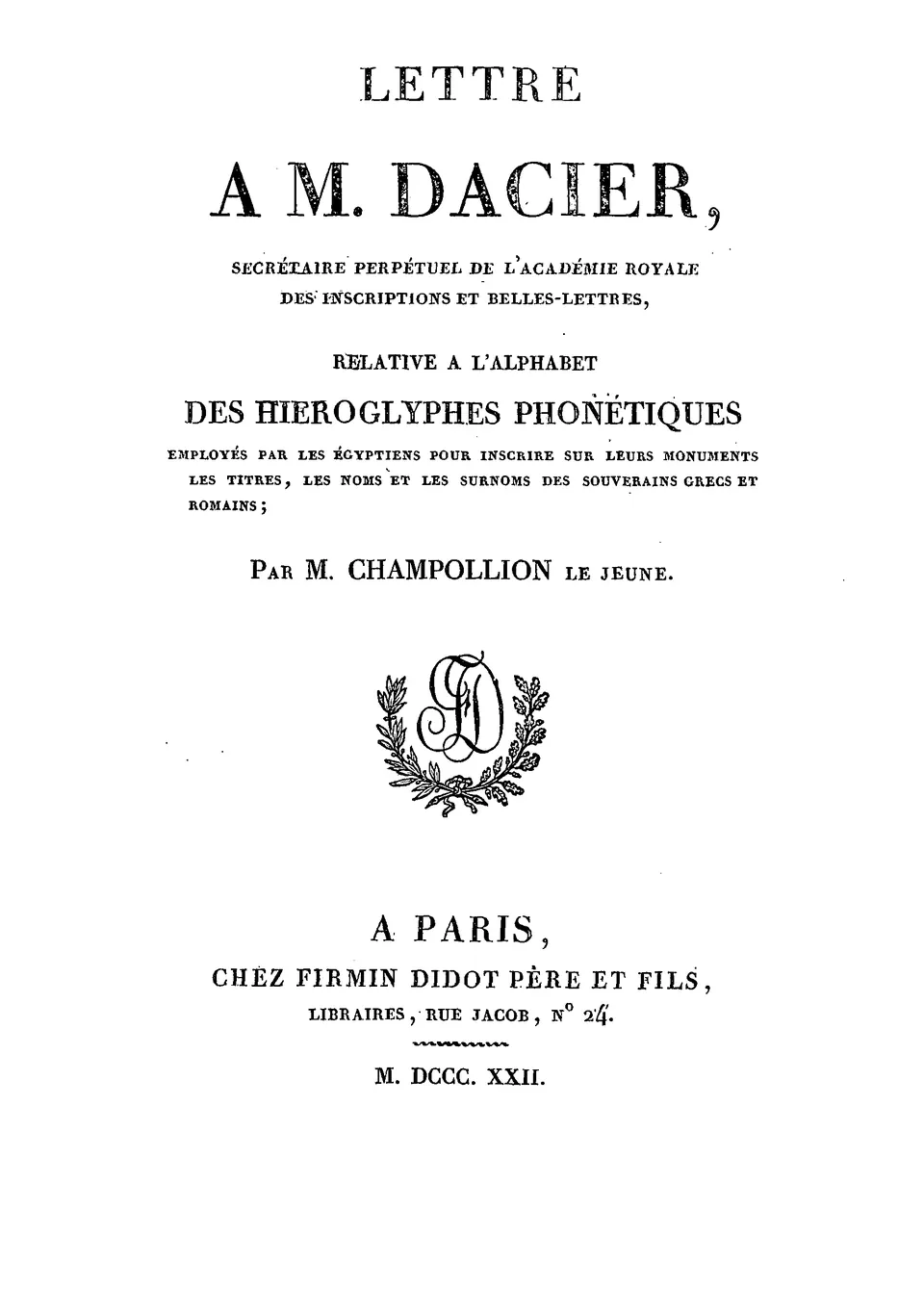
Photo: Unknown author · CC BY-SA 4.0 · source
EG-I.14

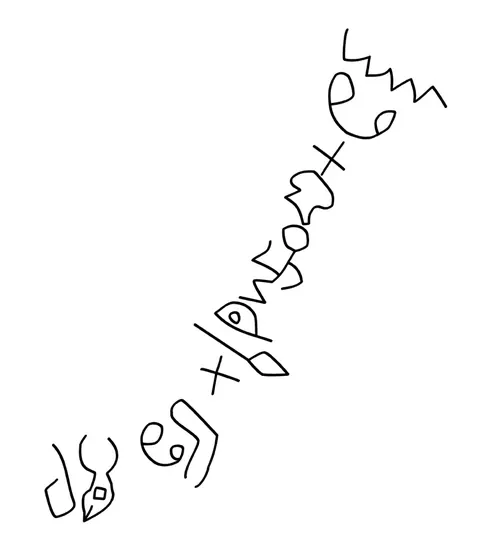
The Wadi el-Hol inscriptions

c. 1900–1800 BCRock inscriptionFound: Wadi el-Hol, desert road west of ThebesIn situ

Two short rock inscriptions on an ancient desert road, discovered by John and Deborah Darnell in the 1990s.

What it says and shows

Letters that look like simplified Egyptian signs, but used alphabetically, one sign per consonant.

Why it matters

They appear to be among the oldest examples of alphabetic writing yet found. Egyptian signs gave shape to the first alphabet, the ancestor of Hebrew, Greek and Latin letters.

Connects to the book

Sources & dating

Dates are approximate and follow the sources below.

Photo: Drawing by Marilyn Lundberg, West Semitic Research · Public domain · source

Photo: Drawing by Marilyn Lundberg, West Semitic Research · Public domain · source

EG-I.15

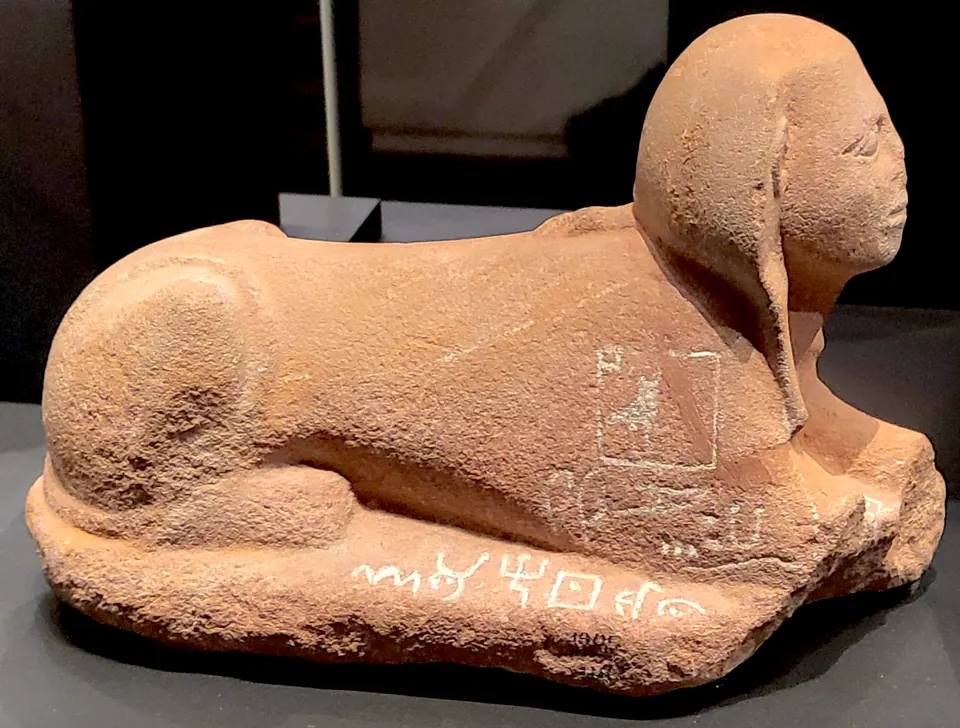
Sphinx from Serabit el-Khadim: “to Baalat”

c. 1800–1500 BCSandstoneFound: Serabit el-Khadim, SinaiBritish Museum, LondonInv. EA 41748

A small sphinx from the turquoise mines of Sinai, inscribed both in Egyptian hieroglyphs and in Proto-Sinaitic, the early alphabet.

What it says and shows

The alphabetic signs are commonly read lbʿlt, “to Baalat”, a Canaanite goddess; the hieroglyphs name the Egyptian goddess Hathor, “mistress of turquoise”.

Why it matters

This bilingual pairing helped scholars recognise that the earliest alphabet borrowed its letter shapes from Egyptian signs.

Connects to the book

Sources & dating

Dates are approximate and follow the sources below.

Photo: Onceinawhile · CC BY-SA 4.0 · source
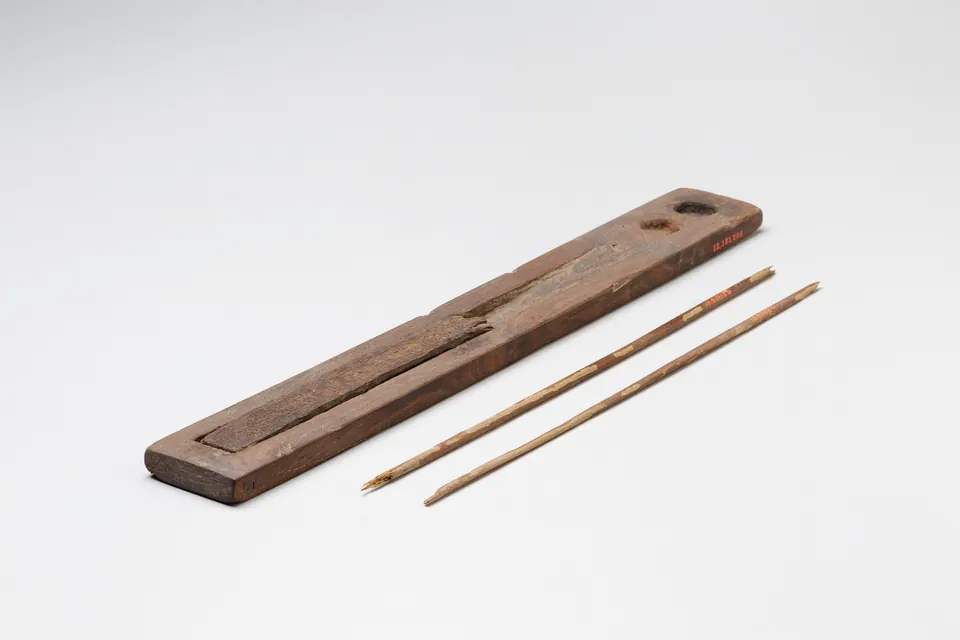
Photo: unknown Uploaded by Kwamikagami at en.wikipedia · Public domain · source

Photo: Onceinawhile · CC BY-SA 4.0 · source
EG-I.16

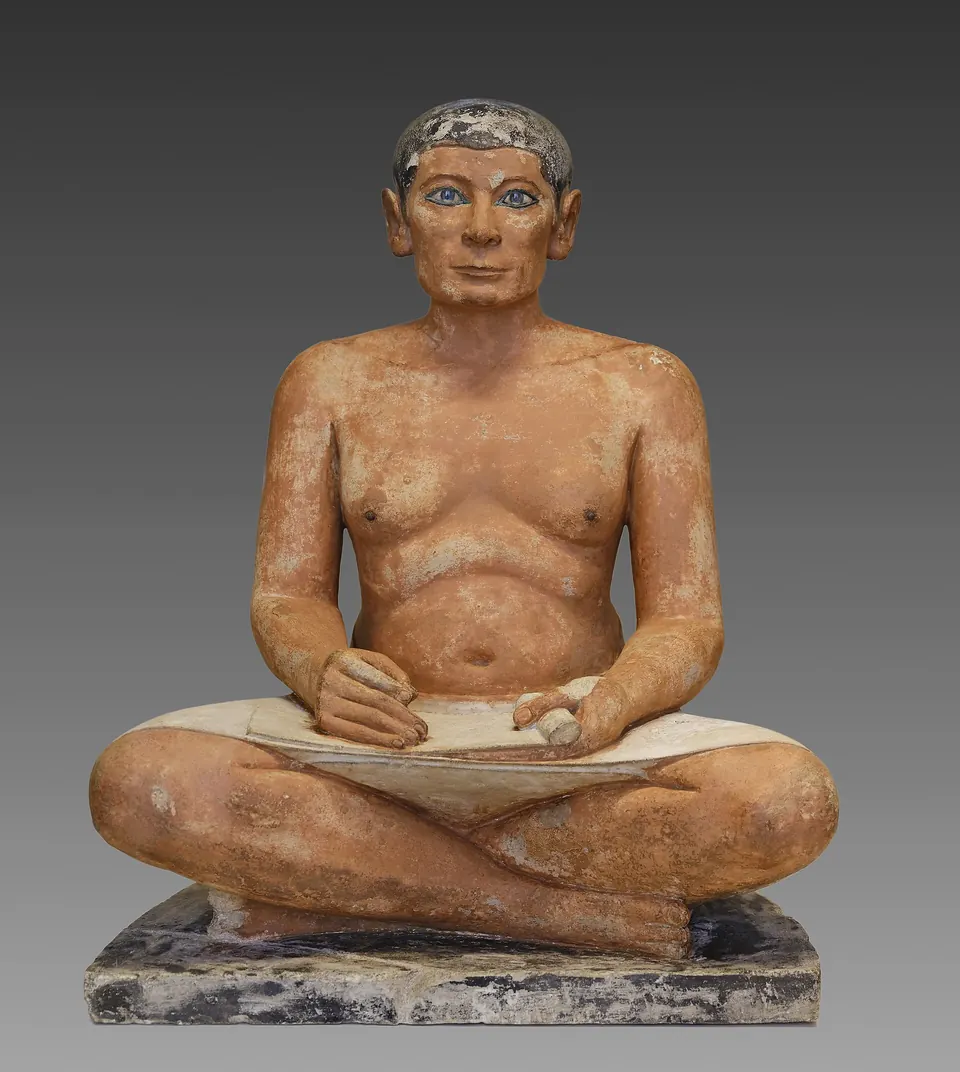
The Seated Scribe

c. 2600–2350 BC (Old Kingdom, 4th–5th Dynasty)Painted limestone; eyes of rock crystal, magnesite and copper alloyFound: Saqqara (found 1850)Musée du Louvre, ParisInv. E 3023

A life-like statue of a scribe seated cross-legged, a papyrus unrolled across his lap, ready to write.

What it says and shows

The inlaid eyes seem to follow the viewer. His hand once held a brush.

Why it matters

Scribes ran Egypt: they counted harvests, recorded taxes, drafted letters and copied sacred texts. Writing was the key to office.

Connects to the book

Sources & dating

Dates are approximate and follow the sources below.

Photo: Shonagon · CC0 · source

Photo: Shonagon · CC0 · source

EG-I.17

A scribe’s palette

c. 2030–1550 BC (Middle Kingdom – Second Intermediate Period)Wood, pigmentFound: EgyptThe Metropolitan Museum of Art, New YorkInv. 10.176.62

The basic writing kit: a slim palette with wells for black ink (soot) and red ink (ochre), and a slot for reed brushes.

What it says and shows

Red ink marked headings and new sections; black ink carried the main text — the habit gave us the word “rubric”, from Latin for red.

Why it matters

The hieroglyph for “scribe” is a picture of exactly this kit: palette, water pot and brush holder.

Connects to the book

Sources & dating

Dates are approximate and follow the sources below.

Photo: Unknown author · CC0 · source

Photo: Unknown author · CC0 · source

EG-I.18

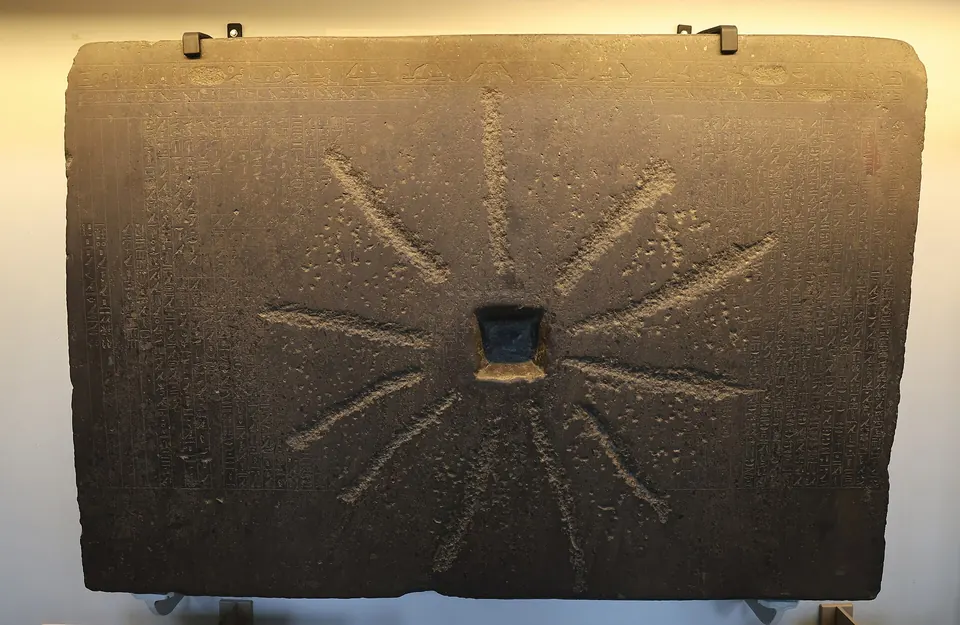
The Shabaka Stone

c. 710 BC (25th Dynasty, the Kushite pharaohs)Conglomerate, per the British Museum record (older literature calls it black basalt or granite; some recent studies call it breccia)Found: MemphisBritish Museum, LondonInv. EA 498

King Shabaka, a Kushite pharaoh, had an ancient religious text copied onto stone. The inscription says he found the original “eaten by worms” and renewed it.

What it says and shows

The “Memphite Theology”: an account of creation in which the god Ptah brings the world into being through his heart (thought) and tongue (speech).

Why it matters

A Kushite king preserved one of Egypt’s most important theological texts. Centuries later the stone was reused as a millstone, which wore away its centre.

Connects to the book

Sources & dating

Dates are approximate and follow the sources below.

Photo: Sanjay ach · CC BY-SA 4.0 · source
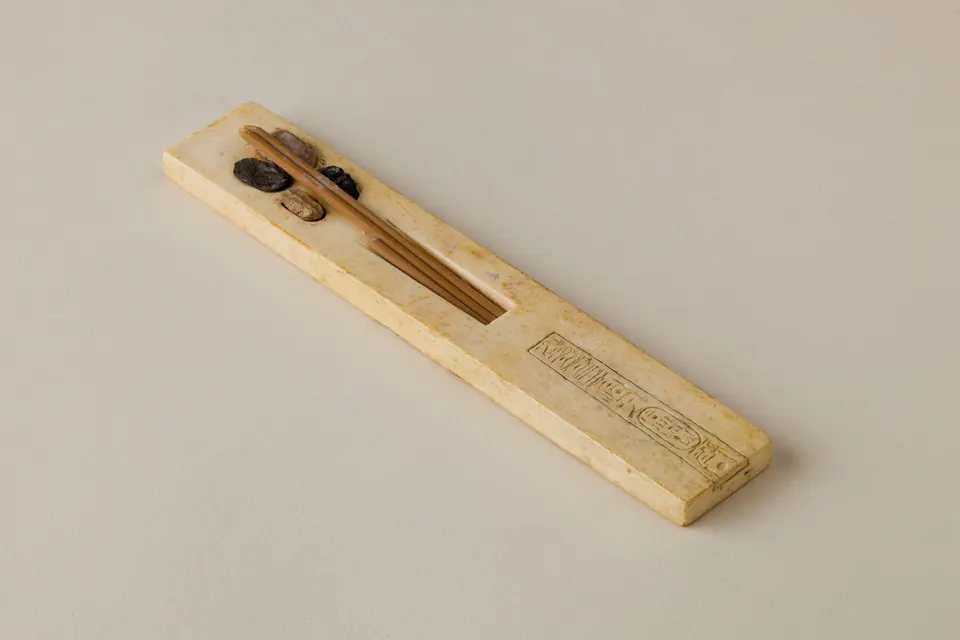
Photo: Sanjay ach · CC BY-SA 4.0 · source
EG-I.19

Champollion’s Lettre à M. Dacier

1822Printed book with engraved platesFound: ParisPublic-domain scan

The public letter in which Jean-François Champollion set out the sound values of hieroglyphs, read from royal names such as Ptolemy and Cleopatra.

What it says and shows

Tables of hieroglyphic signs set against the Greek letters they matched in royal cartouches.

Why it matters

This letter is usually taken as the moment Egyptian writing became readable again after some 1,400 years.

Connects to the book

Sources & dating

Dates are approximate and follow the sources below.

Photo: Librairie Firmin Didot · Public domain · source

Photo: Léon Cogniet · Public domain · source

Photo: Librairie Firmin Didot · Public domain · source

EG-I.20

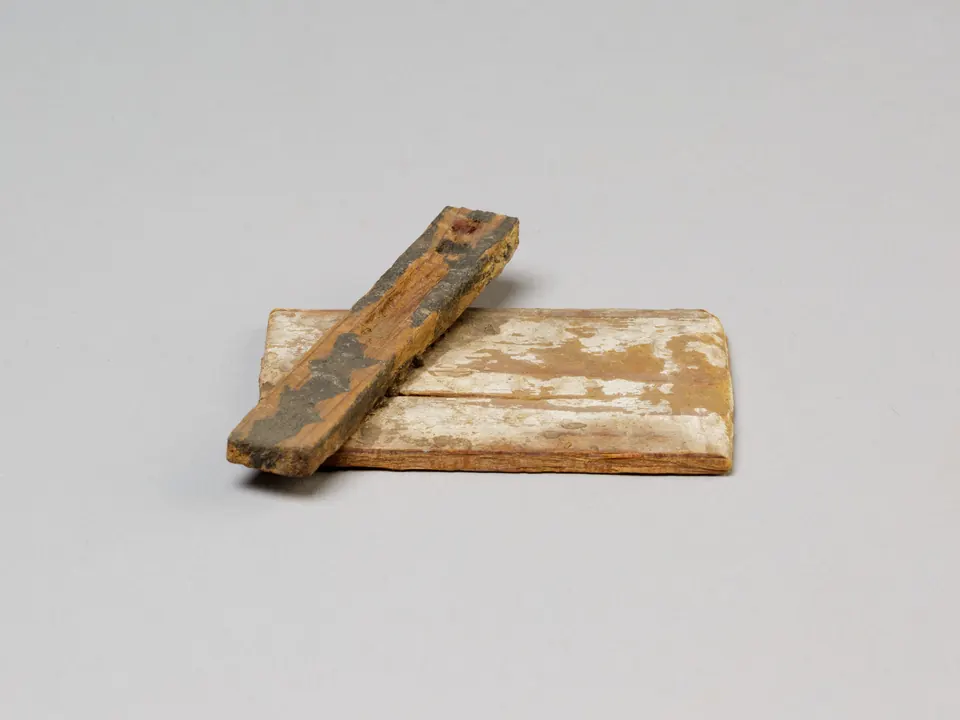
Model of a Scribe’s Palette and Tablet

ca. 2051–1981 B.C.Wood, paintFound: Deir el-Bahri, Upper Egypt, Thebes, Egypt (MMA excavations, 1922–23, Temple of Mentuhotep II, North Triangular Court, Pit 26)The Metropolitan Museum of Art, New YorkInv. Met 25.3.279

Model of a Scribe’s Palette and Tablet: wood, paint, dated ca. 2051–1981 B.C. in the museum’s record.

What it says and shows

The Met catalogues it as Middle Kingdom, Late Dynasty 11; place in the record: Deir el-Bahri, Upper Egypt, Thebes, Egypt (MMA excavations, 1922–23, Temple of Mentuhotep II, North Triangular Court, Pit 26). Size: H. 5.5 × W. 6 cm (2 3/16 × 2 3/8 in.). Rogers Fund, 1925.

Why it matters

A model of the scribe’s two tools, the palette with ink wells and the writing tablet, placed in a tomb for use in the afterlife.

Connects to the book

Sources & dating

Dates are approximate and follow the sources below. Evidence status: CONFIRMED

Photo: The Metropolitan Museum of Art · CC0 (The Met Open Access) · source

Photo: The Metropolitan Museum of Art · CC0 (The Met Open Access) · source

EG-I.21

Scribe's Palette

ca. 1550–1300 BCEWood, inkFound: Dra Abu el-Naga, Upper Egypt, Thebes, Egypt (Carnarvon/Carter, 1906–1911)The Metropolitan Museum of Art, New YorkInv. Met 12.181.203

Scribe's Palette: wood, ink, dated ca. 1550–1300 BCE in the museum’s record.

What it says and shows

The Met catalogues it as New Kingdom, Dynasty 18; place in the record: Dra Abu el-Naga, Upper Egypt, Thebes, Egypt (Carnarvon/Carter, 1906–1911). Size: L. 23.5 × W. 3.2 cm (9 1/4 × 1 1/4 in.). Rogers Fund, 1912.

Why it matters

A working scribe’s palette: wells for black and red ink and a slot for reed brushes.

Connects to the book

Sources & dating

Dates are approximate and follow the sources below. Evidence status: CONFIRMED

Photo: The Metropolitan Museum of Art · CC0 (The Met Open Access) · source

Photo: The Metropolitan Museum of Art · CC0 (The Met Open Access) · source

EG-I.22

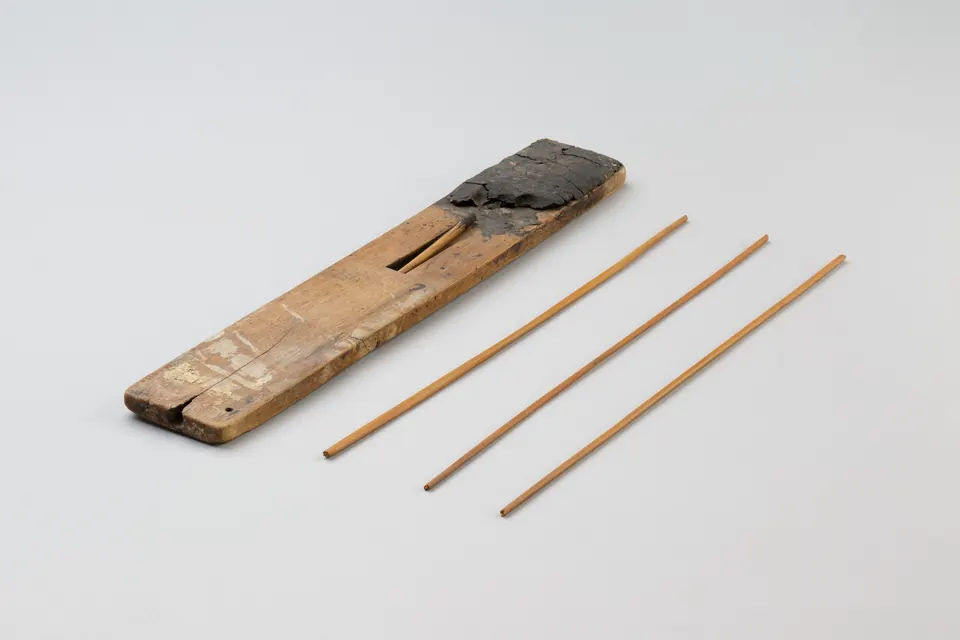
Scribe's Palette and Brushes

664–332 BCEWood, ink, reedFound: Sheikh Abd el-Qurna, Upper Egypt, Thebes, Egypt (MMA excavations, 1913–14, Tomb MMA 804 (M04), Forecourt rubbish)The Metropolitan Museum of Art, New YorkInv. Met 14.1.393a–d

Scribe's Palette and Brushes: wood, ink, reed, dated 664–332 BCE in the museum’s record.

What it says and shows

The Met catalogues it as Late Period, Dynasty 26–30; place in the record: Sheikh Abd el-Qurna, Upper Egypt, Thebes, Egypt (MMA excavations, 1913–14, Tomb MMA 804 (M04), Forecourt rubbish). Size: Palette: L. 26 × W. 4.2 cm (10 1/4 × 1 5/8 in.); Brushes: L. 23.4 cm (9 3/16 in.). Rogers Fund, 1914.

Why it matters

A palette that still holds its brushes, the everyday equipment behind every Egyptian text.

Connects to the book

Sources & dating

Dates are approximate and follow the sources below. Evidence status: CONFIRMED

Photo: The Metropolitan Museum of Art · CC0 (The Met Open Access) · source

Photo: The Metropolitan Museum of Art · CC0 (The Met Open Access) · source

EG-I.23

Writing Palette and Brushes of Princess Meketaten

ca. 1347–1330 BCEIvory, rush, red, yellow, and black pigmentsFound: Upper Egypt; ThebesThe Metropolitan Museum of Art, New YorkInv. Met 26.7.1295

Writing Palette and Brushes of Princess Meketaten: ivory, rush, red, yellow, and black pigments, dated ca. 1347–1330 BCE in the museum’s record.

What it says and shows

The Met catalogues it as New Kingdom, Amarna Period, Dynasty 18, reign of Akhenaten; place in the record: Upper Egypt; Thebes. Size: L. 13.3 × W. 2.3 × Th. 0.5 cm (5 1/4 × 7/8 × 3/16 in.). Purchase, Edward S. Harkness Gift, 1926.

Why it matters

A writing palette made for a princess of Akhenaten’s family, Meketaten, showing that royal children learned to write.

Connects to the book

Sources & dating

Dates are approximate and follow the sources below. Evidence status: CONFIRMED

Photo: The Metropolitan Museum of Art · CC0 (The Met Open Access) · source

Photo: The Metropolitan Museum of Art · CC0 (The Met Open Access) · source

EG-I.24

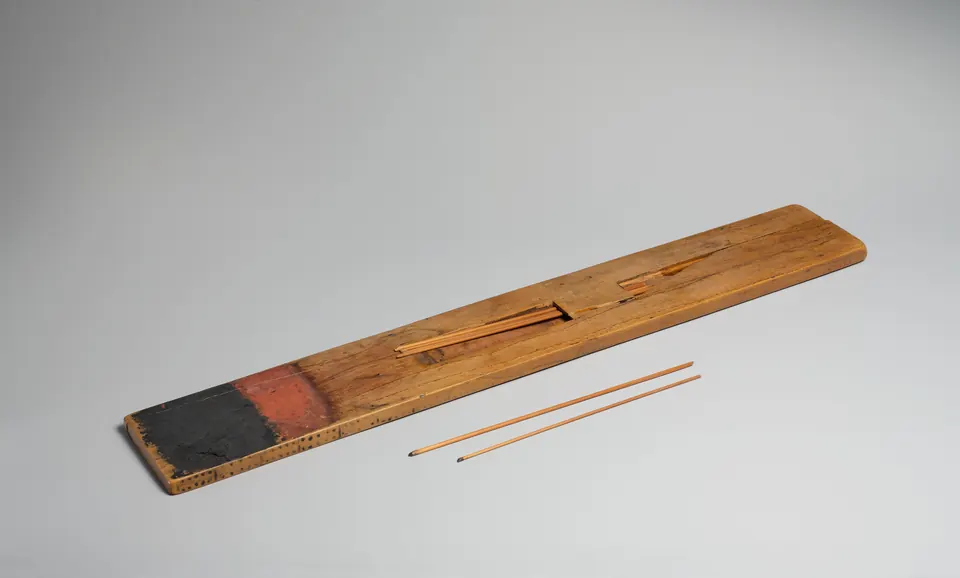
Palette inscribed for Smendes (II), High Priest of Amun

ca. 1002–1000 BCEWood, ink, reedFound: Upper Egypt, ThebesThe Metropolitan Museum of Art, New YorkInv. Met 47.123a–g

Palette inscribed for Smendes (II), High Priest of Amun: wood, ink, reed, dated ca. 1002–1000 BCE in the museum’s record.

What it says and shows

The Met catalogues it as Third Intermediate Period, Dynasty 21, reign of High Priest of Amun Smendes II; place in the record: Upper Egypt, Thebes. Size: Palette: L. 48.6 cm (19 1/8 in.); W. 7.2 cm (2 13/16 in.); Th. 1.1 cm (7/16 in.); Pens: L. 16.5–18 cm (6 1/2 in–7 1/16 in.). Harris Brisbane Dick Fund, 1947.

Why it matters

A palette inscribed for a High Priest of Amun: writing was a mark of rank and office.

Connects to the book

Sources & dating

Dates are approximate and follow the sources below. Evidence status: CONFIRMED

Photo: The Metropolitan Museum of Art · CC0 (The Met Open Access) · source

Photo: The Metropolitan Museum of Art · CC0 (The Met Open Access) · source

EG-I.25

Three Scribe's Brushes

ca. 1981–1640 B.C.WoodFound: Lisht North, Memphite Region, Egypt (MMA excavations, 1913–14, Cemetery)The Metropolitan Museum of Art, New YorkInv. Met 15.3.1112e, i, k

Three Scribe's Brushes: wood, dated ca. 1981–1640 B.C. in the museum’s record.

What it says and shows

The Met catalogues it as Middle Kingdom, Dynasty 12–13; place in the record: Lisht North, Memphite Region, Egypt (MMA excavations, 1913–14, Cemetery). Size: e: L. 18.8 cm (7 3/8 in.); i: L. 19.8 cm (7 13/16 in.); k: L. 21.4 cm (8 7/16 in.). Rogers Fund, 1915.

Why it matters

Reed and rush brushes like these were chewed or cut to a point to write ink on papyrus and stone.

Connects to the book

Sources & dating

Dates are approximate and follow the sources below. Evidence status: CONFIRMED

Photo: The Metropolitan Museum of Art · CC0 (The Met Open Access) · source

Photo: The Metropolitan Museum of Art · CC0 (The Met Open Access) · source

EG-I.26

Scribes from Meketre's Model Granary

ca. 1981–1975 B.C.Wood, plaster, paint, linenFound: Southern Asasif, Upper Egypt, Thebes, Egypt (MMA excavations, 1920, Tomb of Meketre (TT 280, MMA 1101), serdab)The Metropolitan Museum of Art, New YorkInv. Met 20.3.11-SCRIBES

Scribes from Meketre's Model Granary: wood, plaster, paint, linen, dated ca. 1981–1975 B.C. in the museum’s record.

What it says and shows

The Met catalogues it as Middle Kingdom, Dynasty 12, early reign of Amenemhat I; place in the record: Southern Asasif, Upper Egypt, Thebes, Egypt (MMA excavations, 1920, Tomb of Meketre (TT 280, MMA 1101), serdab). Size: H. of right-hand figure: 15.5 cm (6 1/8 in.). Rogers Fund and Edward S. Harkness Gift, 1920.

Why it matters

Wooden model scribes recording grain in a granary: writing was the tool of administration.

Connects to the book

Sources & dating

Dates are approximate and follow the sources below. Evidence status: CONFIRMED

Photo: The Metropolitan Museum of Art · CC0 (The Met Open Access) · source

Photo: The Metropolitan Museum of Art · CC0 (The Met Open Access) · source

EG-I.27

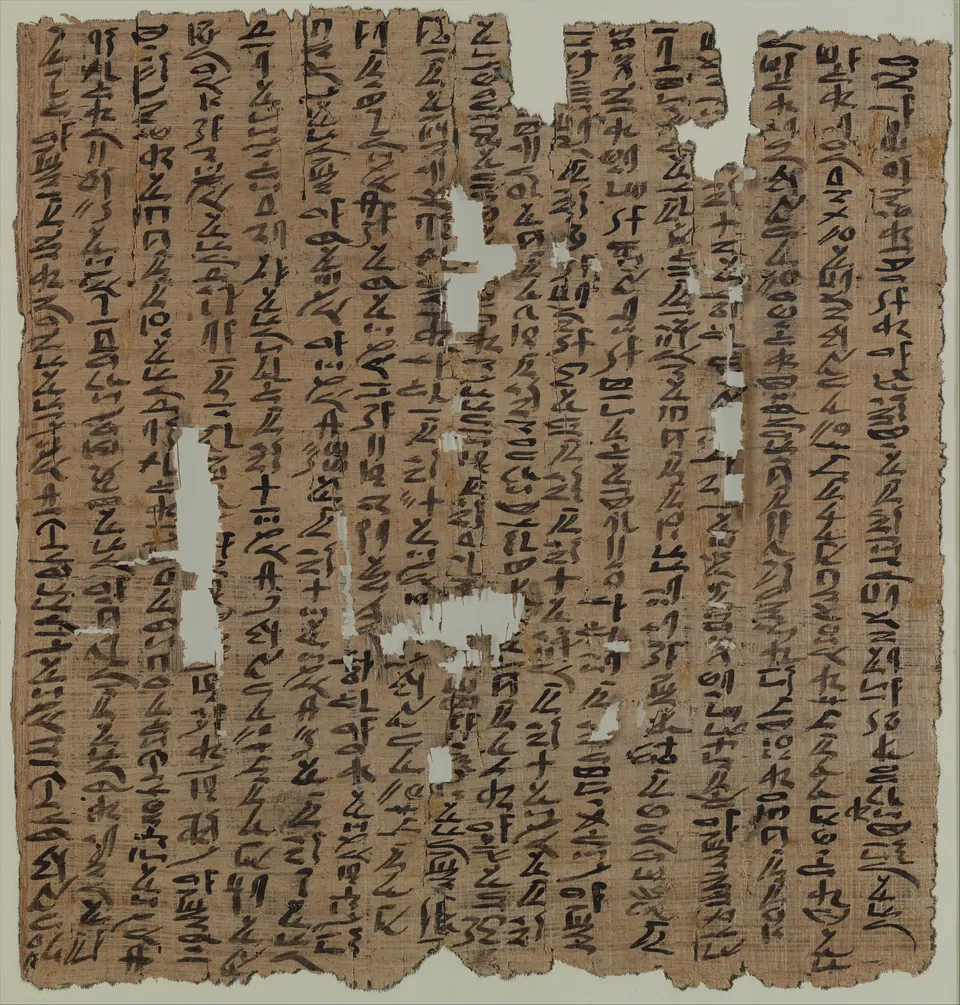
Heqanakht Letter I

ca. 1961–1917 B.C.Papyrus, inkFound: Deir el-Bahri, Upper Egypt, Thebes, Egypt (MMA excavations, 1921–22, Tomb complex of Ipy (TT 315, MMA 516), Tomb of Meseh (MMA 516B))The Metropolitan Museum of Art, New YorkInv. Met 22.3.516

Heqanakht Letter I: papyrus, ink, dated ca. 1961–1917 B.C. in the museum’s record.

What it says and shows

The Met catalogues it as Middle Kingdom, Dynasty 12, reign of Senwosret I; place in the record: Deir el-Bahri, Upper Egypt, Thebes, Egypt (MMA excavations, 1921–22, Tomb complex of Ipy (TT 315, MMA 516), Tomb of Meseh (MMA 516B)). Size: H. 28.4 cm (11 3/16 in.), W. 27.1 cm (10 11/16 in.). Rogers Fund and Edward S. Harkness Gift, 1922.

Why it matters

One of the Heqanakht letters, private letters about a farming household written in hieratic, among the best-known everyday documents from Egypt.

Connects to the book

Sources & dating

Dates are approximate and follow the sources below. Evidence status: CONFIRMED

Photo: The Metropolitan Museum of Art · CC0 (The Met Open Access) · source

Photo: The Metropolitan Museum of Art · CC0 (The Met Open Access) · source

EG-I.28

Letter written in hieratic script on papyrus

ca. 1473–1458 BCEPapyrus, inkFound: Deir el-Bahri, Upper Egypt, Thebes, Egypt (MMA excavations, 1926–27, Temple of Hatshepsut, In rubbish near foundation deposit 9)The Metropolitan Museum of Art, New YorkInv. Met 27.3.560

Letter written in hieratic script on papyrus: papyrus, ink, dated ca. 1473–1458 BCE in the museum’s record.

What it says and shows

The Met catalogues it as New Kingdom, Dynasty 18, Joint reign of Hatshepsut and Thutmose III; place in the record: Deir el-Bahri, Upper Egypt, Thebes, Egypt (MMA excavations, 1926–27, Temple of Hatshepsut, In rubbish near foundation deposit 9). Size: L. 17.5 cm (6 7/8 in); w. 4.5 cm (1 3/4 in). Rogers Fund, 1927.

Why it matters

A letter on papyrus in hieratic, the cursive script scribes used for daily writing.

Connects to the book

Sources & dating

Dates are approximate and follow the sources below. Evidence status: CONFIRMED

Photo: The Metropolitan Museum of Art · CC0 (The Met Open Access) · source

Photo: The Metropolitan Museum of Art · CC0 (The Met Open Access) · source

EG-I.29

Hieratic copy of the Teaching of Amenemhat I

ca. 1300–1080 BCEPottery, inkFound: Lisht South, Memphite Region, Egypt (MMA excavations, 1931–32)The Metropolitan Museum of Art, New YorkInv. Met 32.1.119

Hieratic copy of the Teaching of Amenemhat I: pottery, ink, dated ca. 1300–1080 BCE in the museum’s record.

What it says and shows

The Met catalogues it as New Kingdom, Ramesside, Dynasty 19–20; place in the record: Lisht South, Memphite Region, Egypt (MMA excavations, 1931–32). Size: L. 22.6 cm (8 7/8 in.); W. 19.4 cm (7 5/8 in.); Th. 1 cm (3/8 in.). Rogers Fund, 1932.

Why it matters

Scribes in training copied classic texts such as the Teaching of Amenemhat I on pottery and stone flakes.

Connects to the book

Sources & dating

Dates are approximate and follow the sources below. Evidence status: CONFIRMED

Photo: The Metropolitan Museum of Art · CC0 (The Met Open Access) · source

Photo: The Metropolitan Museum of Art · CC0 (The Met Open Access) · source

EG-I.30

Hieratic Ostracon Dated to Year 21 of Ramesses II

ca. 1269 BCELimestone, inkFound: Valley of the Kings, Upper Egypt, Thebes, Egypt (Davis/Ayrton excavations, 1907–08, Workmen's Huts near KV 55 (site 18) or between KV 18 and KV 21, or from chip heap in same branch of Valley)The Metropolitan Museum of Art, New YorkInv. Met 09.184.183

Hieratic Ostracon Dated to Year 21 of Ramesses II: limestone, ink, dated ca. 1269 BCE in the museum’s record.

What it says and shows

The Met catalogues it as New Kingdom, Ramesside, Dynasty 19, Reign of Ramesses II, year 21; place in the record: Valley of the Kings, Upper Egypt, Thebes, Egypt (Davis/Ayrton excavations, 1907–08, Workmen's Huts near KV 55 (site 18) or between KV 18 and KV 21, or from chip heap in same branch of Valley). Size: H. 14.2 × W. 14.1 × Th. 3.4 cm (5 9/16 × 5 9/16 × 1 5/16 in.). Gift of Theodore M. Davis, 1909.

Why it matters

An ostracon dated by the king’s regnal year, the way Egyptians dated documents.

Connects to the book

Sources & dating

Dates are approximate and follow the sources below. Evidence status: CONFIRMED

Photo: The Metropolitan Museum of Art · CC0 (The Met Open Access) · source

Photo: The Metropolitan Museum of Art · CC0 (The Met Open Access) · source

EG-I.31

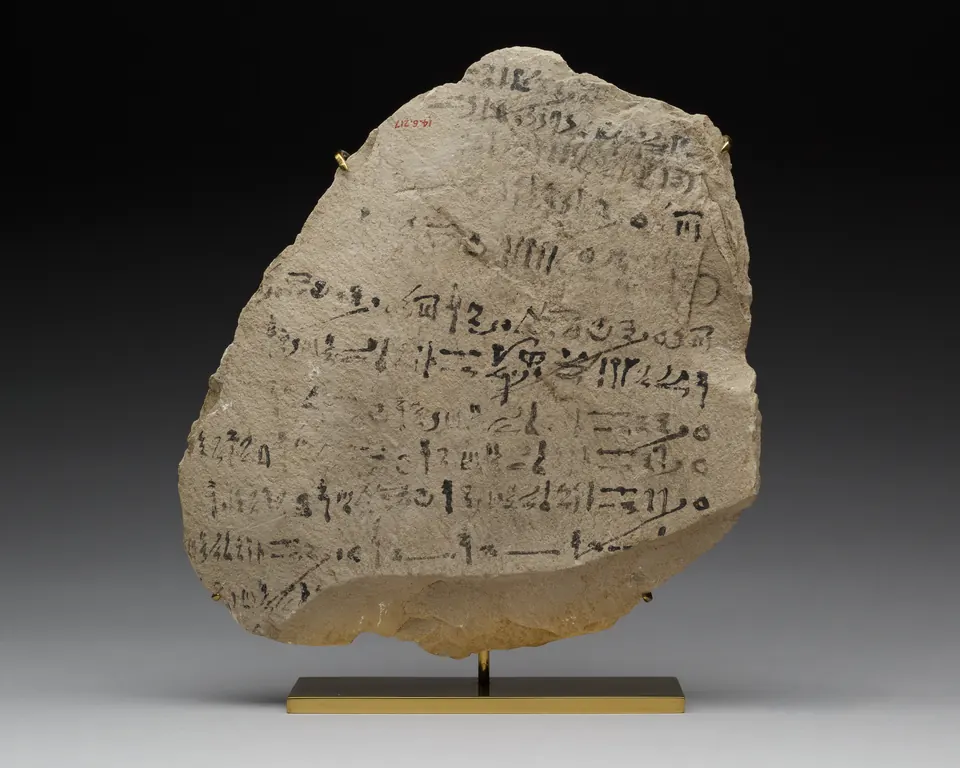
Hieratic ostracon recording the accession of Seti II

ca. 1214–1208 BCELimestone, paintFound: Valley of the Kings, Upper Egypt, Thebes, Egypt (Davis excavations, before 1913)The Metropolitan Museum of Art, New YorkInv. Met 14.6.217

Hieratic ostracon recording the accession of Seti II: limestone, paint, dated ca. 1214–1208 BCE in the museum’s record.

What it says and shows

The Met catalogues it as New Kingdom, Ramesside, Dynasty 19, Reign of Seti II; place in the record: Valley of the Kings, Upper Egypt, Thebes, Egypt (Davis excavations, before 1913). Size: H. 15.5 × W. 15 × D. 2.8 cm (6 1/8 × 5 7/8 × 1 1/8 in.). Gift of Theodore M. Davis, 1913.

Why it matters

A hieratic note recording a king’s accession: news written on a flake of limestone.

Connects to the book

Sources & dating

Dates are approximate and follow the sources below. Evidence status: CONFIRMED

Photo: The Metropolitan Museum of Art · CC0 (The Met Open Access) · source

Photo: The Metropolitan Museum of Art · CC0 (The Met Open Access) · source

EG-I.32

Ostracon with a grid giving days of the months in hieratic against names and locations in hieroglyphs

545–404 BCELimestone, inkFound: Deir el-Bahri, Upper Egypt, Thebes, Egypt (MMA excavations, 1922–23, Tomb of Nespakashuty (TT 312, MMA 509a))The Metropolitan Museum of Art, New YorkInv. Met 26.3.169

Ostracon with a grid giving days of the months in hieratic against names and locations in hieroglyphs: limestone, ink, dated 545–404 BCE in the museum’s record.

What it says and shows

The Met catalogues it as Late Period, Persian Period, Dynasty 27; place in the record: Deir el-Bahri, Upper Egypt, Thebes, Egypt (MMA excavations, 1922–23, Tomb of Nespakashuty (TT 312, MMA 509a)). Size: H. 10.5 × W. 5.3 cm (4 1/8 × 2 1/16 in.). Rogers Fund, 1926.

Why it matters

A calendar grid of days and months written on stone.

Connects to the book

Sources & dating

Dates are approximate and follow the sources below. Evidence status: CONFIRMED

Photo: The Metropolitan Museum of Art · CC0 (The Met Open Access) · source

Photo: The Metropolitan Museum of Art · CC0 (The Met Open Access) · source

EG-I.33

Hieratic ostracon with practice layout for monumental inscription

ca. 1550–1080 BCELimestone, paintThe Metropolitan Museum of Art, New YorkInv. Met 14.1.455

Hieratic ostracon with practice layout for monumental inscription: limestone, paint, dated ca. 1550–1080 BCE in the museum’s record.

What it says and shows

The Met catalogues it as New Kingdom, Ramesside, Dynasty 18–20; no findspot recorded. Size: H. 17.2 × W. 9.1 × D. 1.8 cm (6 3/4 × 3 9/16 × 11/16 in.). Rogers Fund, 1914.

Why it matters

A practice layout for a monumental inscription: the carved texts on temples began as drafts like this.

Connects to the book

Sources & dating

Dates are approximate and follow the sources below. Evidence status: CONFIRMED

Photo: The Metropolitan Museum of Art · CC0 (The Met Open Access) · source

Photo: The Metropolitan Museum of Art · CC0 (The Met Open Access) · source

EG-I.34

Unfinished hieroglyphs

ca. 1981–1975 B.C.Limestone, inkFound: Southern Asasif, Upper Egypt, Thebes, Egypt (MMA excavations, 1920, Tomb of Meketre (TT 280, MMA 1101), Buried in top of ramp)The Metropolitan Museum of Art, New YorkInv. Met 20.3.160

Unfinished hieroglyphs: limestone, ink, dated ca. 1981–1975 B.C. in the museum’s record.

What it says and shows

The Met catalogues it as Middle Kingdom, Dynasty 12, reign of Amenemhat I, early; place in the record: Southern Asasif, Upper Egypt, Thebes, Egypt (MMA excavations, 1920, Tomb of Meketre (TT 280, MMA 1101), Buried in top of ramp). Size: H. 20.2 × W. 16.5 cm (7 15/16 × 6 1/2 in.). Rogers Fund and Edward S. Harkness Gift, 1920.

Why it matters

Unfinished hieroglyphs show the sequence of work: drawn in ink first, then carved.

Connects to the book

Sources & dating

Dates are approximate and follow the sources below. Evidence status: CONFIRMED

Photo: The Metropolitan Museum of Art · CC0 (The Met Open Access) · source

Photo: The Metropolitan Museum of Art · CC0 (The Met Open Access) · source

EG-I.35

Hieroglyph ostracon

ca. 1427–1347 BCELimestone, ink, paintFound: Valley of the Kings, Upper Egypt, Thebes, Egypt (Davis excavations)The Metropolitan Museum of Art, New YorkInv. Met 09.184.786

Hieroglyph ostracon: limestone, ink, paint, dated ca. 1427–1347 BCE in the museum’s record.

What it says and shows

The Met catalogues it as New Kingdom, Dynasty 18, reigns of Amenhotep II – Amenhotep III; place in the record: Valley of the Kings, Upper Egypt, Thebes, Egypt (Davis excavations). Size: L. 11.5 × H. 6.8 × D. 3.6 cm (4 1/2 × 2 11/16 × 1 7/16 in.). Gift of Theodore M. Davis, 1909.

Why it matters

A hieroglyph drawn on a limestone flake, a sketch or exercise.

Connects to the book

Sources & dating

Dates are approximate and follow the sources below. Evidence status: CONFIRMED

Photo: The Metropolitan Museum of Art · CC0 (The Met Open Access) · source

Photo: The Metropolitan Museum of Art · CC0 (The Met Open Access) · source

EG-I.36

Nesiamun's Book of the Dead

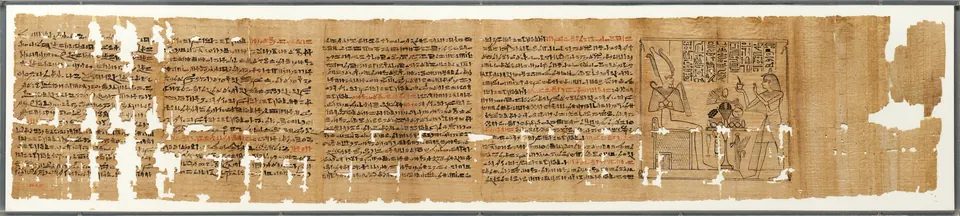
ca. 1080–945 BCEPapyrus, inkFound: Sheikh Abd el-Qurna, Upper Egypt, ThebesThe Metropolitan Museum of Art, New YorkInv. Met 26.2.51

Nesiamun's Book of the Dead: papyrus, ink, dated ca. 1080–945 BCE in the museum’s record.

What it says and shows

The Met catalogues it as Third Intermediate Period, Dynasty 21; place in the record: Sheikh Abd el-Qurna, Upper Egypt, Thebes. Size: Papyrus: L. 119.5 × H. 24 cm (47 1/16 × 9 7/16 in.); Framed: L. 123.2 × H. 28.1 × D. 2 cm (48 1/2 × 11 1/16 × 13/16 in.). Rogers Fund, 1926.

Why it matters

A Book of the Dead: a collection of spells written on papyrus to guide the dead.

Connects to the book

Sources & dating

Dates are approximate and follow the sources below. Evidence status: CONFIRMED

Photo: The Metropolitan Museum of Art · CC0 (The Met Open Access) · source

Photo: The Metropolitan Museum of Art · CC0 (The Met Open Access) · source

EG-I.37

Book of the Dead for the Chantress of Amun, Nauny

ca. 1050 BCEPapyrus, paintFound: Deir el-Bahri, Upper Egypt, Thebes, Egypt (MMA excavations, 1928–29, Tomb of Meritamun (TT 358, MMA 65), burial of Nauny, first corridor, inside Osiris figure)The Metropolitan Museum of Art, New YorkInv. Met 30.3.31

Book of the Dead for the Chantress of Amun, Nauny: papyrus, paint, dated ca. 1050 BCE in the museum’s record.

What it says and shows

The Met catalogues it as Third Intermediate Period, Dynasty 21; place in the record: Deir el-Bahri, Upper Egypt, Thebes, Egypt (MMA excavations, 1928–29, Tomb of Meritamun (TT 358, MMA 65), burial of Nauny, first corridor, inside Osiris figure). Size: L. 521.5 cm (206 5/16 in); H. 35 cm (13 3/4 in). Rogers Fund, 1930.

Why it matters

The Book of the Dead of the chantress Nauny, painted on papyrus.

Connects to the book

Sources & dating

Dates are approximate and follow the sources below. Evidence status: CONFIRMED

Photo: The Metropolitan Museum of Art · CC0 (The Met Open Access) · source

Photo: The Metropolitan Museum of Art · CC0 (The Met Open Access) · source

EG-I.38

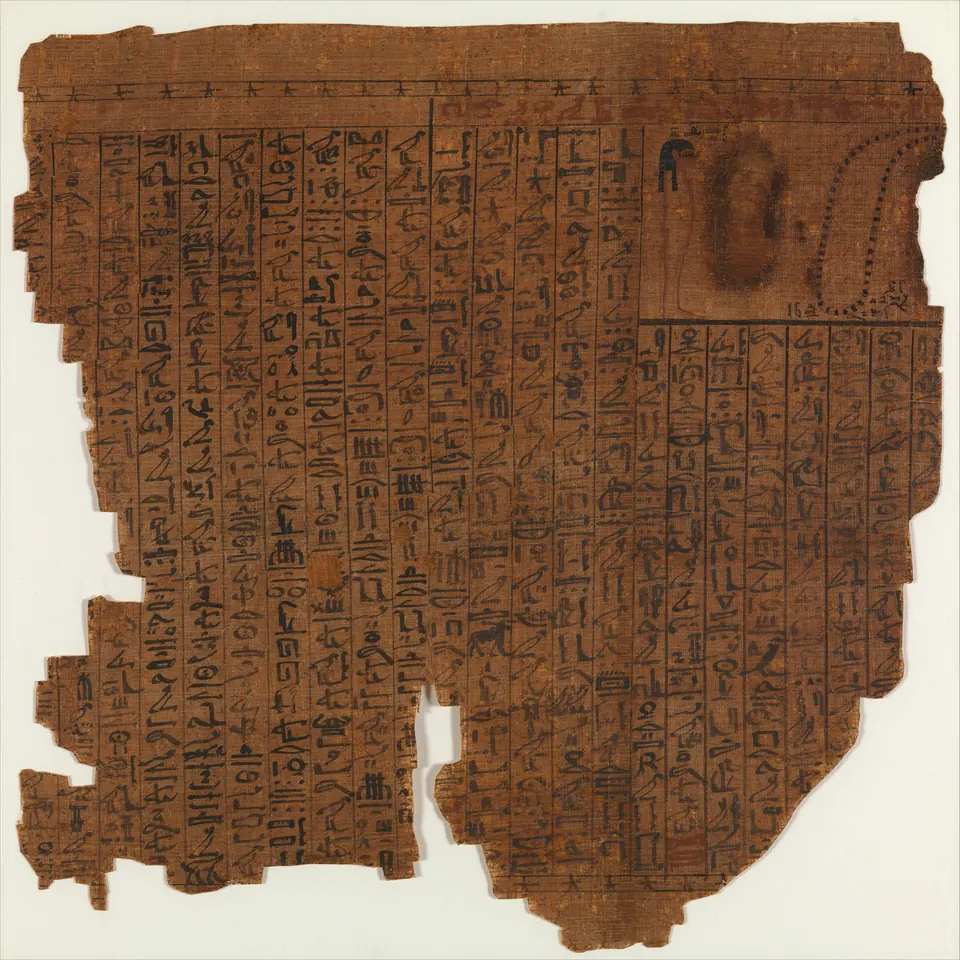
Sheet from the Papyrus of Amenhotep

ca. 1427–1386 BCEPapyrus, ink, pigmentFound: Dra Abu el-Naga (Tomb of Amenhotep, TT A 7)The Metropolitan Museum of Art, New YorkInv. Met 30.8.70a

Sheet from the Papyrus of Amenhotep: papyrus, ink, pigment, dated ca. 1427–1386 BCE in the museum’s record.

What it says and shows

The Met catalogues it as New Kingdom, Dynasty 18, reign of Amenhotep II–Thutmose IV; place in the record: Dra Abu el-Naga (Tomb of Amenhotep, TT A 7). Size: H. 34.9 cm (13 3/4 in.); W. 33.7 cm (13 1/4 in.); Framed: H. 35.5 cm (14 in.); W. 35.6 cm (14 in.); Th. 2 cm (13/16 in.). Theodore M. Davis Collection, Bequest of Theodore M. Davis, 1915.

Why it matters

A sheet from a Book of the Dead papyrus with ink and painted vignettes.

Connects to the book

Sources & dating

Dates are approximate and follow the sources below. Evidence status: CONFIRMED

Photo: The Metropolitan Museum of Art · CC0 (The Met Open Access) · source

Photo: The Metropolitan Museum of Art · CC0 (The Met Open Access) · source

EG-I.39

Papyrus inscribed with six "Osiris Liturgies"

ca. 332–200 BCEPapyrus, inkFound: Meir, Middle Egypt (south part of the necropolis)The Metropolitan Museum of Art, New YorkInv. Met 35.9.21a–o

Papyrus inscribed with six "Osiris Liturgies": papyrus, ink, dated ca. 332–200 BCE in the museum’s record.

What it says and shows

The Met catalogues it as Early Ptolemaic Period; place in the record: Meir, Middle Egypt (south part of the necropolis). Size: Approximate framed length 1120 cm (36 ft. 9 in.); height 23 cm (9 1/4 in.). Gift of Edward S. Harkness, 1935.

Why it matters

A Ptolemaic papyrus of Osiris liturgies, showing Egyptian religious writing continuing under Greek rule.

Connects to the book

Sources & dating

Dates are approximate and follow the sources below. Evidence status: CONFIRMED

Photo: The Metropolitan Museum of Art · CC0 (The Met Open Access) · source

Photo: The Metropolitan Museum of Art · CC0 (The Met Open Access) · source

EG-I.40

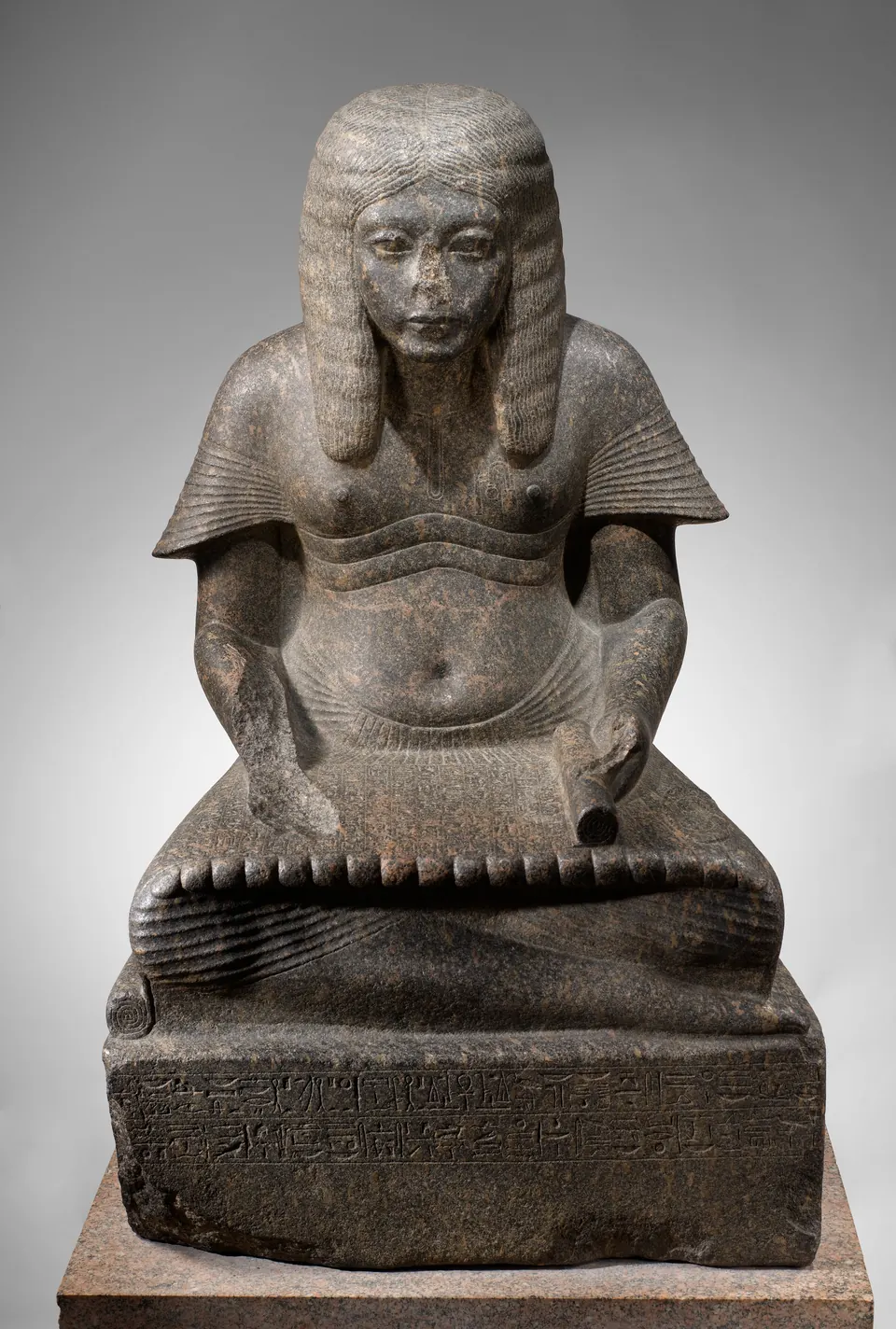
Haremhab as a Scribe of the King

ca. 1328–1314 BCEGranodioriteFound: Memphis (Mit Rahina), Memphite Region (Ptah Temple, a hole among palm trees)The Metropolitan Museum of Art, New YorkInv. Met 23.10.1

Haremhab as a Scribe of the King: granodiorite, dated ca. 1328–1314 BCE in the museum’s record.

What it says and shows

The Met catalogues it as New Kingdom, Dynasty 18, reign of Tutankhamun or Aya; place in the record: Memphis (Mit Rahina), Memphite Region (Ptah Temple, a hole among palm trees). Size: h. 113 cm (44 1/2 in); w. 71 cm (27 15/16 in); d. 55.5 cm (21 7/8 in). Gift of Mr. and Mrs. V. Everit Macy, 1923.

Why it matters

Haremhab, before he became king, chose to be shown as a scribe with papyrus on his lap: writing meant power.

Connects to the book

Sources & dating

Dates are approximate and follow the sources below. Evidence status: CONFIRMED

Photo: The Metropolitan Museum of Art · CC0 (The Met Open Access) · source

Photo: The Metropolitan Museum of Art · CC0 (The Met Open Access) · source

Hall II · 18 objects

Stone that Speaks

Kings published their deeds on stone: victory hymns, royal annals, lists of ancestors, maps of conquered towns. Read closely, these walls name peoples and places that also appear in Scripture — Canaan, Israel, Judah’s neighbours, the land of Punt.

EG-II.01

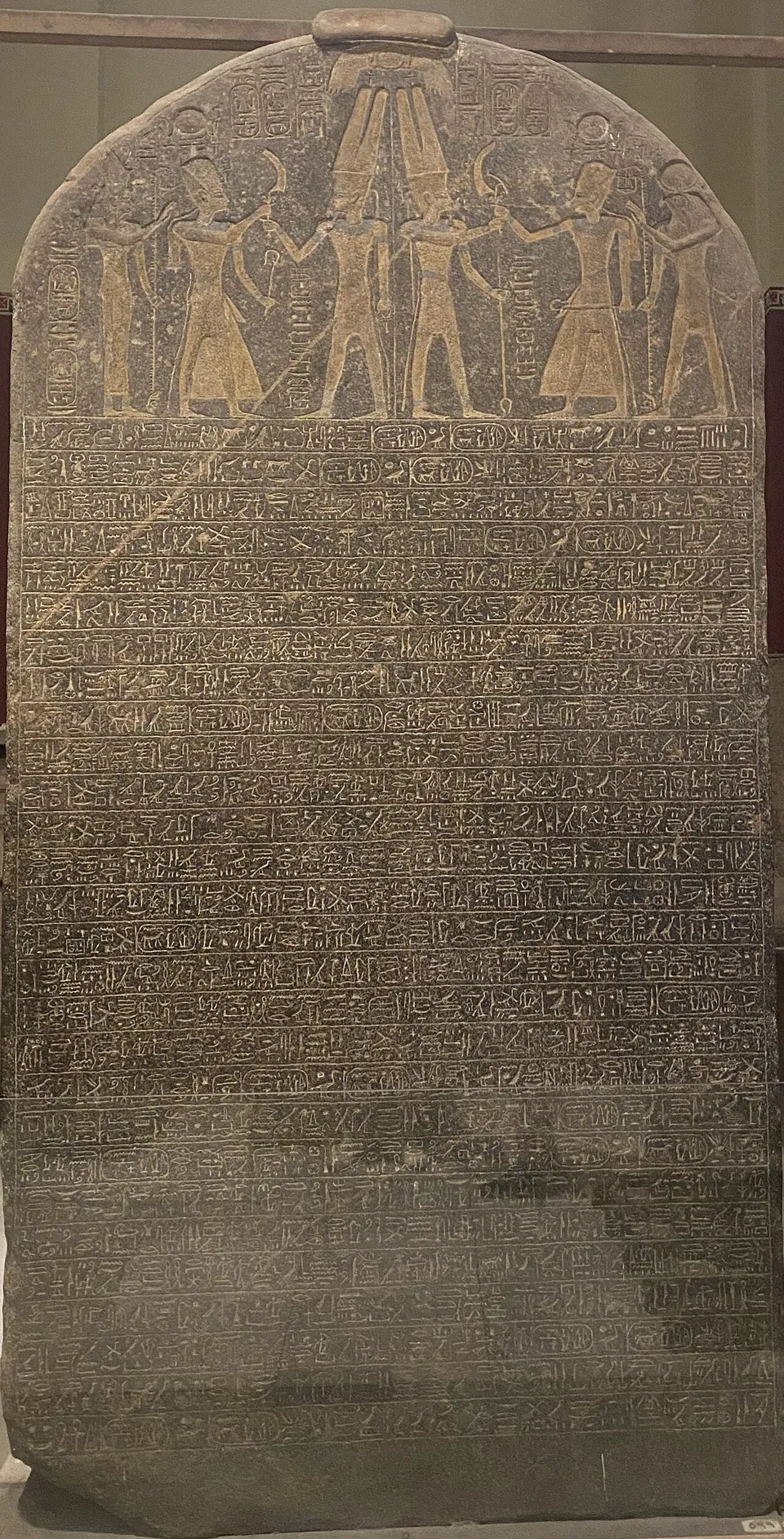
The Merneptah Stele (the “Israel Stele”)

c. 1208 BC (19th Dynasty, year 5 of Merneptah)Black graniteFound: Mortuary temple of Merneptah, Thebes (found by Flinders Petrie, 1896)Egyptian Museum, CairoInv. JE 31408

A victory hymn of King Merneptah, son of Ramesses II. Most of its 28 lines celebrate a victory over the Libyans; the last lines turn to Canaan.

What it says and shows

Line 27 names Canaan, Ashkelon, Gezer, Yenoam — and a people the majority of scholars read as “Israel”.

“Canaan is plundered with every evil … Israel is laid waste, his seed is not”

Merneptah Stele, lines 26–27 (trans. J. A. Wilson, in Ancient Near Eastern Texts)

Why it matters

It is generally regarded as the earliest secure mention of Israel outside the Bible, and the only undisputed one in Egyptian texts (an older Berlin statue-base fragment that may name Israel is debated). It also names Canaan as a land, as Genesis 10 does.

Connects to the book

Sources & dating

Dates are approximate and follow the sources below.

Photo: 𐰇𐱅𐰚𐰤 · CC BY-SA 4.0 · source
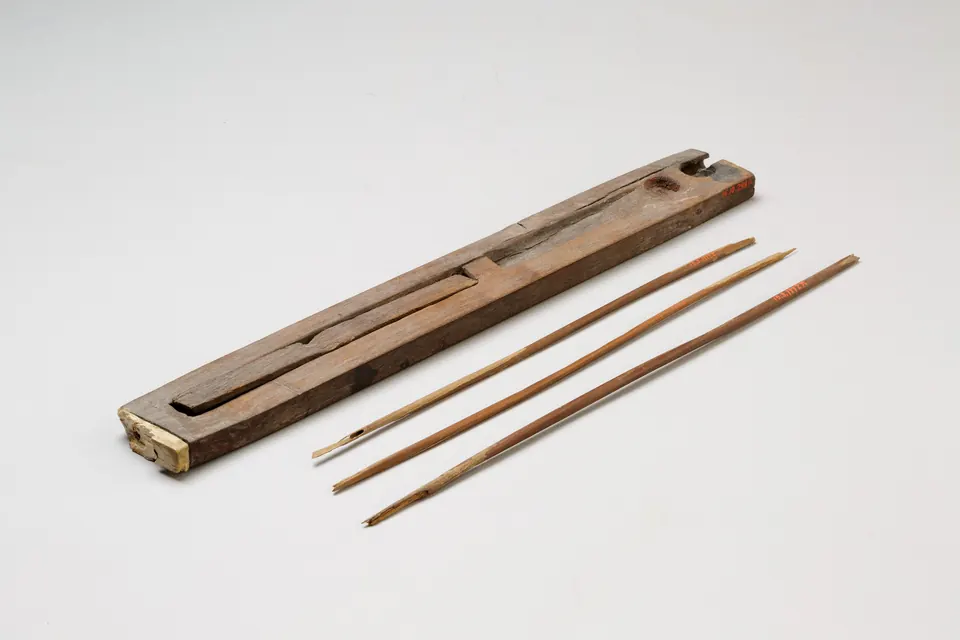
Photo: Darer101 · CC BY-SA 4.0 · source
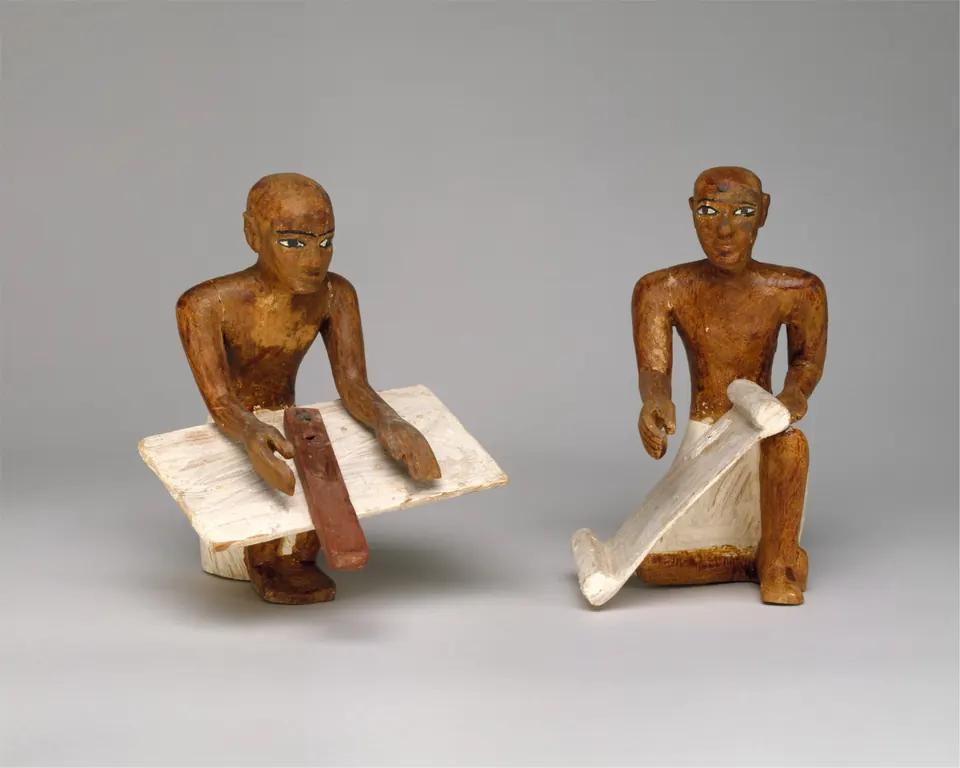
Photo: 𐰇𐱅𐰚𐰤 · CC BY-SA 4.0 · source
EG-II.02

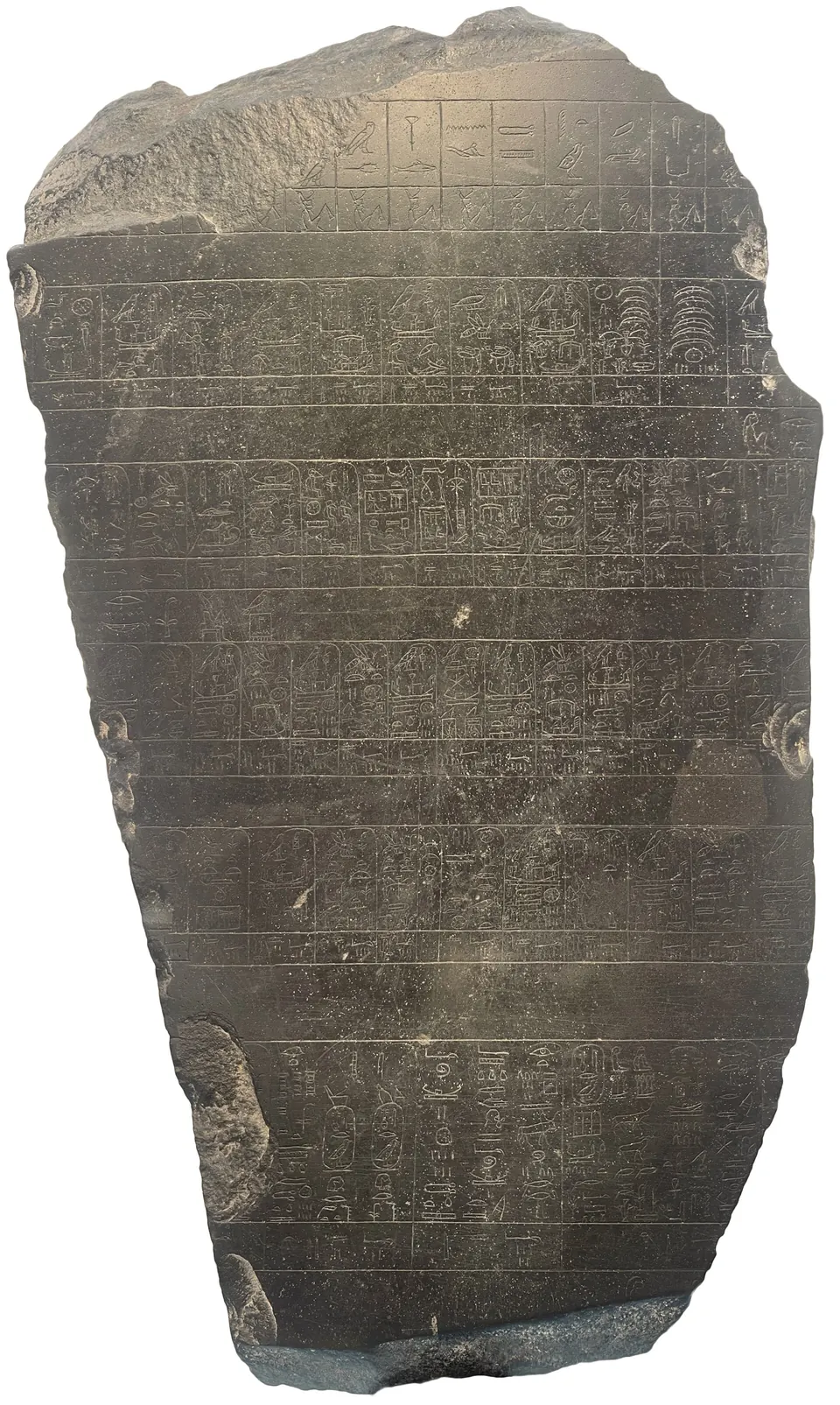
The Palermo Stone

c. 2400 BC (Old Kingdom, 5th Dynasty)Black basaltFound: Egypt (findspot unknown)Regional Archaeological Museum Antonino Salinas, Palermo

The largest surviving fragment of the Royal Annals of the Old Kingdom: a stone ledger of kings and the events of each year.

What it says and shows

Year-boxes recording festivals, temple foundations, cattle counts, expeditions — and the height of the Nile flood each year.

Why it matters

It is probably the oldest surviving historical text from Egypt, and a key source for the first five dynasties.

Connects to the book

Sources & dating

Dates are approximate and follow the sources below.

Photo: CvZ · CC BY-SA 4.0 · source
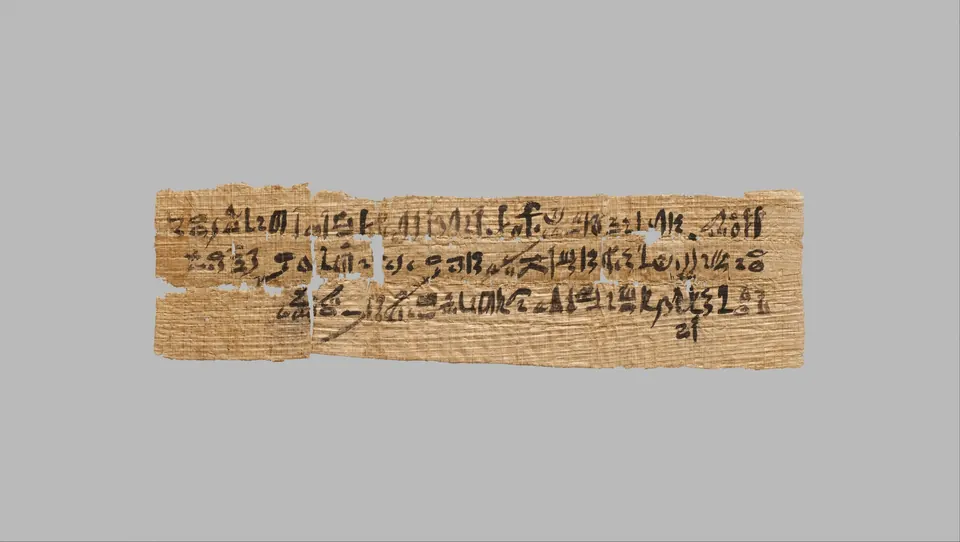
Photo: CvZ · CC BY-SA 4.0 · source
EG-II.03

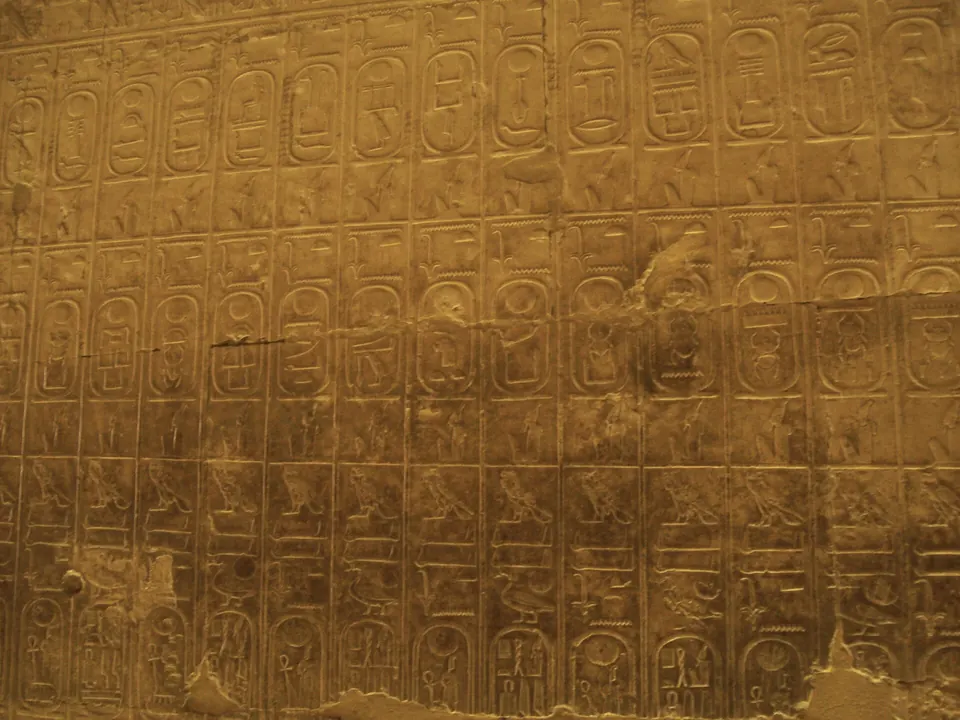
The Abydos King List

c. 1290–1279 BC (reign of Seti I)Painted limestone reliefFound: Temple of Seti I, AbydosIn situ

A carved list of 76 earlier kings, honoured by Seti I and his young son, the future Ramesses II.

What it says and shows

Three rows of 38 cartouches: two rows of ancestors, a third repeating Seti’s own names.

Why it matters

It preserves the order of the Old Kingdom kings and is the only source for the names of many kings of the 7th and 8th Dynasties.

Connects to the book

Sources & dating

Dates are approximate and follow the sources below.

Photo: isawnyu · CC BY 2.0 · source
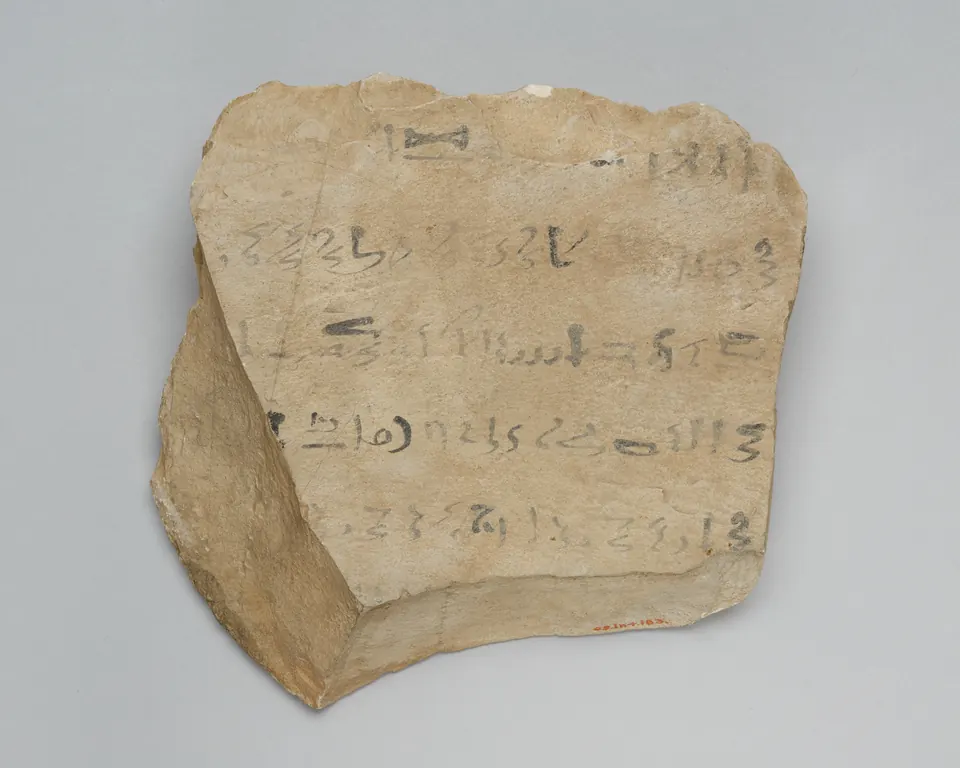
Photo: isawnyu · CC BY 2.0 · source
EG-II.04

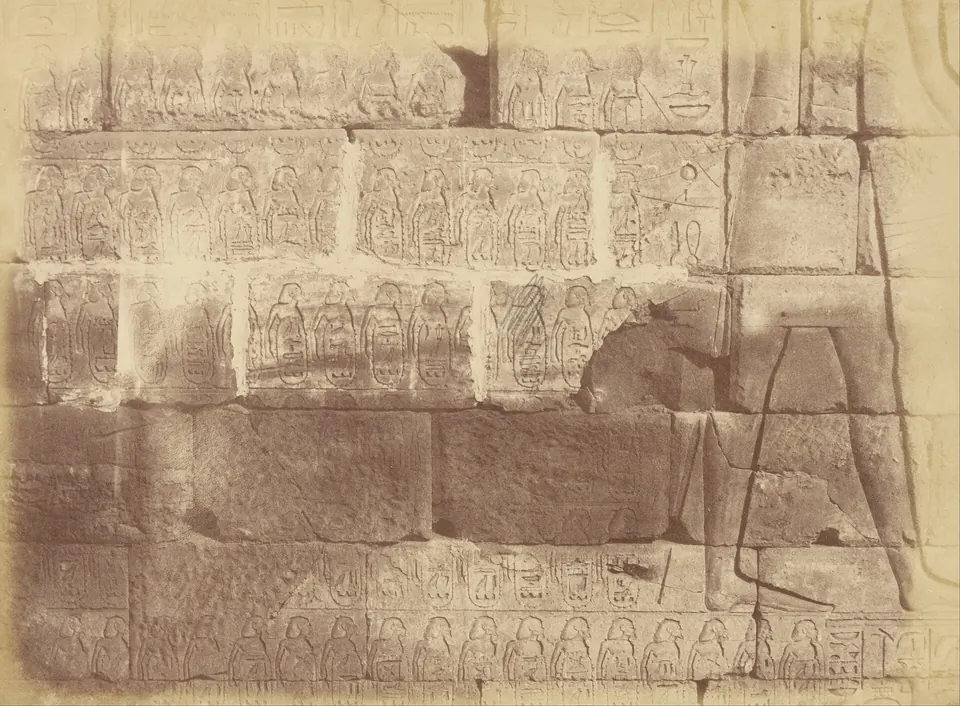
The Bubastite Portal: Shoshenq I’s campaign

c. 925 BC (22nd Dynasty)Sandstone reliefFound: Precinct of Amun-Re, KarnakIn situ

A triumphal relief recording the military campaign of King Shoshenq I into the Levant.

What it says and shows

Rows of bound captives, each wearing a name-ring of a town or region he claimed.

Why it matters

Shoshenq I is widely identified with Shishak, the king of Egypt who came against Jerusalem in the fifth year of Rehoboam (1 Kings 14:25–26).

Connects to the book

Sources & dating

Dates are approximate and follow the sources below.

Photo: Théodule Devéria (French, 1831 - 1871) (1831 - 1871) – photographer (French) Details on Go · Public domain · source
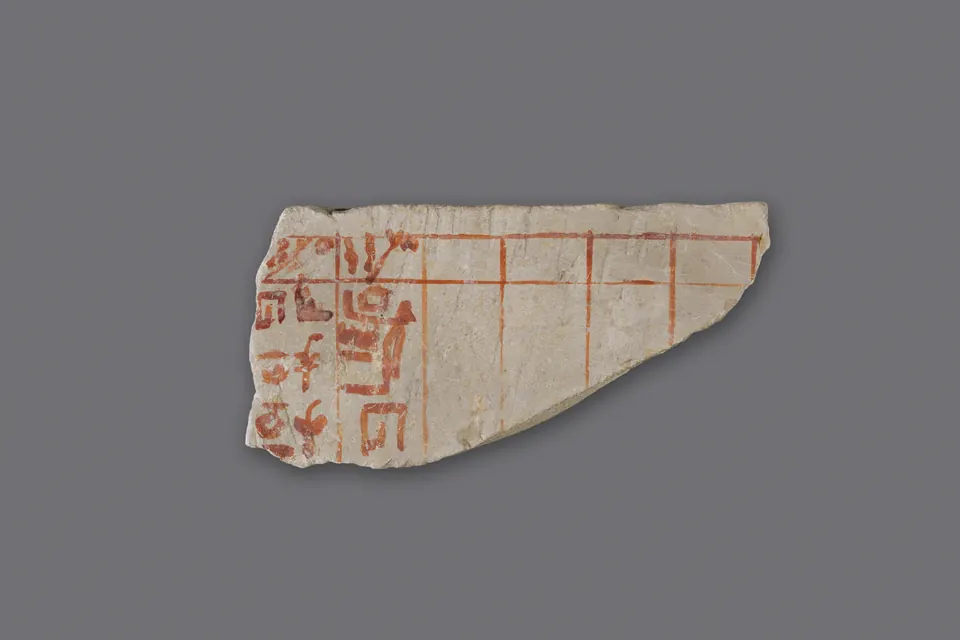
Photo: Ippolito Rosellini (1800-1843) · Public domain · source
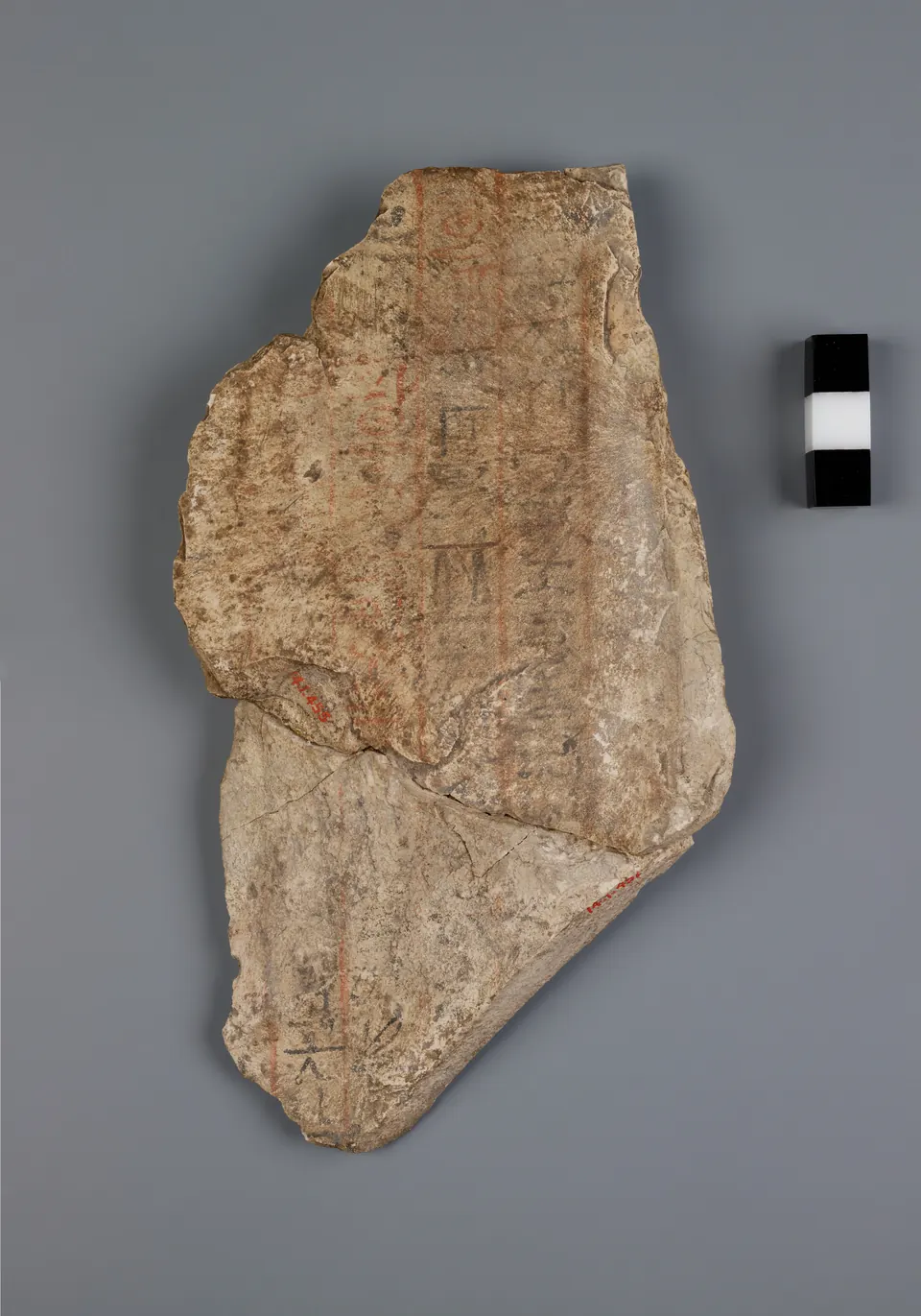
Photo: Théodule Devéria (French, 1831 - 1871) (1831 - 1871) – photographer (French) Details on Go · Public domain · source
EG-II.05

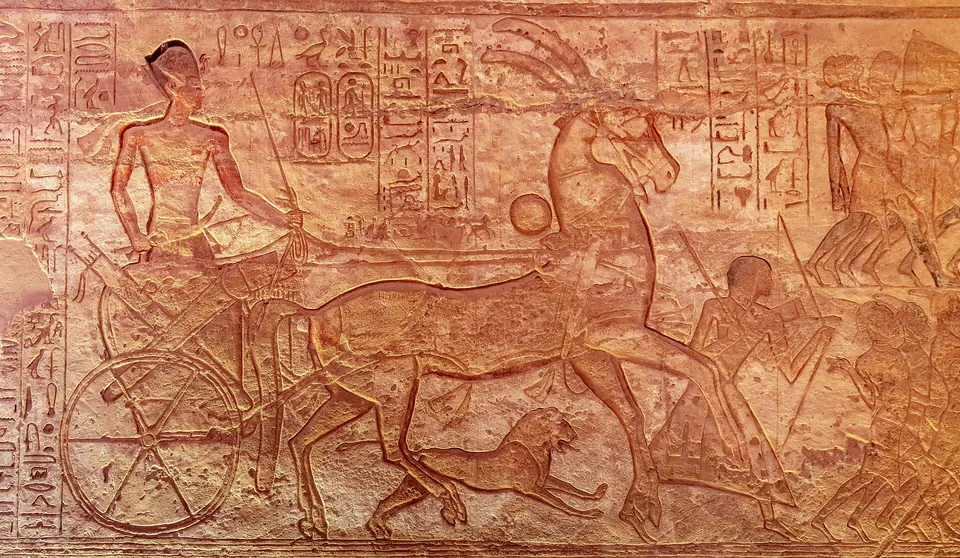
The Battle of Kadesh reliefs

c. 1274 BC (reign of Ramesses II)Sandstone reliefFound: Great Temple, Abu Simbel (also Karnak, Luxor, the Ramesseum, Abydos)In situ

Ramesses II covered temple walls with his account of the battle against the Hittites at Kadesh, in Syria.

What it says and shows

Chariots, camps, spies being beaten, and the king charging alone into the enemy.

Why it matters

Kadesh is among the best-documented battles of the ancient world; years later Egypt and the Hittites made one of the earliest known peace treaties.

Connects to the book

Sources & dating

Dates are approximate and follow the sources below.

Photo: Diego Delso · CC BY-SA 4.0 · source
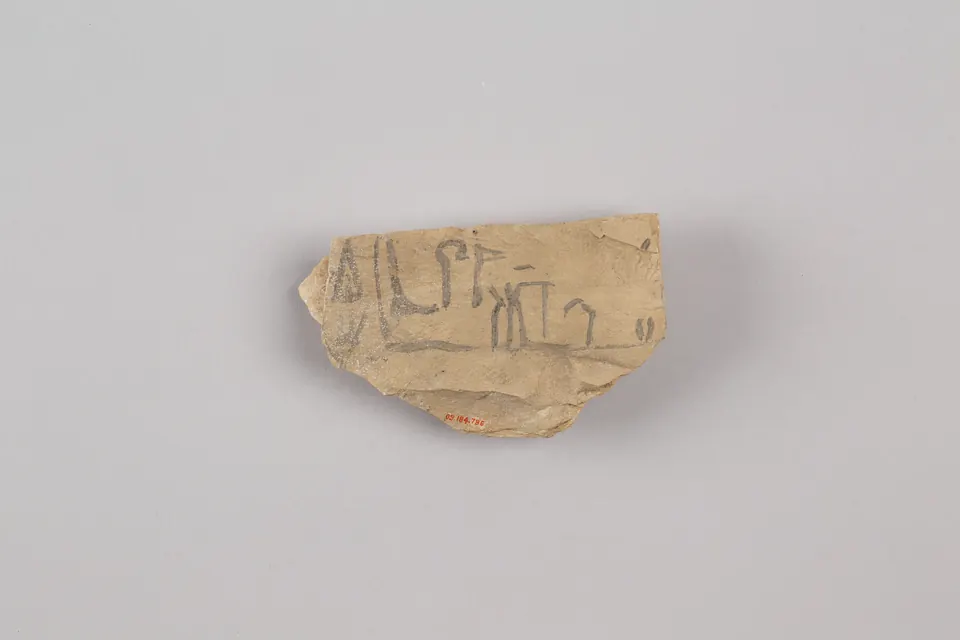
Photo: Diego Delso · CC BY-SA 4.0 · source
EG-II.06

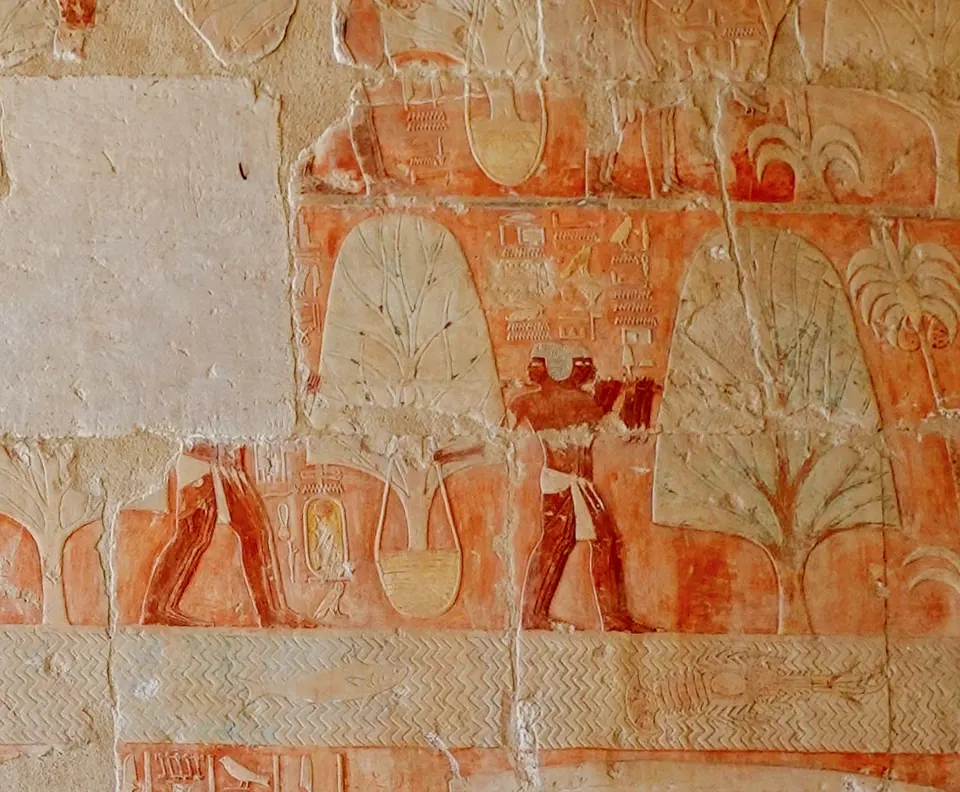
The expedition to Punt

c. 1470 BC (reign of Hatshepsut)Painted limestone reliefFound: Mortuary temple of Hatshepsut, Deir el-BahariIn situ

Reliefs recording a trading voyage sent by Queen Hatshepsut to the land of Punt, somewhere on the coast of the southern Red Sea.

What it says and shows

Ships, houses on stilts, the ruler of Punt and his wife, and incense trees carried in baskets to be replanted in Egypt.

Why it matters

It is one of the earliest pictorial records of long-distance trade and of a people of northeast Africa.

Connects to the book

Sources & dating

Dates are approximate and follow the sources below.

Photo: Ismoon (talk) 22:02, 2 March 2020 (UTC) · CC BY-SA 4.0 · source
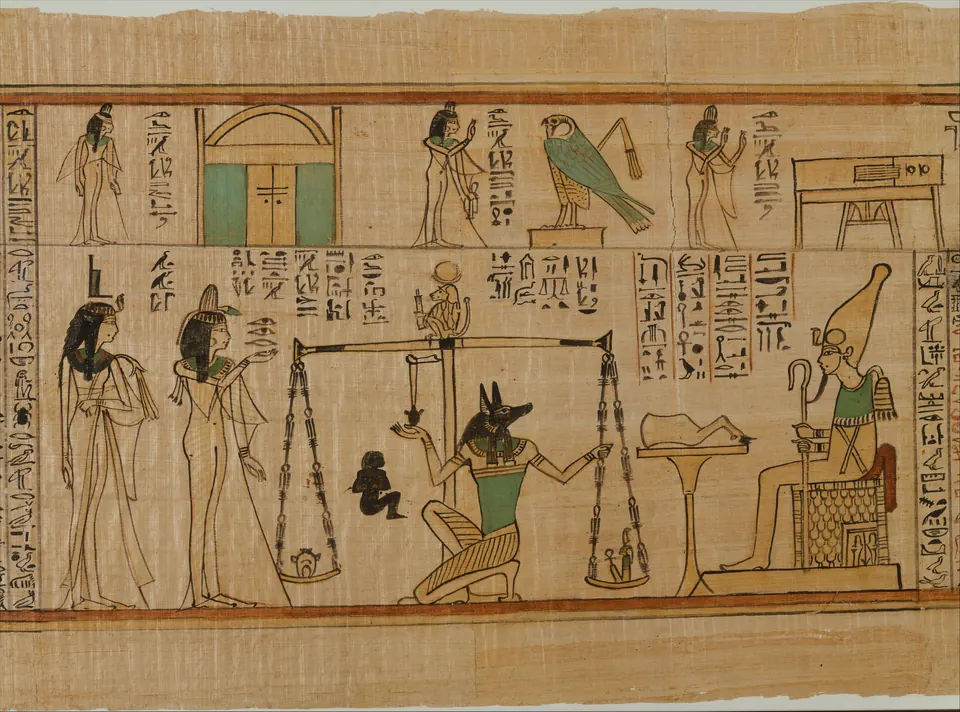
Photo: Ismoon (talk) 22:02, 2 March 2020 (UTC) · CC BY-SA 4.0 · source
EG-II.07

The Dream Stele

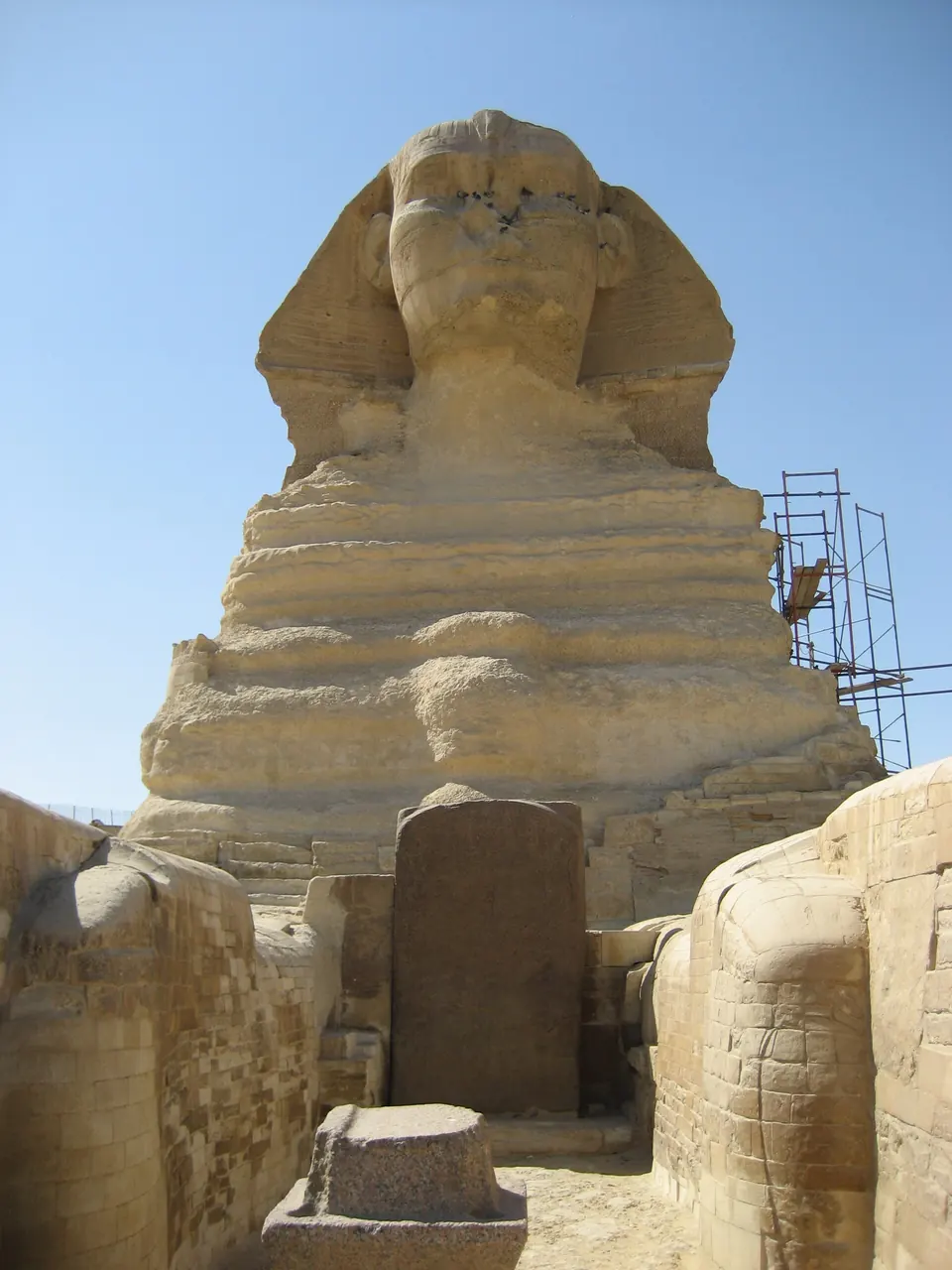
c. 1401 BC (year 1 of Thutmose IV)Red graniteFound: Between the paws of the Great Sphinx, GizaIn situ

A granite stela set up by Thutmose IV between the paws of the Sphinx.

What it says and shows

It tells how the young prince fell asleep in the Sphinx’s shadow and dreamed that the god promised him the kingship if he cleared away the sand.

Why it matters

It shows the Sphinx was already ancient, half-buried and revered more than 3,400 years ago.

Connects to the book

Sources & dating

Dates are approximate and follow the sources below.

Photo: Chanel Wheeler · CC BY-SA 2.0 · source

Photo: Chanel Wheeler · CC BY-SA 2.0 · source

EG-II.08

Daily life in the Mastaba of Ti

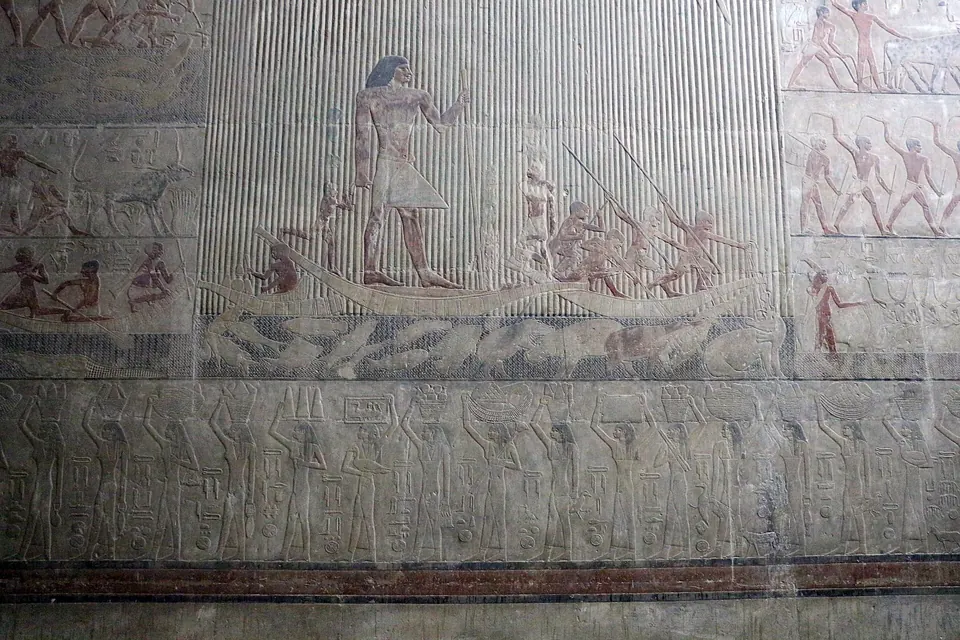
c. 2400 BC (5th Dynasty)Painted limestone reliefFound: SaqqaraIn situ

The tomb chapel of Ti, an official of the 5th Dynasty, carved with some of the finest scenes of daily life from the Old Kingdom.

What it says and shows

Farming, cattle, boat-building, craftsmen, hippopotamus hunts in the marshes — each scene with short captions.

Why it matters

These captions are among the earliest everyday speech recorded in Egyptian, and the scenes are a picture-book of life in the pyramid age.

Connects to the book

Sources & dating

Dates are approximate and follow the sources below.

Photo: Sailko · CC BY 3.0 · source

Photo: Einsamer Schütze · CC BY-SA 3.0 · source

Photo: Sailko · CC BY 3.0 · source

EG-II.09

The Dendera Zodiac

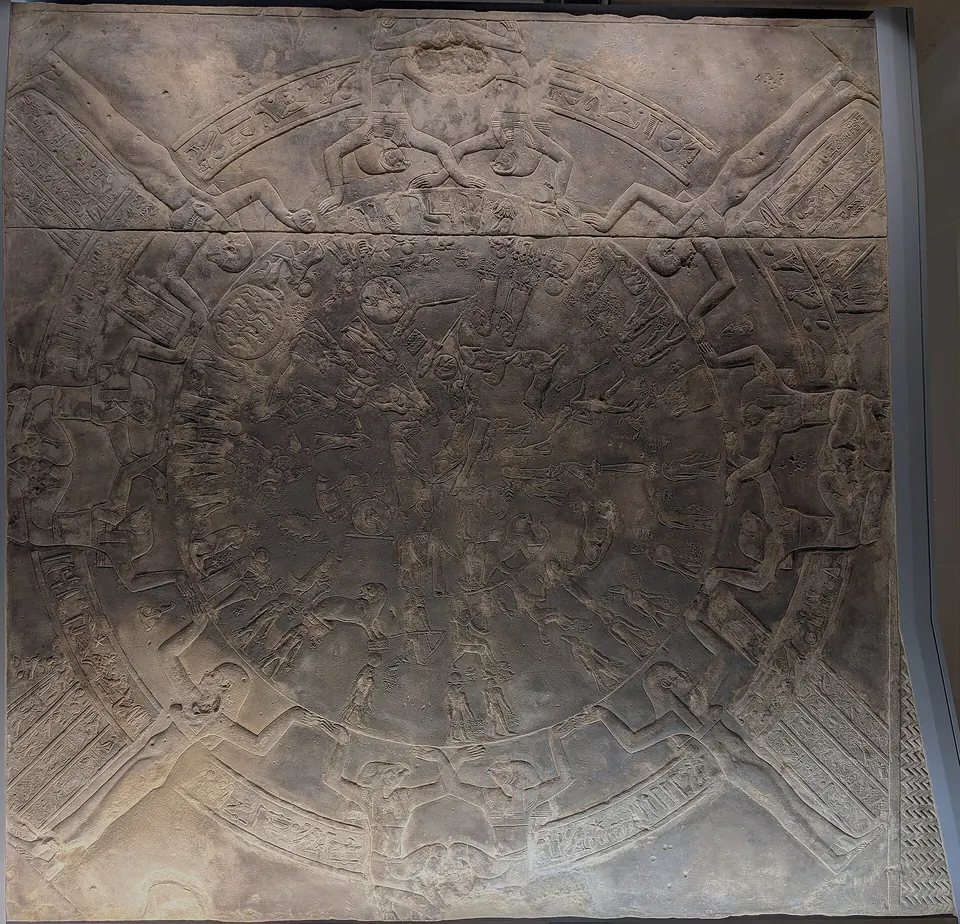
c. 50 BC (late Ptolemaic)Sandstone reliefFound: Chapel of Osiris, Temple of Hathor, DenderaMusée du Louvre, Paris (cast in situ)Inv. D 38

A circular map of the sky carved on the ceiling of a chapel at Dendera.

What it says and shows

Egyptian constellations and the 36 decans alongside the twelve zodiac signs adopted from Babylonian and Greek astronomy; the sky disc is held up by four standing women and four pairs of kneeling falcon-headed figures.

Why it matters

It is the only complete circular map of the sky to survive from ancient Egypt. It was removed to France in 1821.

Connects to the book

Sources & dating

Dates are approximate and follow the sources below.

Photo: Shonagon · CC0 · source

Photo: Shonagon · CC0 · source

EG-II.10

The tomb paintings of Nebamun

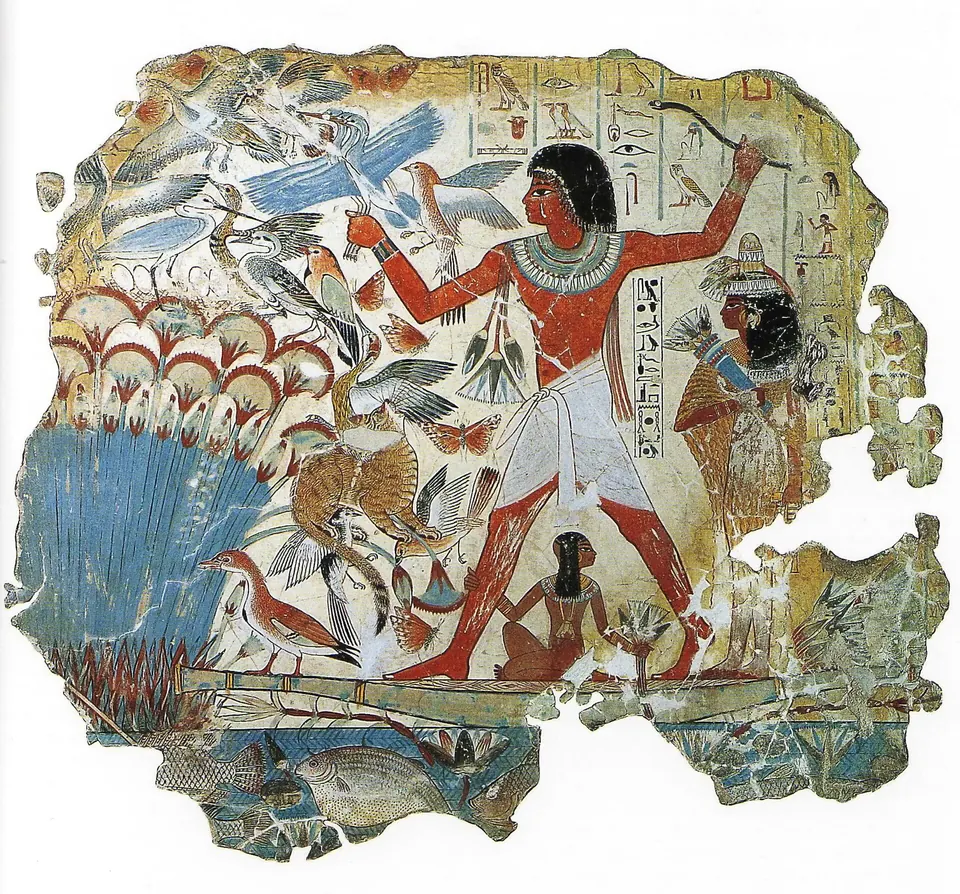
c. 1350 BC (18th Dynasty)Painted plasterFound: Tomb-chapel of Nebamun, ThebesBritish Museum, LondonInv. EA 37977 and others

Wall paintings from the tomb-chapel of Nebamun, an accountant of grain at the temple of Amun.

What it says and shows

Nebamun hunting birds in the marshes, a garden pool, a banquet with musicians and dancers.

Why it matters

They are among the most celebrated paintings to survive from ancient Egypt.

Connects to the book

Sources & dating

Dates are approximate and follow the sources below.

Photo: Unknown author · Public domain · source

Photo: Unknown author · Public domain · source

EG-II.11

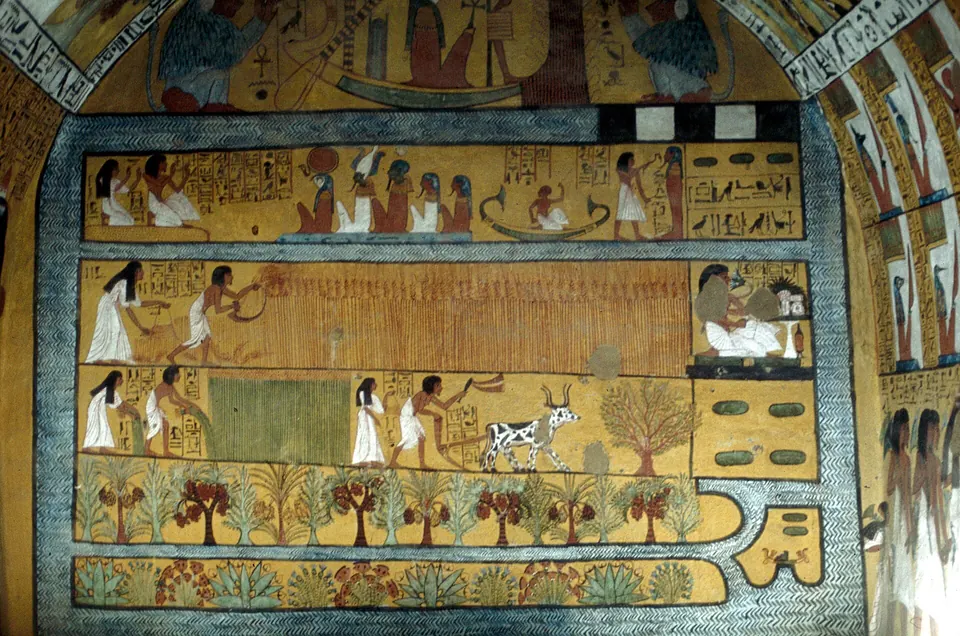
The tomb of Sennedjem

c. 1280 BC (19th Dynasty)Painted plasterFound: Deir el-Medina, Thebes (found 1886)In situInv. TT1

The burial chamber of Sennedjem, one of the craftsmen who built the royal tombs in the Valley of the Kings.

What it says and shows

Sennedjem and his wife ploughing and harvesting in the Field of Reeds, the ideal afterlife.

Why it matters

It shows how the skilled workmen of Deir el-Medina decorated their own tombs, with colours still vivid today.

Connects to the book

Sources & dating

Dates are approximate and follow the sources below.

Photo: Gerd Eichmann · CC BY-SA 4.0 · source
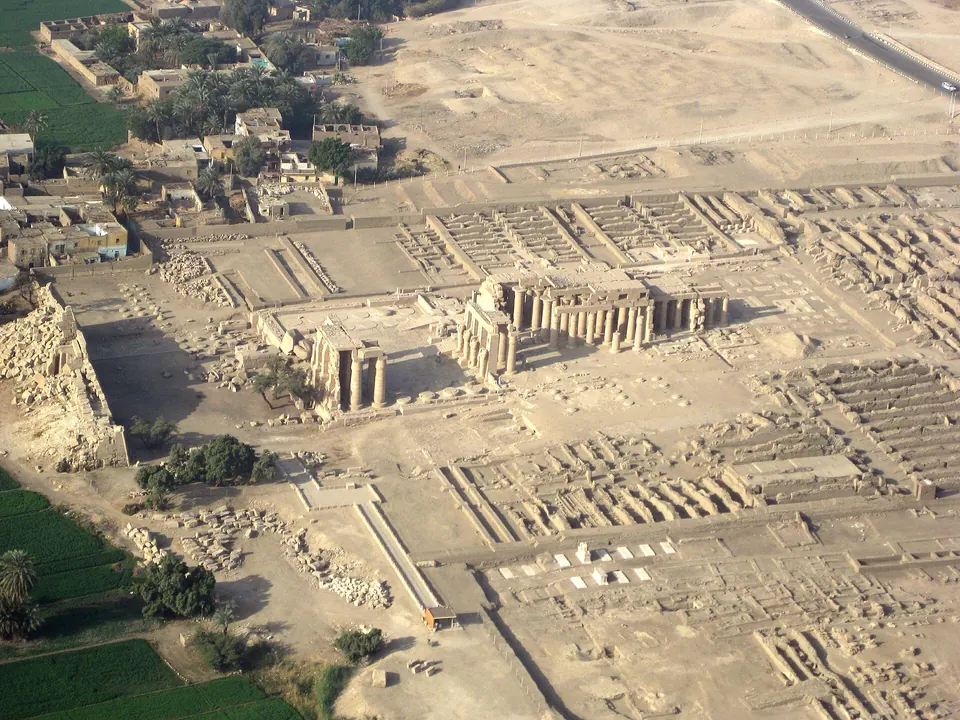
Photo: Gerd Eichmann · CC BY-SA 4.0 · source
EG-II.12

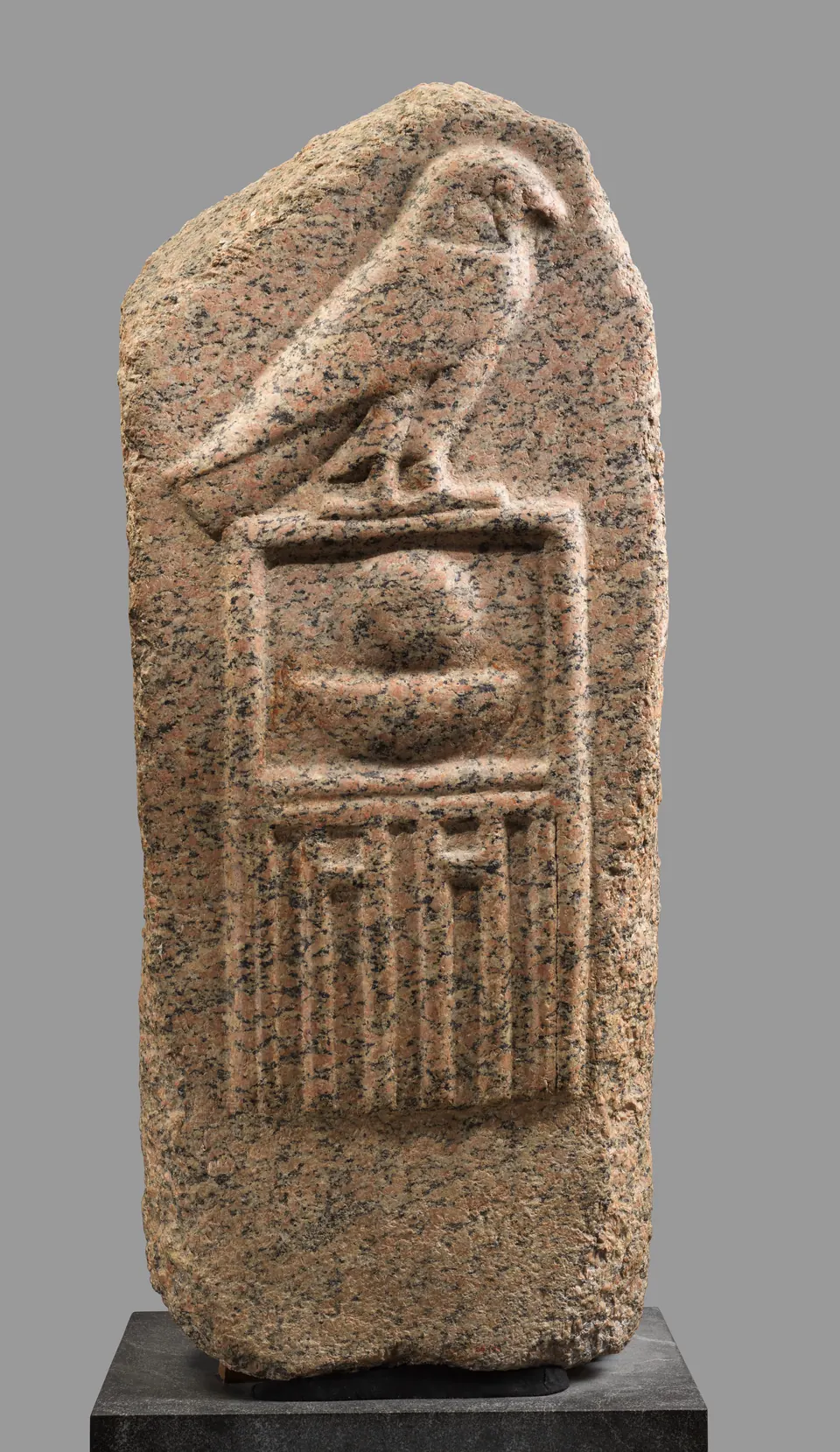
Stela of King Raneb

ca. 2880 BCEGraniteFound: Saqqara, Memphite Region (Tomb of Raneb)The Metropolitan Museum of Art, New YorkInv. Met 60.144

Stela of King Raneb: granite, dated ca. 2880 BCE in the museum’s record.

What it says and shows

The Met catalogues it as Early Dynastic Period, Dynasty 2, reign of Raneb; place in the record: Saqqara, Memphite Region (Tomb of Raneb). Size: H. 100 × W. 42.5 × D. 27 cm (39 3/8 × 16 3/4 × 10 5/8 in.). Purchase, Joseph Pulitzer Bequest, 1960; Purchase, Lila Acheson Wallace Gift, 1975.

Why it matters

One of the earliest royal stelae with a king’s name in a serekh, from the Second Dynasty.

Connects to the book

Sources & dating

Dates are approximate and follow the sources below. Evidence status: CONFIRMED

Photo: The Metropolitan Museum of Art · CC0 (The Met Open Access) · source

Photo: The Metropolitan Museum of Art · CC0 (The Met Open Access) · source

EG-II.13

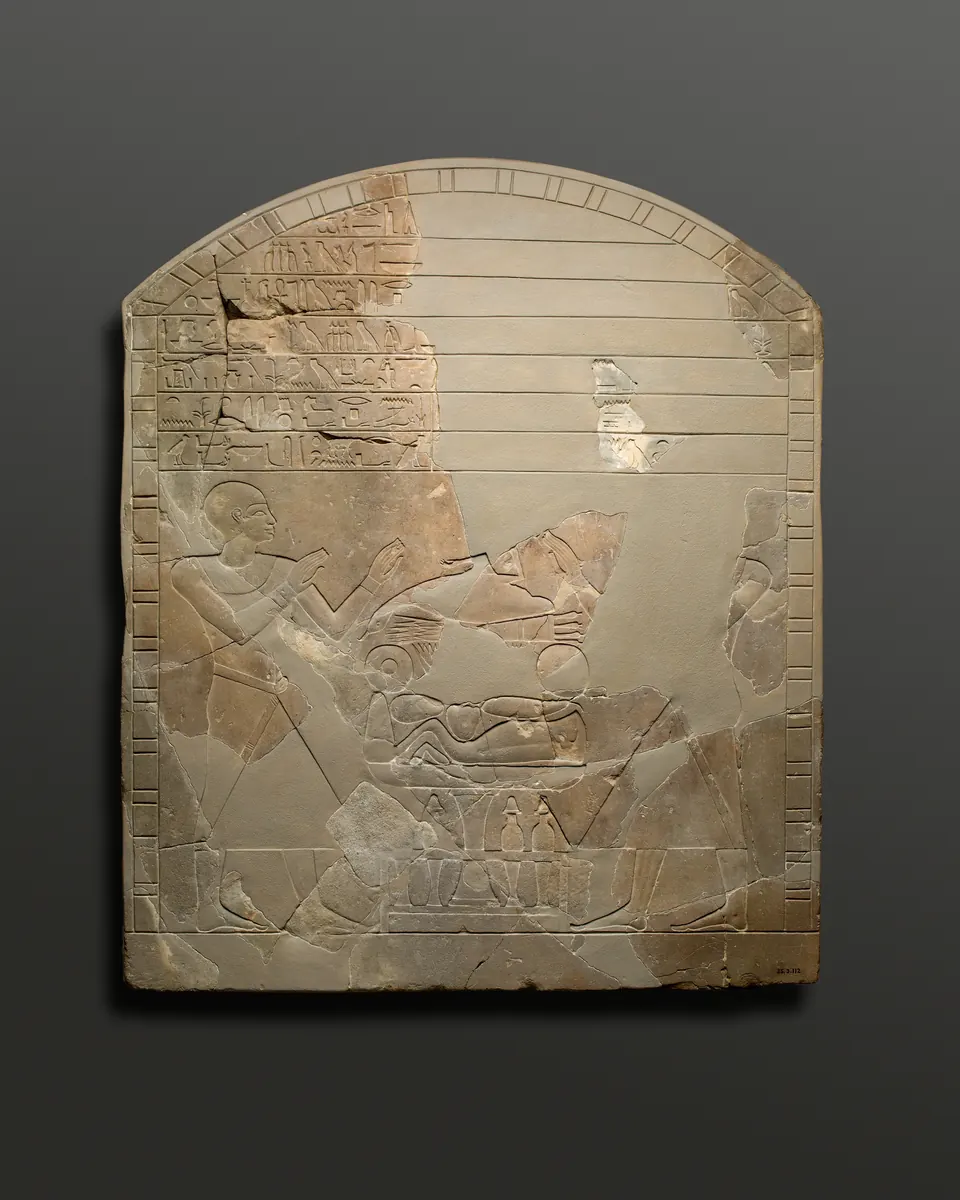
Stela of Two Brothers

ca. 1981–1802 B.C.Limestone, paintFound: Asasif, Upper Egypt, Thebes, Egypt (MMA excavations, 1934–35, Ramesside Temple Area, Tomb MMA 710, pit)The Metropolitan Museum of Art, New YorkInv. Met 35.3.112

Stela of Two Brothers: limestone, paint, dated ca. 1981–1802 B.C. in the museum’s record.

What it says and shows

The Met catalogues it as Middle Kingdom, Dynasty 12; place in the record: Asasif, Upper Egypt, Thebes, Egypt (MMA excavations, 1934–35, Ramesside Temple Area, Tomb MMA 710, pit). Size: H. 72.7 cm (28 5/8 in.); W. 61 cm (24 in.); D. 14 cm (5 1/2 in.). Rogers Fund, 1935.

Why it matters

A Middle Kingdom stela for two brothers, with an offering formula in hieroglyphs.

Connects to the book

Sources & dating

Dates are approximate and follow the sources below. Evidence status: CONFIRMED

Photo: The Metropolitan Museum of Art · CC0 (The Met Open Access) · source

Photo: The Metropolitan Museum of Art · CC0 (The Met Open Access) · source

EG-II.14

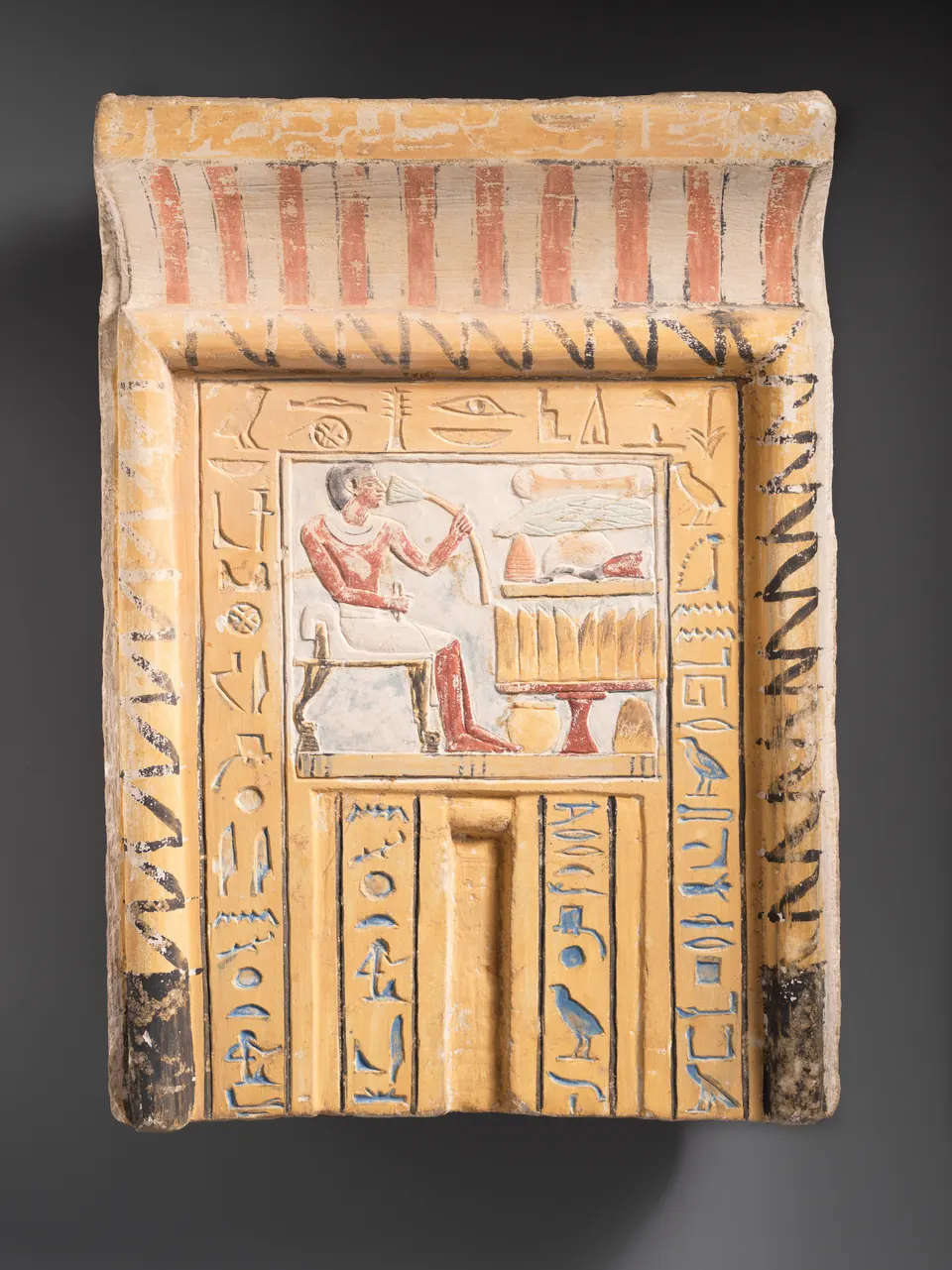
Stela of Nakht

ca. 1950–1900 B.C.Limestone, paintFound: Upper Egypt, ThebesThe Metropolitan Museum of Art, New YorkInv. Met 11.155.1

Stela of Nakht: limestone, paint, dated ca. 1950–1900 B.C. in the museum’s record.

What it says and shows

The Met catalogues it as Middle Kingdom, Dynasty 12, early; place in the record: Upper Egypt, Thebes. Size: H. 34.6 × W. 25 × D. 7.6 cm, 9.9 kg (13 5/8 × 9 13/16 × 3 in., 21.8 lb.). Gift of J. Pierpont Morgan, 1911.

Why it matters

A painted Middle Kingdom stela with offering text and figures.

Connects to the book

Sources & dating

Dates are approximate and follow the sources below. Evidence status: CONFIRMED

Photo: The Metropolitan Museum of Art · CC0 (The Met Open Access) · source

Photo: The Metropolitan Museum of Art · CC0 (The Met Open Access) · source

EG-II.15

Stela of Itubaal and Masutu

ca. 1550–1396 BCELimestoneFound: EgyptThe Metropolitan Museum of Art, New YorkInv. Met O.C.679

Stela of Itubaal and Masutu: limestone, dated ca. 1550–1396 BCE in the museum’s record.

What it says and shows

The Met catalogues it as New Kingdom, Dynasty 18; place in the record: Egypt. Size: H. 42.5 cm (16 3/4 in); W. 26.7 cm (10 1/2 in); Th. 5.6 cm (2 3/16 in.). Museum Accession.

Why it matters

A New Kingdom stela for a couple whose names the Met records as Itubaal and Masutu.

Connects to the book

Sources & dating

Dates are approximate and follow the sources below. Evidence status: CONFIRMED

Photo: The Metropolitan Museum of Art · CC0 (The Met Open Access) · source

Photo: The Metropolitan Museum of Art · CC0 (The Met Open Access) · source

EG-II.16

Magical stela or cippus of Horus

332–280 BCEChlorite schistFound: EgyptThe Metropolitan Museum of Art, New YorkInv. Met 20.2.23

Magical stela or cippus of Horus: chlorite schist, dated 332–280 BCE in the museum’s record.

What it says and shows

The Met catalogues it as Ptolemaic Period; place in the record: Egypt. Size: H. 20.5 cm (8 1/16 in.); W. 12 cm (4 3/4 in.); D. 4.5 cm (1 3/4 in.). Rogers Fund, 1920.

Why it matters

A magical cippus of Horus: water poured over its spells was believed to heal stings and bites.

Connects to the book

Sources & dating

Dates are approximate and follow the sources below. Evidence status: CONFIRMED

Photo: The Metropolitan Museum of Art · CC0 (The Met Open Access) · source

Photo: The Metropolitan Museum of Art · CC0 (The Met Open Access) · source

EG-II.17

Writing board stela of Ita, usurped by Hetepi

ca. 2030–1981 B.C.Sycomore, plaster, paintFound: Deir el-Bahri, Upper Egypt, Thebes, Egypt (MMA excavations, 1926–27, Tomb MMA 110, 1st chamber on right)The Metropolitan Museum of Art, New YorkInv. Met 27.3.50

Writing board stela of Ita, usurped by Hetepi: sycomore, plaster, paint, dated ca. 2030–1981 B.C. in the museum’s record.

What it says and shows

The Met catalogues it as Middle Kingdom, Dynasty 11; place in the record: Deir el-Bahri, Upper Egypt, Thebes, Egypt (MMA excavations, 1926–27, Tomb MMA 110, 1st chamber on right). Size: H. 55.3 × W. 34.6 × Th. 1.7 cm (21 3/4 × 13 5/8 × 11/16 in.). Rogers Fund, 1927.

Why it matters

A writing board reused as a stela, later usurped for another man: texts were re-used and re-named.

Connects to the book

Sources & dating

Dates are approximate and follow the sources below. Evidence status: CONFIRMED

Photo: The Metropolitan Museum of Art · CC0 (The Met Open Access) · source

Photo: The Metropolitan Museum of Art · CC0 (The Met Open Access) · source

EG-II.18

Statue of Roy Chanting the Solar Hymn Written on His Stela

ca. 1427–1396 BCELimestone, paintFound: Upper Egypt, Thebes, EgyptThe Metropolitan Museum of Art, New YorkInv. Met 17.190.1960

Statue of Roy Chanting the Solar Hymn Written on His Stela: limestone, paint, dated ca. 1427–1396 BCE in the museum’s record.

What it says and shows

The Met catalogues it as New Kingdom, Dynasty 18, reign of Amenhotep II; place in the record: Upper Egypt, Thebes, Egypt. Size: H. 31.5 × w. 16.3 × d. 19 cm (12 3/8 × 6 7/16 × 7 1/2 in. ). Gift of J. Pierpont Morgan, 1917.

Why it matters

A statue of Roy holding a stela that carries a written hymn to the sun.

Connects to the book

Sources & dating

Dates are approximate and follow the sources below. Evidence status: CONFIRMED

Photo: The Metropolitan Museum of Art · CC0 (The Met Open Access) · source

Photo: The Metropolitan Museum of Art · CC0 (The Met Open Access) · source

Hall III · 19 objects

Monuments & Megaliths

Pyramids, temples carved into mountains, obelisks cut from a single block: the largest works of the ancient world. Each label keeps to what excavation, inscriptions and survey actually document.

EG-III.01

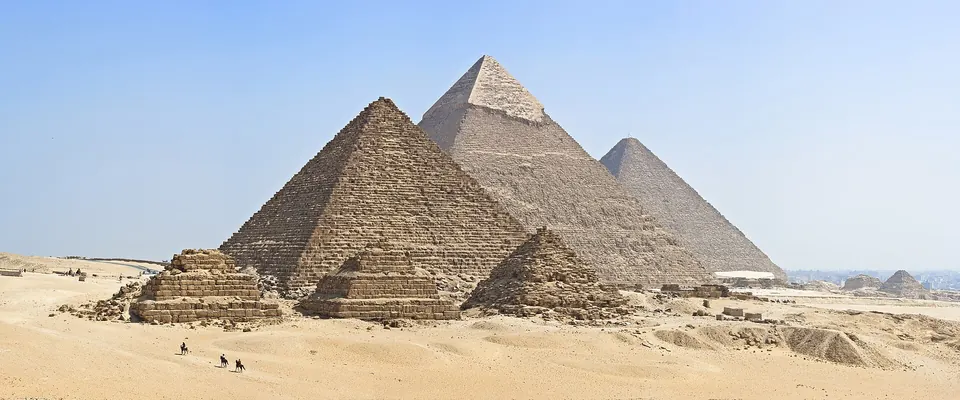
The Giza pyramid complex

c. 2600–2500 BC (4th Dynasty)Limestone and graniteFound: Giza plateau, west of CairoIn situ (UNESCO World Heritage: Memphis and its Necropolis)

The pyramids of Khufu, Khafre and Menkaure, with their temples, causeways, queens’ pyramids and cemeteries of officials.

What it shows

Three royal pyramids in a line across the plateau, with the Great Sphinx below them beside Khafre’s causeway.

Why it matters

Excavations of the workers’ town and cemeteries south of the plateau show an organised, fed and housed workforce.

Connects to the book

Sources & dating

Dates are approximate and follow the sources below.

Photo: KennyOMG · CC BY-SA 4.0 · source
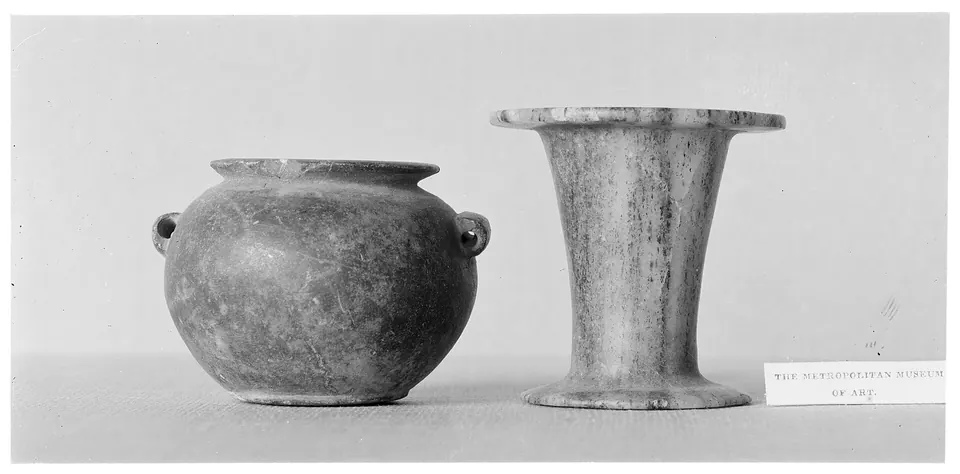
Photo: KennyOMG · CC BY-SA 4.0 · source
EG-III.02

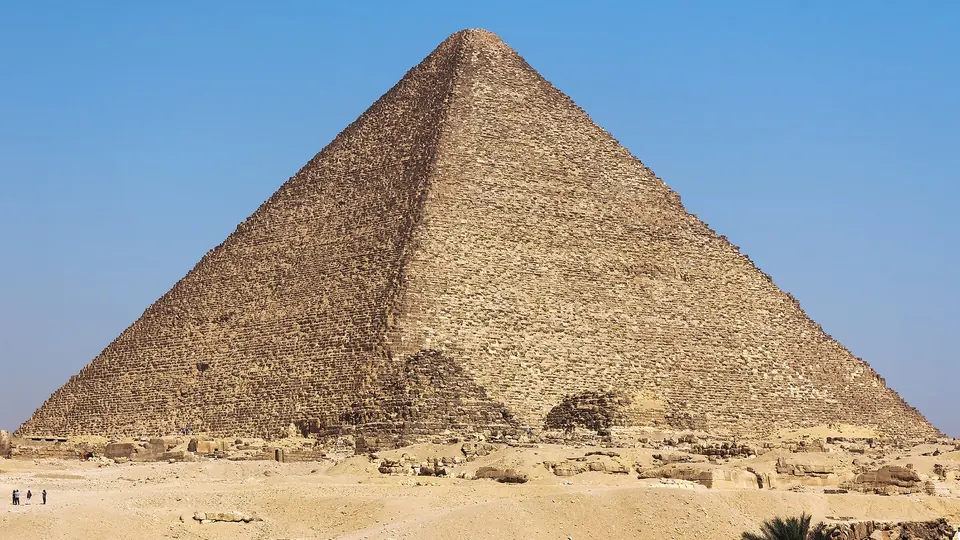
The Great Pyramid of Khufu

c. 2560 BC (4th Dynasty)Limestone, with granite in the King’s ChamberFound: GizaIn situ

The tomb of King Khufu, originally about 146 metres high: the oldest of the Seven Wonders of the Ancient World and the only one still standing.

What it shows

Its interior holds the descending passage, the Grand Gallery and the King’s Chamber. The 3D view is a geometric reconstruction of the original outer form only, built from the published measurements (base c. 230.3 m per side, original height c. 146.6 m): the casing, chambers and surroundings are not modelled.

Why it matters

It was the tallest human-made structure on earth for more than 3,700 years. The papyri of Merer, found in 2013, record crews shipping white limestone from Tura to Giza in Khufu’s reign.

Connects to the book

Sources & dating

Dates are approximate and follow the sources below.

Photo: Douwe C. van der Zee · CC BY-SA 4.0 · source
Geometric reconstruction (not a scan): Ham's Legacy, from published measurements (base 440 royal cubits ≈ 230.3 m, original height 280 royal cubits ≈ 146.6 m) · CC0 (this museum) · source

Photo: Douwe C. van der Zee · CC BY-SA 4.0 · source
EG-III.03

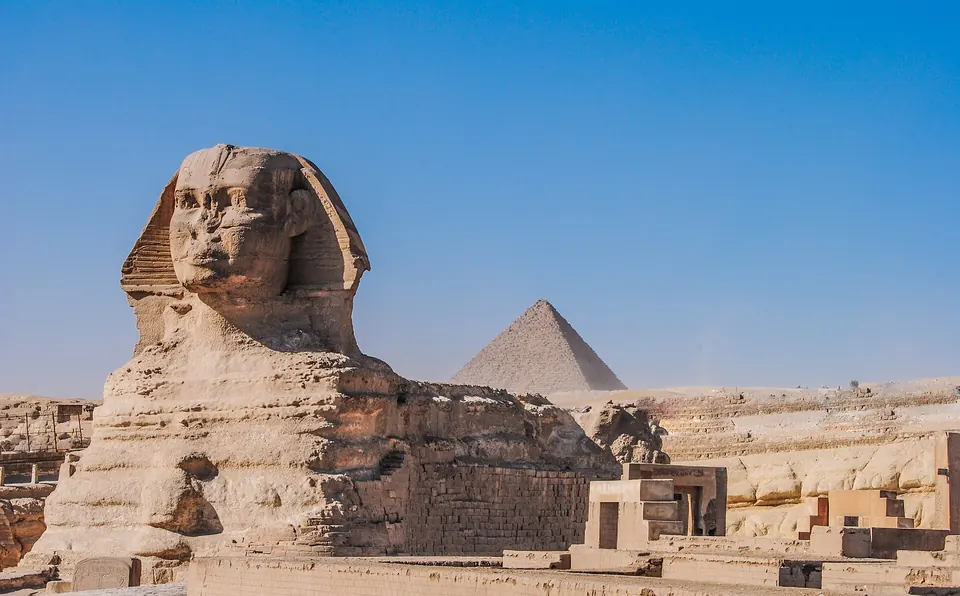
The Great Sphinx

c. 2550 BC (generally attributed to Khafre)Carved from the limestone bedrockFound: GizaIn situ

A lion with a king’s head, carved out of the living rock beside Khafre’s valley temple.

What it shows

About 73 metres long and 20 metres high, it is the largest monolithic statue in the world.

Why it matters

It is generally attributed to Khafre, whose pyramid complex it guards.

Connects to the book

Sources & dating

Dates are approximate and follow the sources below.

Photo: Hesham Ebaid · CC0 · source

Photo: Hesham Ebaid · CC0 · source

EG-III.04

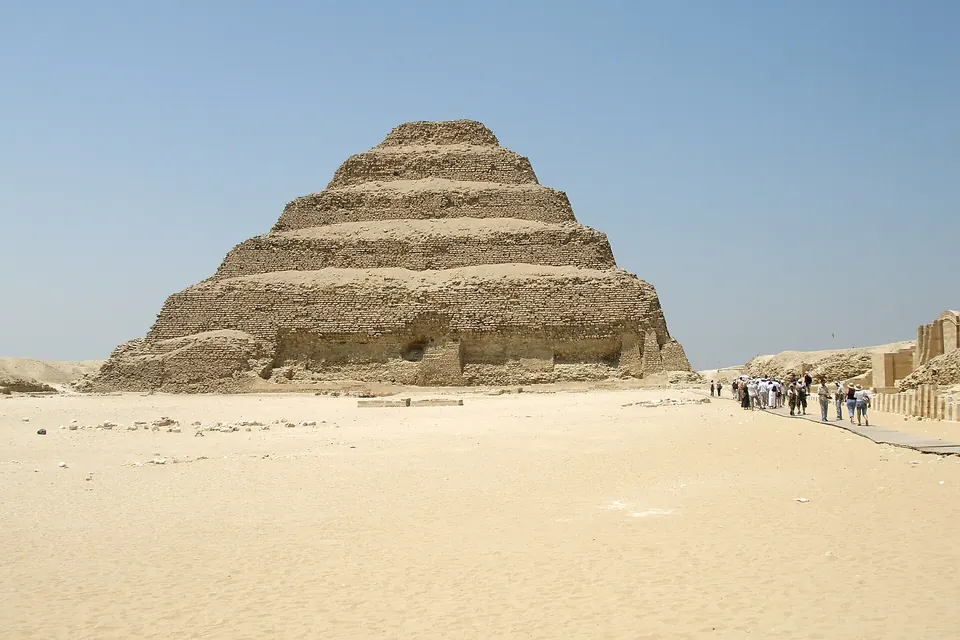
The Step Pyramid of Djoser

c. 2670–2650 BC (3rd Dynasty)LimestoneFound: SaqqaraIn situ

Six stacked steps of stone, about 62 metres high, built for King Djoser and traditionally credited to his official Imhotep.

What it shows

Under the pyramid, galleries held tens of thousands of stone vessels, many from earlier reigns.

Why it matters

It is the earliest colossal stone building in Egypt and the first of the pyramids.

Connects to the book

Sources & dating

Dates are approximate and follow the sources below.

Photo: Vyacheslav Argenberg · CC BY 4.0 · source

Photo: Vyacheslav Argenberg · CC BY 4.0 · source

EG-III.05

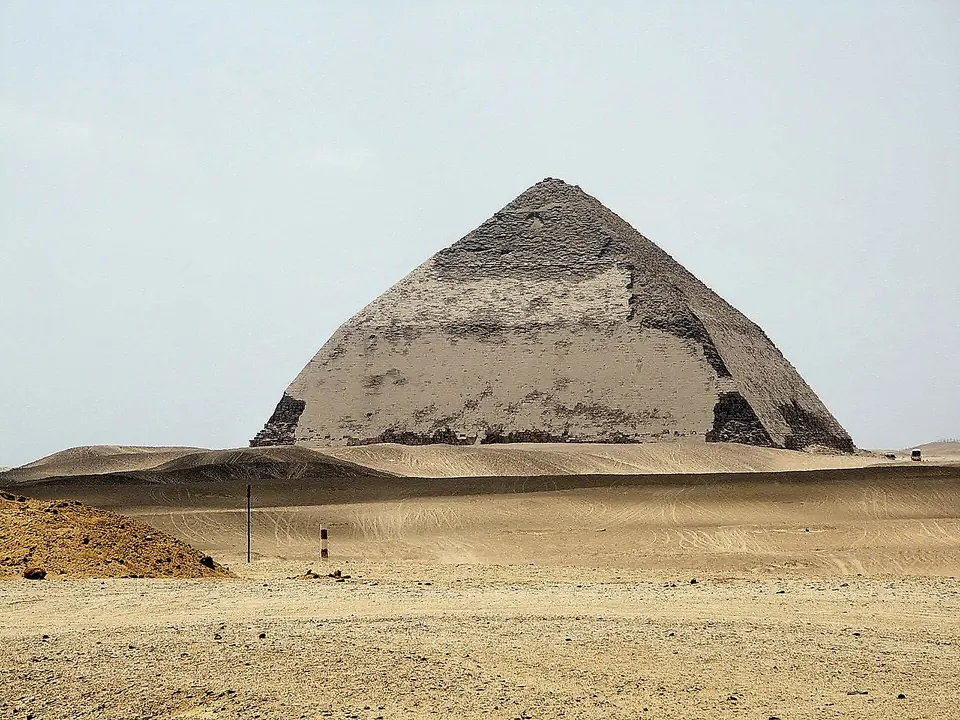
The Bent Pyramid

c. 2600 BC (reign of Sneferu)LimestoneFound: DahshurIn situ

One of three pyramids built by King Sneferu, Khufu’s father.

What it shows

The slope changes about halfway up, from roughly 54 degrees to about 43 — a mid-course correction by the builders.

Why it matters

It preserves much of its original smooth casing and shows engineers learning, in real time, how to build a true pyramid.

Connects to the book

Sources & dating

Dates are approximate and follow the sources below.

Photo: lienyuan lee · CC BY 3.0 · source

Photo: lienyuan lee · CC BY 3.0 · source

EG-III.06

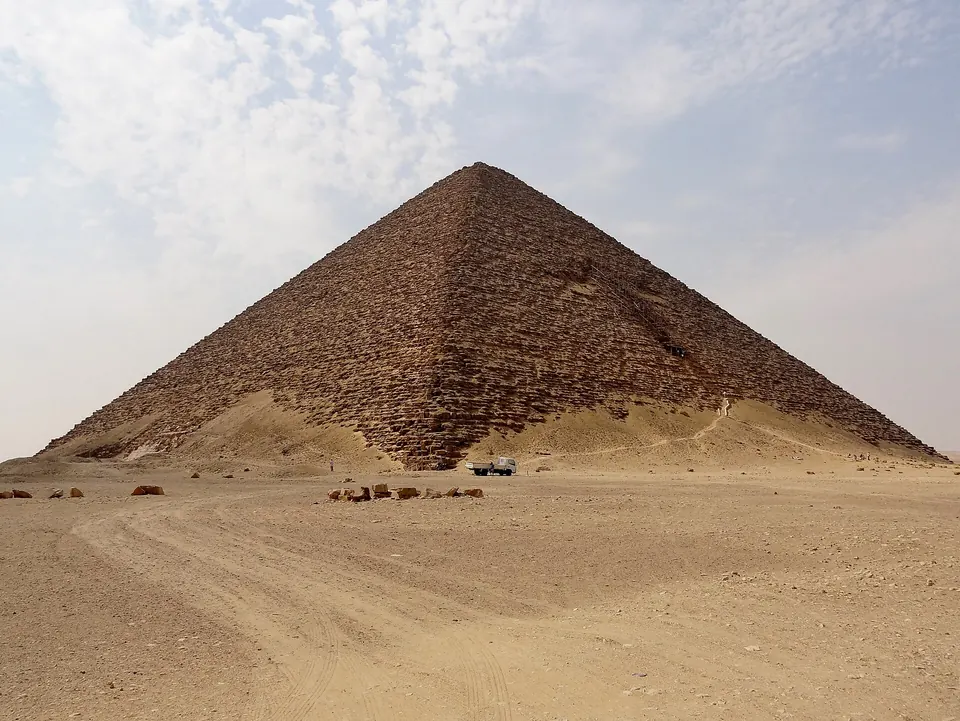
The Red Pyramid

c. 2600 BC (reign of Sneferu)Red-tinted limestoneFound: DahshurIn situ

Sneferu’s third pyramid, named for the reddish colour of its exposed stone.

What it shows

Its gentle slope of about 43 degrees runs from base to top.

Why it matters

It is generally considered Egypt’s first successful smooth-sided “true” pyramid.

Connects to the book

Sources & dating

Dates are approximate and follow the sources below.

Photo: Olaf Tausch · CC BY 3.0 · source

Photo: Olaf Tausch · CC BY 3.0 · source

EG-III.07

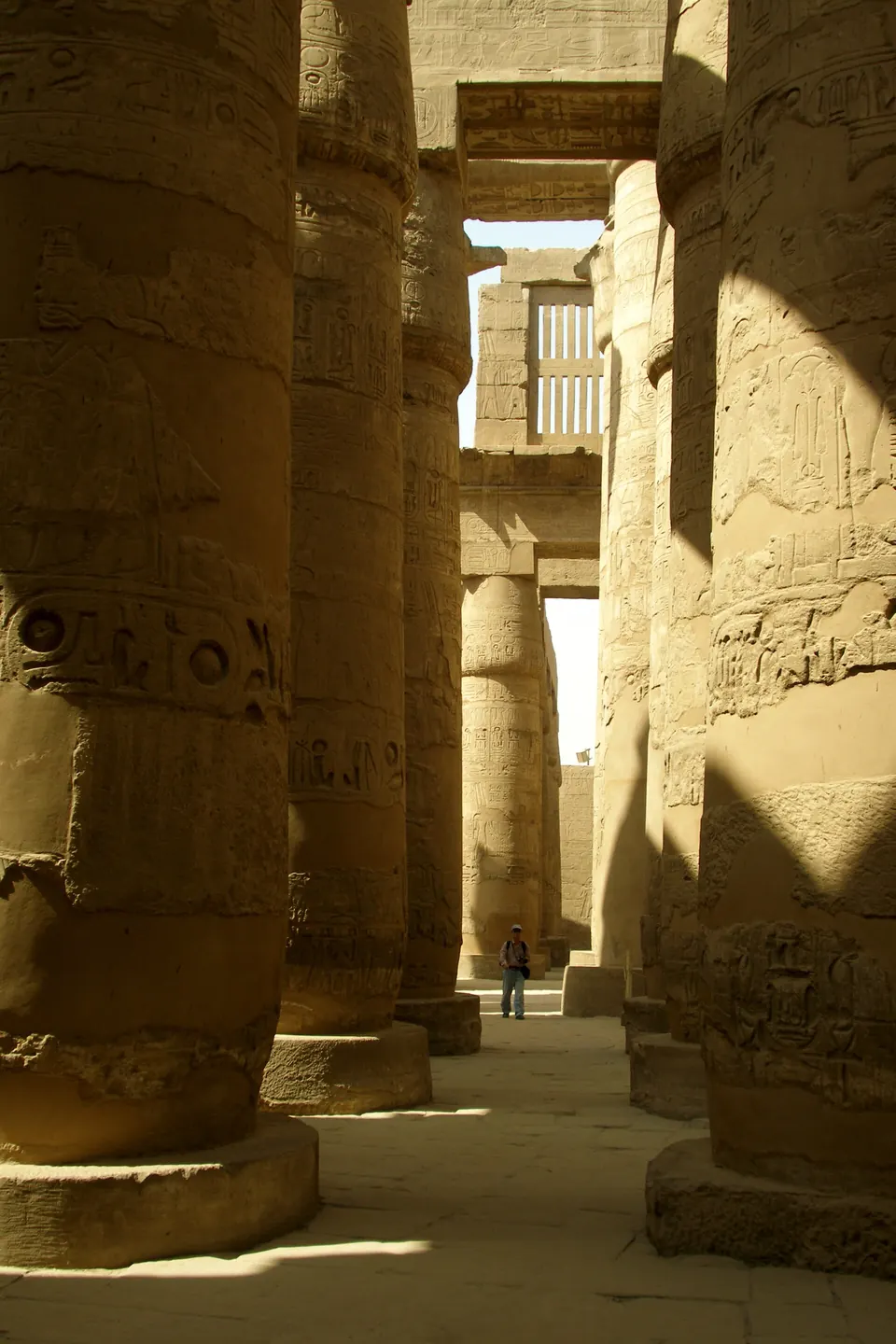
Karnak: the Great Hypostyle Hall

Built over some 2,000 years; hall c. 1290–1220 BCSandstoneFound: Luxor (ancient Thebes)In situ (UNESCO World Heritage: Ancient Thebes)

The vast temple complex of the god Amun-Re, enlarged by kings for about two thousand years.

What it shows

The Great Hypostyle Hall: 134 columns, the central ones about 21 metres high, every surface carved. Hatshepsut’s obelisk still stands nearby.

Why it matters

Karnak is one of the largest religious complexes ever built. The Kushite kings of the 25th Dynasty also built here.

Connects to the book

Sources & dating

Dates are approximate and follow the sources below.

Photo: Vyacheslav Argenberg · CC BY 4.0 · source

Photo: Olaf Tausch · CC BY 3.0 · source

Photo: Vyacheslav Argenberg · CC BY 4.0 · source

EG-III.08

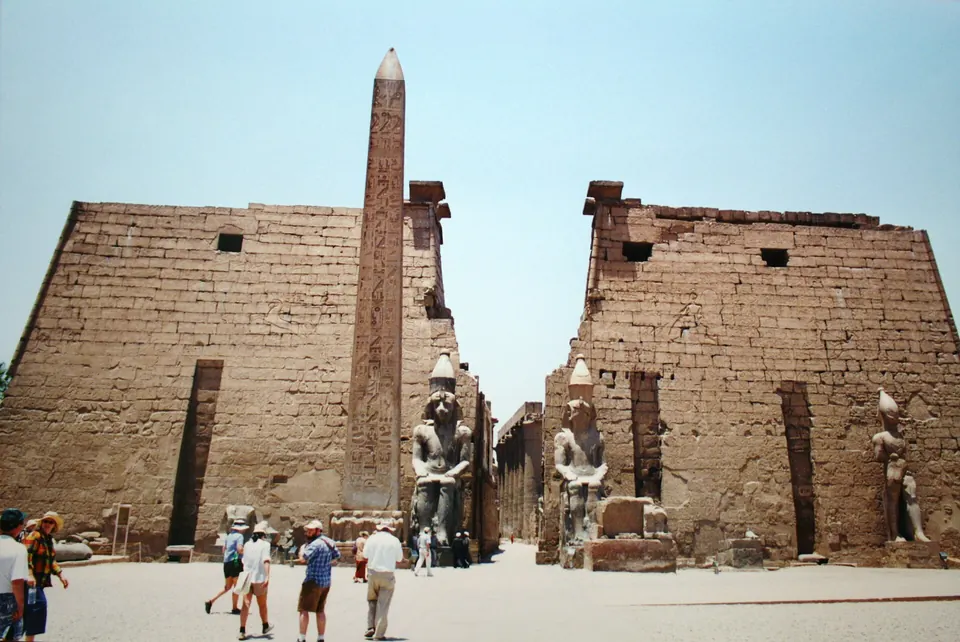
Luxor Temple

c. 1390–1213 BC (Amenhotep III and Ramesses II)SandstoneFound: LuxorIn situ

A temple of the Theban gods, linked to Karnak by a long avenue of sphinxes.

What it shows

Ramesses II’s pylon with its colossal statues and one remaining obelisk; its twin has stood in the Place de la Concorde in Paris since 1836.

Why it matters

It was the setting of the Opet festival, when the statue of Amun travelled from Karnak to Luxor.

Connects to the book

Sources & dating

Dates are approximate and follow the sources below.

Photo: Gary Todd from Xinzheng, China · CC0 · source

Photo: Gary Todd from Xinzheng, China · CC0 · source

EG-III.09

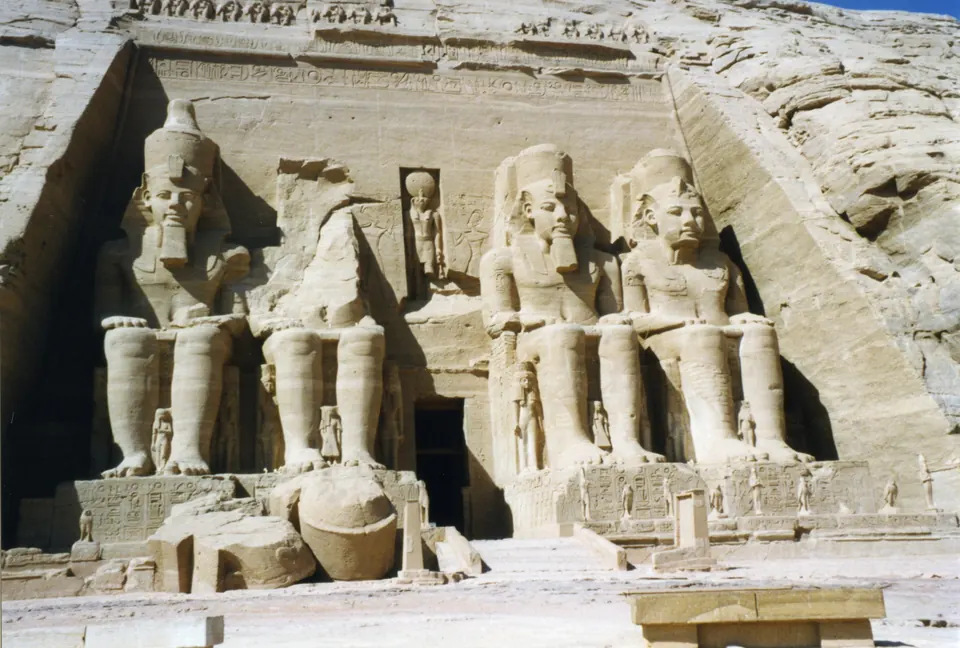
Abu Simbel

c. 1264–1244 BC (reign of Ramesses II)Carved into a sandstone cliffFound: Lower Nubia (moved 1964–68)In situ, relocated (UNESCO: Nubian Monuments from Abu Simbel to Philae)

Two temples cut into a cliff in Nubia, with four seated colossi of Ramesses II, each about 20 metres high.

What it shows

Twice a year, around 22 February and 22 October, sunlight reaches the inner sanctuary.

Why it matters

When the Aswan High Dam threatened to flood it, UNESCO’s international campaign cut the temples into blocks and rebuilt them on higher ground (1964–68).

Connects to the book

Sources & dating

Dates are approximate and follow the sources below.

Photo: Arian Zwegers from Brussels, Belgium · CC BY 2.0 · source

Photo: Arian Zwegers from Brussels, Belgium · CC BY 2.0 · source

EG-III.10

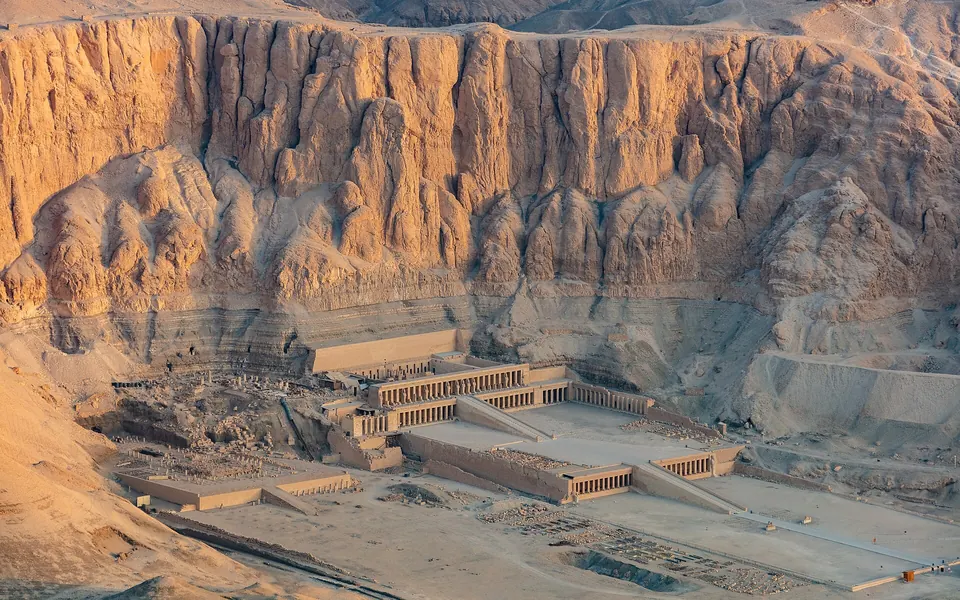
Temple of Hatshepsut, Deir el-Bahari

c. 1470 BC (18th Dynasty)LimestoneFound: West bank, LuxorIn situ

The mortuary temple of Hatshepsut, one of the few women to rule Egypt as king, built in terraces against the cliffs.

What it shows

Long colonnades, ramps, and reliefs of her divine birth and the voyage to Punt.

Why it matters

Its architect is traditionally named as Senenmut; it is one of the masterpieces of ancient architecture.

Connects to the book

Sources & dating

Dates are approximate and follow the sources below.

Photo: Diego Delso · CC BY-SA 4.0 · source
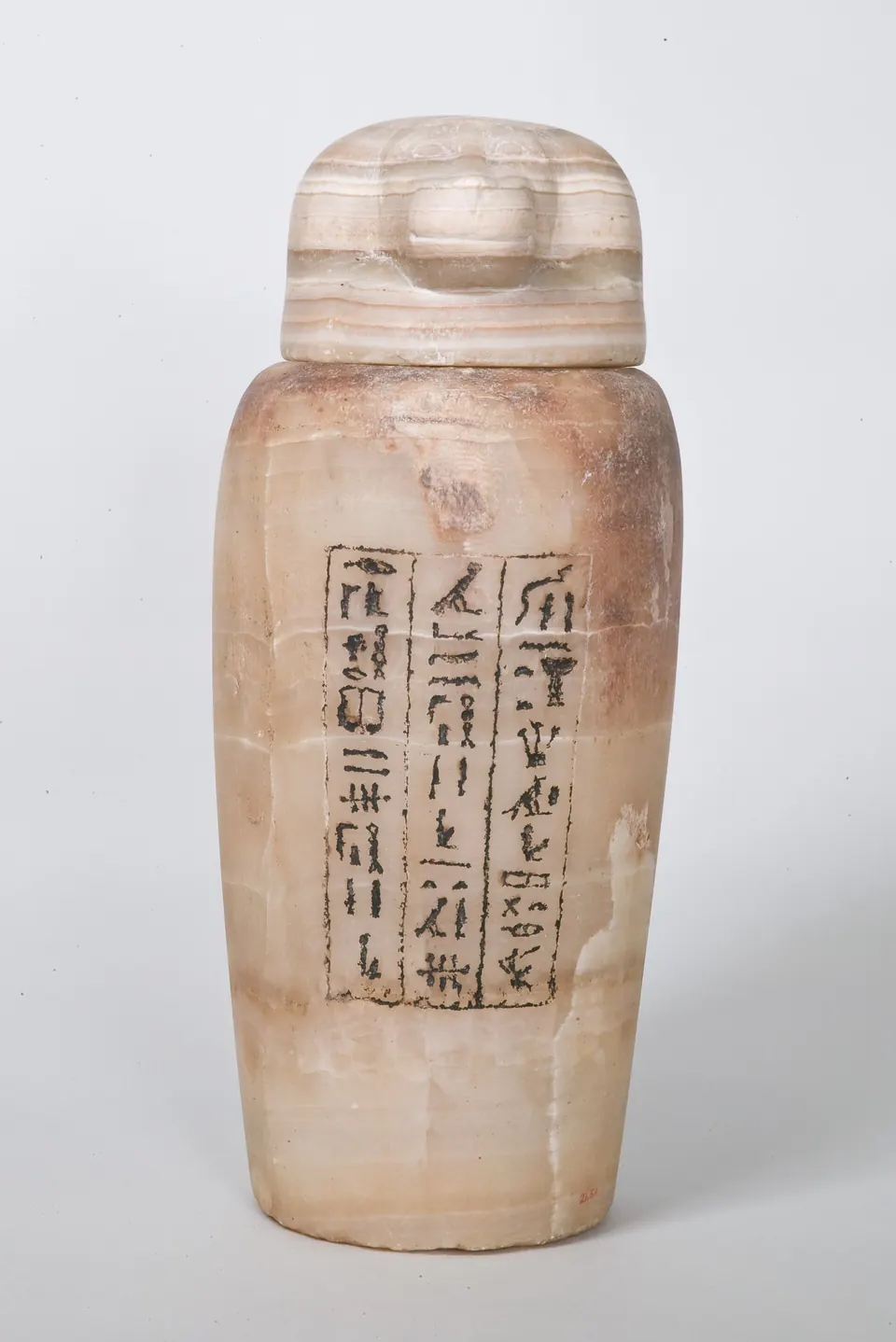
Photo: Diego Delso · CC BY-SA 4.0 · source
EG-III.11

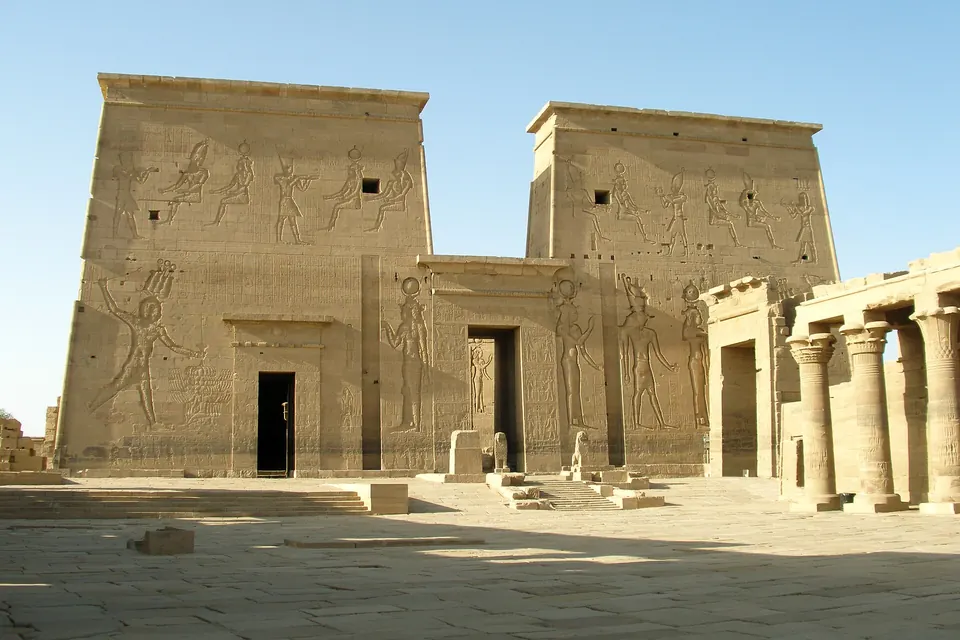
Philae: the temple of Isis

Mostly 380 BC – AD 2nd centurySandstoneFound: Agilkia Island, Aswan (moved 1977–80)In situ, relocated

The island sanctuary of the goddess Isis at the southern frontier of Egypt, also visited by worshippers from Nubia.

What it shows

Here, on 24 August AD 394, a priest carved the last known hieroglyphic inscription; the last demotic graffito followed in AD 452.

Why it matters

Philae is where the ancient Egyptian scripts were last written. The temples were moved to a nearby island to save them from flooding.

Connects to the book

Sources & dating

Dates are approximate and follow the sources below.

Photo: Vyacheslav Argenberg · CC BY 4.0 · source

Photo: Vyacheslav Argenberg · CC BY 4.0 · source

EG-III.12

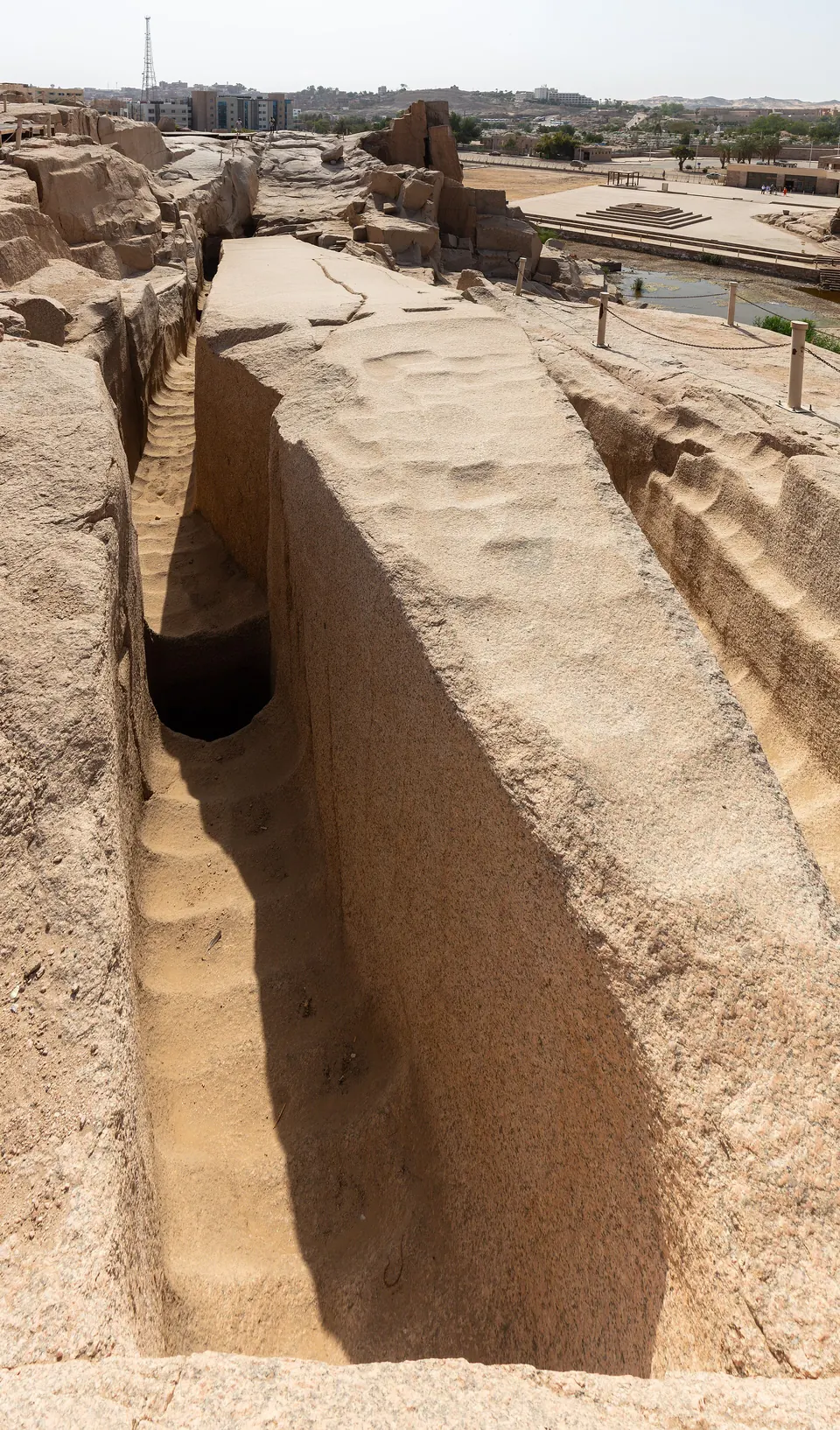
The Unfinished Obelisk

c. 1500–1450 BC (probably Hatshepsut’s reign)Red graniteFound: Northern quarries, AswanIn situ

An obelisk abandoned in the quarry after cracks appeared in the granite.

What it shows

Had it been finished it would have been about 42 metres long, roughly a third larger than any obelisk the Egyptians raised.

Why it matters

It shows how obelisks were made: the surrounding trenches were pounded out with balls of hard dolerite, whose marks are still visible.

Connects to the book

Sources & dating

Dates are approximate and follow the sources below.

Photo: Diego Delso · CC BY-SA 4.0 · source
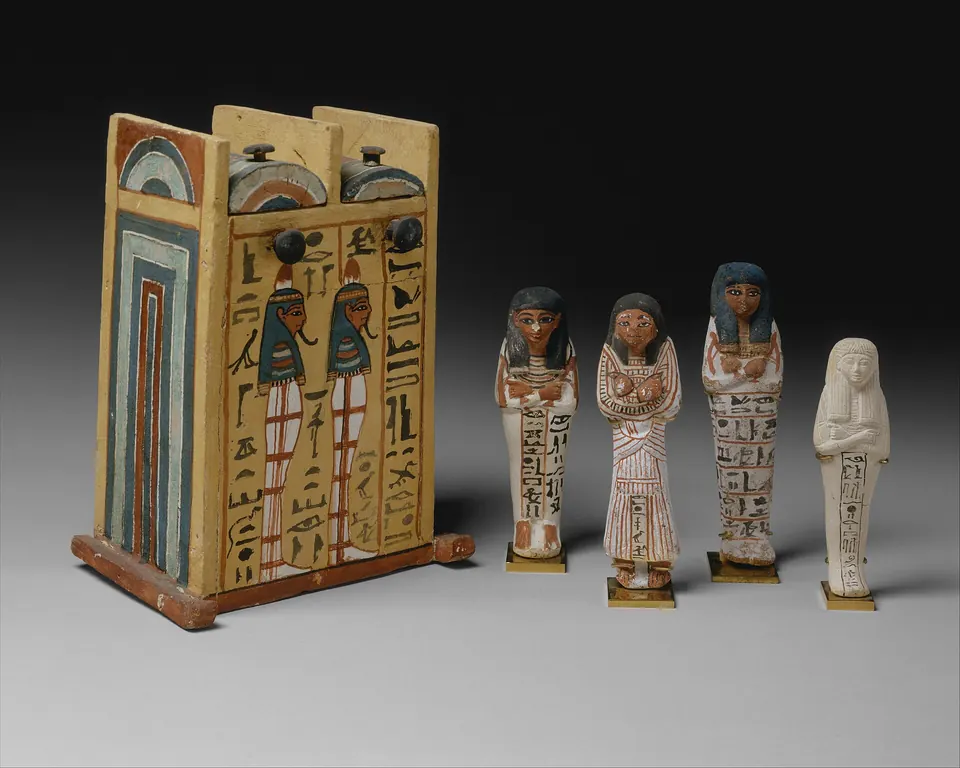
Photo: Diego Delso · CC BY-SA 4.0 · source
EG-III.13

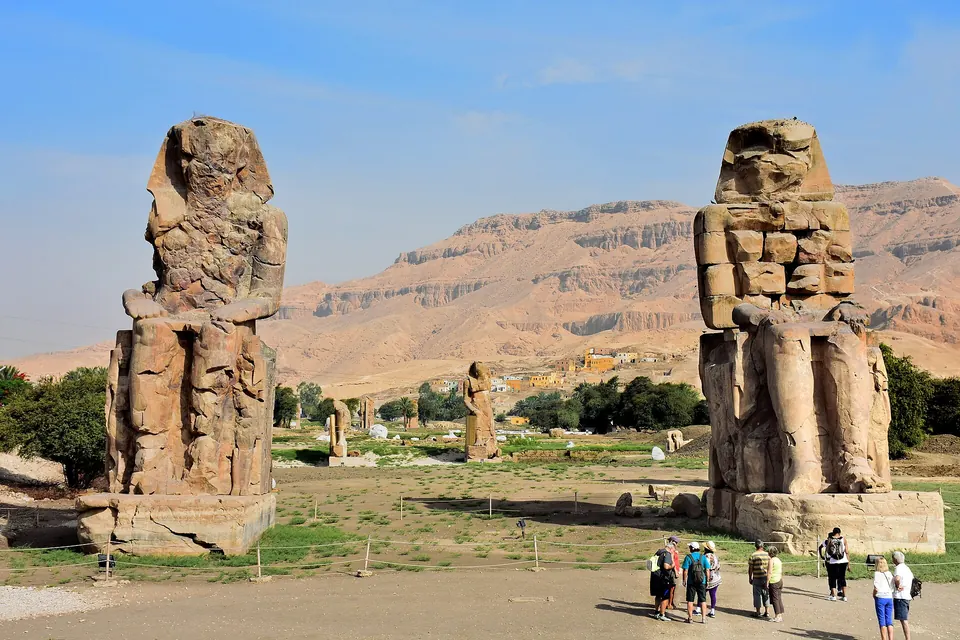
The Colossi of Memnon

c. 1350 BC (reign of Amenhotep III)Quartzite sandstoneFound: West bank, LuxorIn situ

Two seated statues of Amenhotep III, about 18 metres high, that once guarded the gate of his vast mortuary temple.

What it shows

Greek and Roman visitors carved poems on their legs; after an earthquake, one statue was said to “sing” at dawn.

Why it matters

They were a tourist attraction already in Roman times.

Connects to the book

Sources & dating

Dates are approximate and follow the sources below.

Photo: MusikAnimal · CC BY-SA 4.0 · source
Photo: MusikAnimal · CC BY-SA 4.0 · source
EG-III.14

The Valley of the Kings

c. 1539–1075 BC (New Kingdom)Rock-cut tombs in limestoneFound: West bank, LuxorIn situ

The royal cemetery of the New Kingdom, with more than sixty known tombs.

What it shows

The tomb of Seti I (KV17) is the longest in the valley; its walls are painted with guides to the night journey of the sun.

Why it matters

The tomb of Tutankhamun (KV62), found in 1922, is the only royal tomb here found largely intact.

Connects to the book

Sources & dating

Dates are approximate and follow the sources below.

Photo: Endlisnis · CC BY 2.0 · source

Photo: Carole Raddato from Frankfurt, Germany · CC BY-SA 2.0 · source

Photo: Endlisnis · CC BY 2.0 · source

EG-III.15

The Serapeum of Saqqara

c. 1400 BC – Ptolemaic periodRock-cut galleries; stone sarcophagiFound: SaqqaraIn situ

The burial place of the Apis bulls, sacred animals of the god Ptah of Memphis, rediscovered by Auguste Mariette in 1850–51.

What it shows

Long underground galleries lined with huge stone sarcophagi; inscriptions and many dated stelae left by visitors tie the burials to the Apis cult and to named kings.

Why it matters

Those dated Apis stelae are an important tool for Egyptian chronology — one of them helps fix the end of Taharqa’s reign. Popular online theories about lost technology are not supported by the excavated evidence.

Connects to the book

Sources & dating

Dates are approximate and follow the sources below.

Photo: Happa · CC BY 3.0 · source

Photo: Happa · CC BY 3.0 · source

EG-III.16

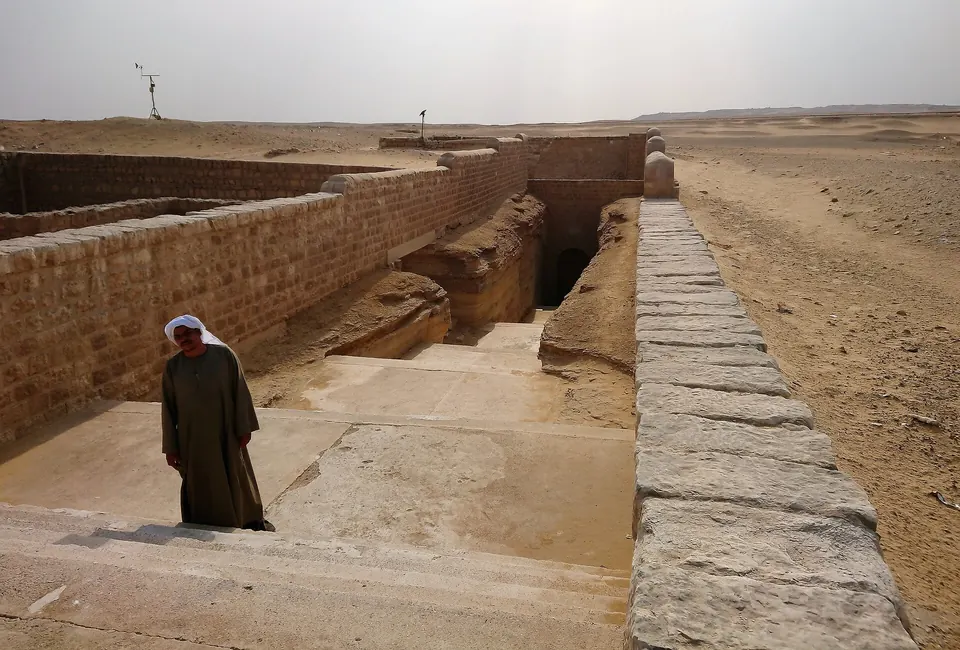
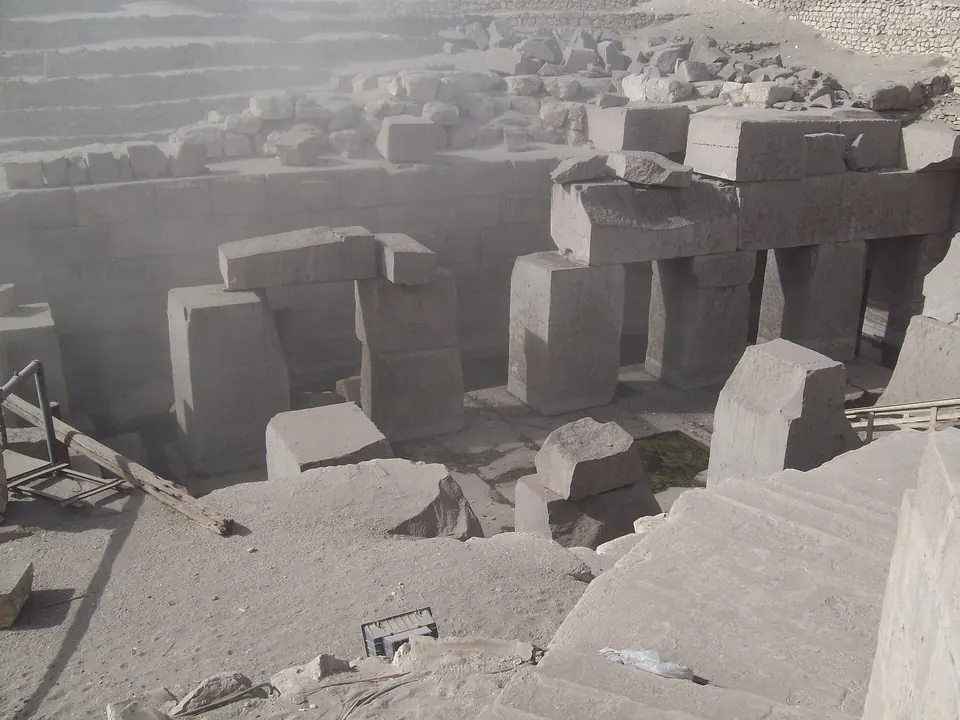
The Osireion

c. 1290–1203 BC (Seti I and Merneptah)Granite and sandstoneFound: Behind the Temple of Seti I, AbydosIn situ

A cenotaph, or symbolic tomb, of the god Osiris, built of massive granite pillars and now partly flooded by groundwater.

What it shows

Inscriptions of Seti I and his grandson Merneptah, and the excavators’ finds, date it to the 19th Dynasty.

Why it matters

Its rough-hewn, archaic style was a deliberate echo of the most ancient past, in keeping with Osiris’s role as a primeval god. Claims that it is far older are not supported by the excavation evidence.

Connects to the book

Sources & dating

Dates are approximate and follow the sources below.

Photo: isawnyu · CC BY 2.0 · source

Photo: isawnyu · CC BY 2.0 · source

EG-III.17

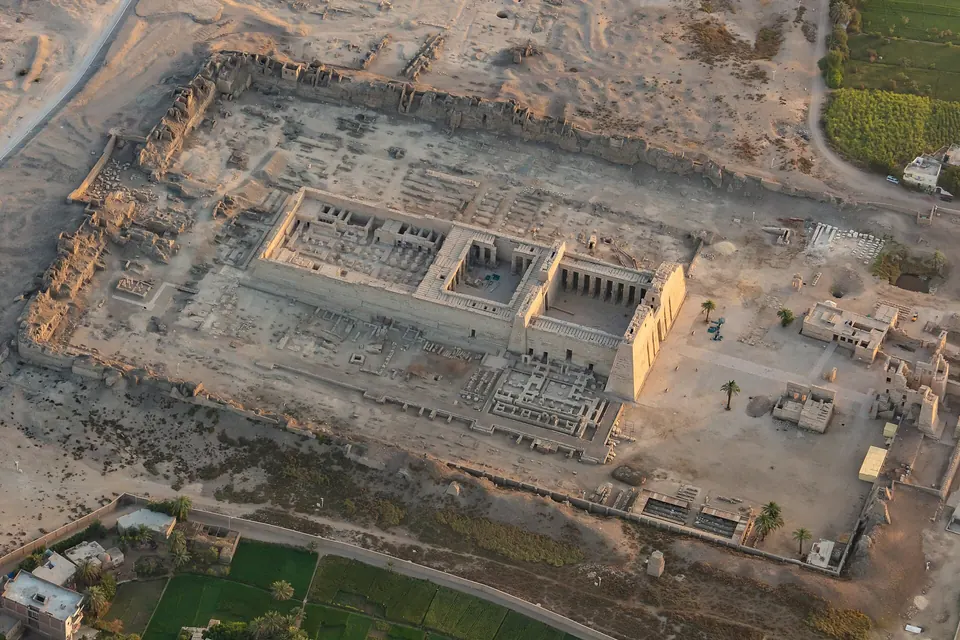
Medinet Habu

c. 1170 BC (reign of Ramesses III)SandstoneFound: West bank, LuxorIn situ

The mortuary temple of Ramesses III, one of the best preserved in Egypt.

What it shows

Reliefs of Ramesses III’s wars, including his battles against the “Sea Peoples”.

Why it matters

Its deep-cut reliefs keep much of their original colour, and its texts are a key source for the upheavals of around 1200 BC.

Connects to the book

Sources & dating

Dates are approximate and follow the sources below.

Photo: Diego Delso · CC BY-SA 4.0 · source
Photo: Diego Delso · CC BY-SA 4.0 · source
EG-III.18

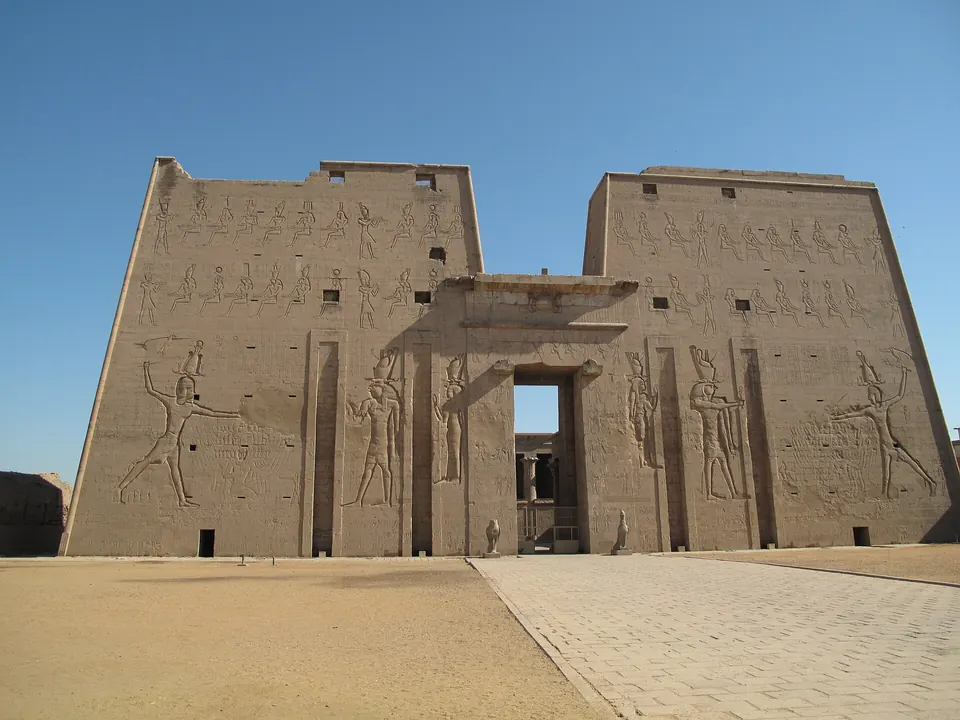
The Temple of Horus at Edfu

237–57 BC (Ptolemaic)SandstoneFound: Edfu, Upper EgyptIn situ

A temple of the falcon god Horus, begun under Ptolemy III and finished almost two centuries later.

What it shows

Walls covered with texts about the temple’s own building, its rituals and the myth of Horus.

Why it matters

It is one of the best-preserved temples of ancient Egypt.

Connects to the book

Sources & dating

Dates are approximate and follow the sources below.

Photo: Patrick.reb · CC BY-SA 3.0 · source
Photo: Patrick.reb · CC BY-SA 3.0 · source
EG-III.19

The Ramesseum

c. 1279–1213 BC (Ramesses II)Sandstone and graniteFound: West bank, LuxorIn situ

The mortuary temple of Ramesses II.

What it shows

The broken remains of a colossal granite statue of the king lie in its court.

Why it matters

Greek writers called it the tomb of “Ozymandias”, a form of Ramesses’ throne name; the ruins are often linked to Shelley’s poem of that name.

Connects to the book

Sources & dating

Dates are approximate and follow the sources below.

Photo: Steve F-E-Cameron · CC BY 3.0 · source
Photo: Steve F-E-Cameron · CC BY 3.0 · source
Hall IV · 18 objects

Vessels & Treasures

From painted pots made before the first king to the gold of Tutankhamun, objects show how people of the Nile lived, worked, believed and buried their dead.

EG-IV.01

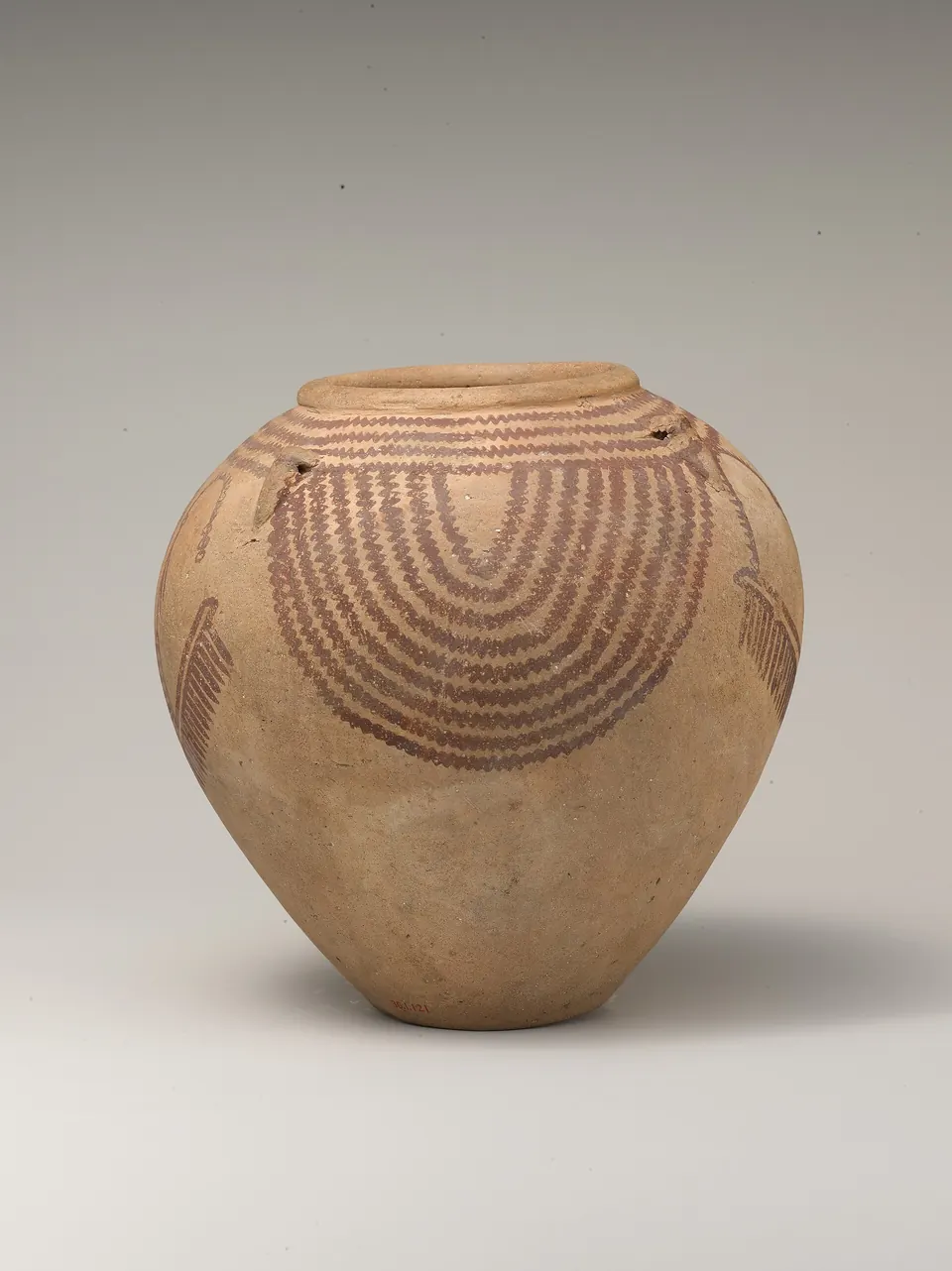
Painted jar with boats (Naqada II)

c. 3500–3300 BC (Predynastic)Painted potteryFound: Hierakonpolis (Nekhen), Fort Cemetery; Met excavations 1934–35The Metropolitan Museum of Art, New YorkInv. 36.1.121

A jar of the Naqada II culture, before the first kings, painted in red on a buff body.

What it shows

Many-oared boats with cabins, standards, and wavy lines for water.

Why it matters

Boats were central to life on the Nile and to later Egyptian religion; these jars show that world centuries before writing.

Connects to the book

Sources & dating

Dates are approximate and follow the sources below.

Photo: Unknown author · CC0 · source
Photo: Unknown author · CC0 · source
EG-IV.02

Early stone vessel

c. 3300–3100 BC (late Predynastic)StoneFound: EgyptThe Metropolitan Museum of Art, New YorkInv. 07.228.151

A jar carved and hollowed from stone, a prestige object made just before the first dynasties.

What it shows

The hieroglyph for “craft” shows the weighted drill used to hollow such vessels; tomb scenes show craftsmen drilling them by hand with abrasive sand.

Why it matters

Tens of thousands of stone vessels were stored beneath Djoser’s Step Pyramid. Their documented methods of manufacture leave no need for theories of lost technology.

Connects to the book

Sources & dating

Dates are approximate and follow the sources below.

Photo: Unknown author · CC0 · source
Photo: Unknown author · CC0 · source
EG-IV.03

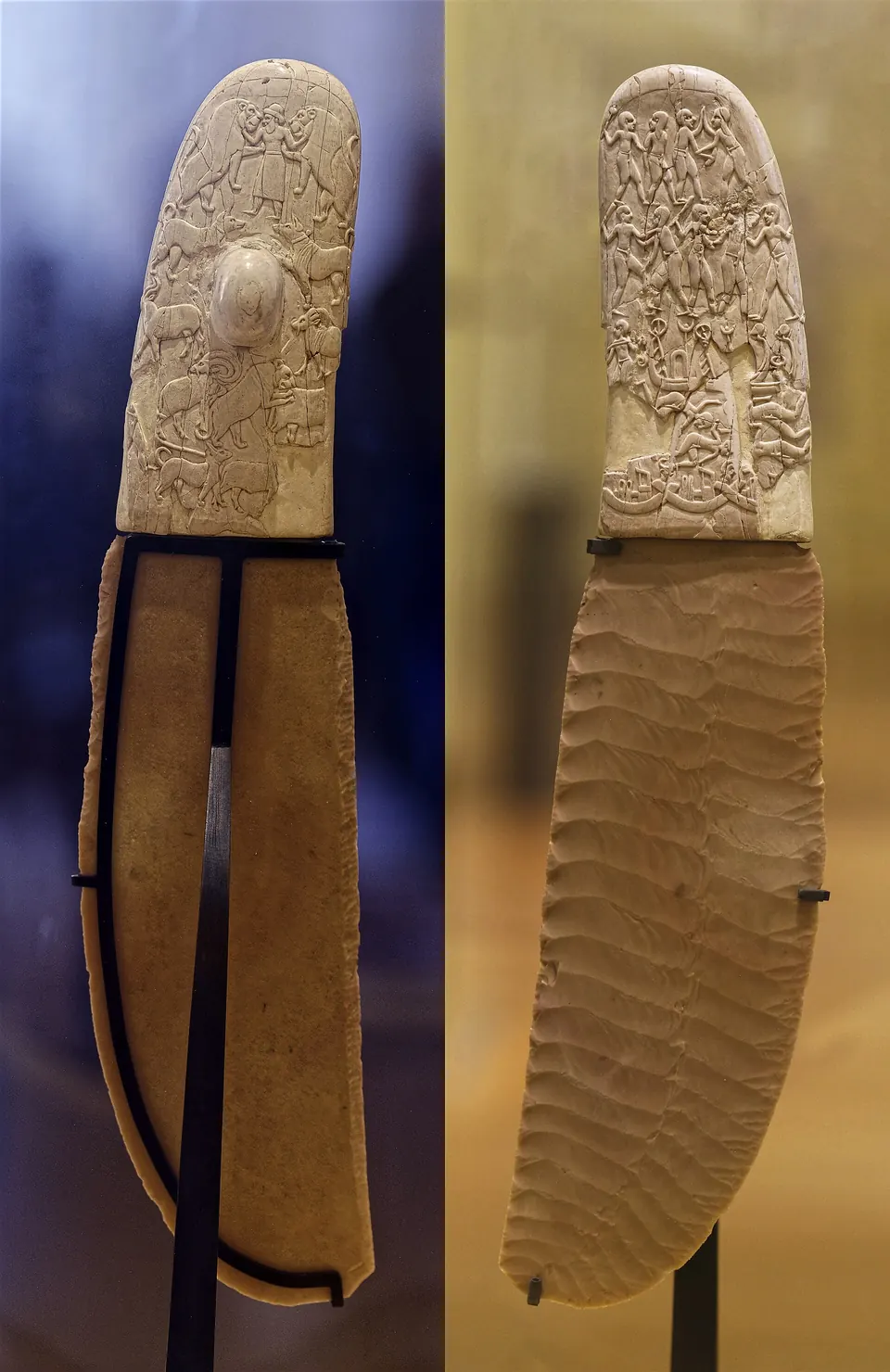
The Gebel el-Arak Knife

c. 3300–3200 BC (Naqada II)Flint blade; hippopotamus-ivory handleFound: Said to be from Gebel el-Arak, Upper EgyptMusée du Louvre, ParisInv. E 11517

A ceremonial knife with a ripple-flaked flint blade and a carved ivory handle.

What it shows

A battle on land and water on one side; on the other a man grasping two lions, a motif shared with Mesopotamian art.

Why it matters

It is evidence of contacts between Egypt and Mesopotamia before the first dynasties.
Connects to the book

Sources & dating

Dates are approximate and follow the sources below.

Photo: Shonagon · CC0 · source

Photo: Shonagon · CC0 · source

EG-IV.04

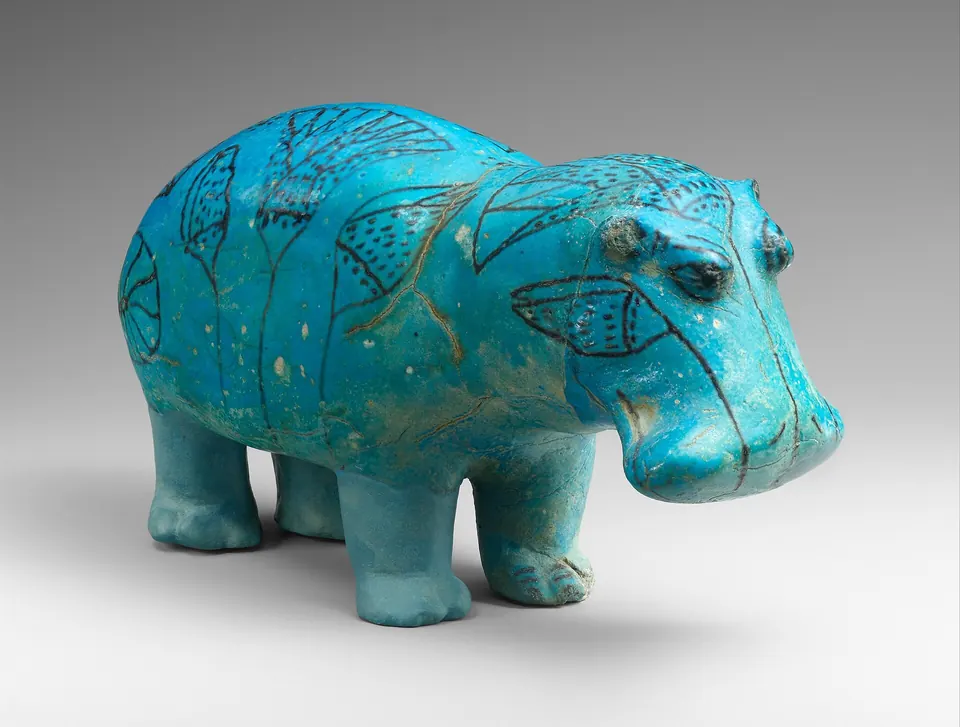
“William”, the faience hippopotamus

c. 1961–1878 BC (Middle Kingdom, 12th Dynasty)FaienceFound: Meir, tomb B3 of the nomarch Senbi II, shaft of the steward Senbi (Khashaba excavations, 1910)The Metropolitan Museum of Art, New YorkInv. 17.9.1

A blue faience figure of a hippopotamus, painted with the lotus and water plants of its marsh home.

What it shows

Three of its legs were broken on purpose, probably so the dangerous animal could not harm the dead.

Why it matters

Faience, a glazed quartz paste, was one of Egypt’s great inventions; “William” is the Met’s unofficial mascot.

Connects to the book

Sources & dating

Dates are approximate and follow the sources below.

Photo: anonymous · CC0 · source

Photo: anonymous · CC0 · source

EG-IV.05

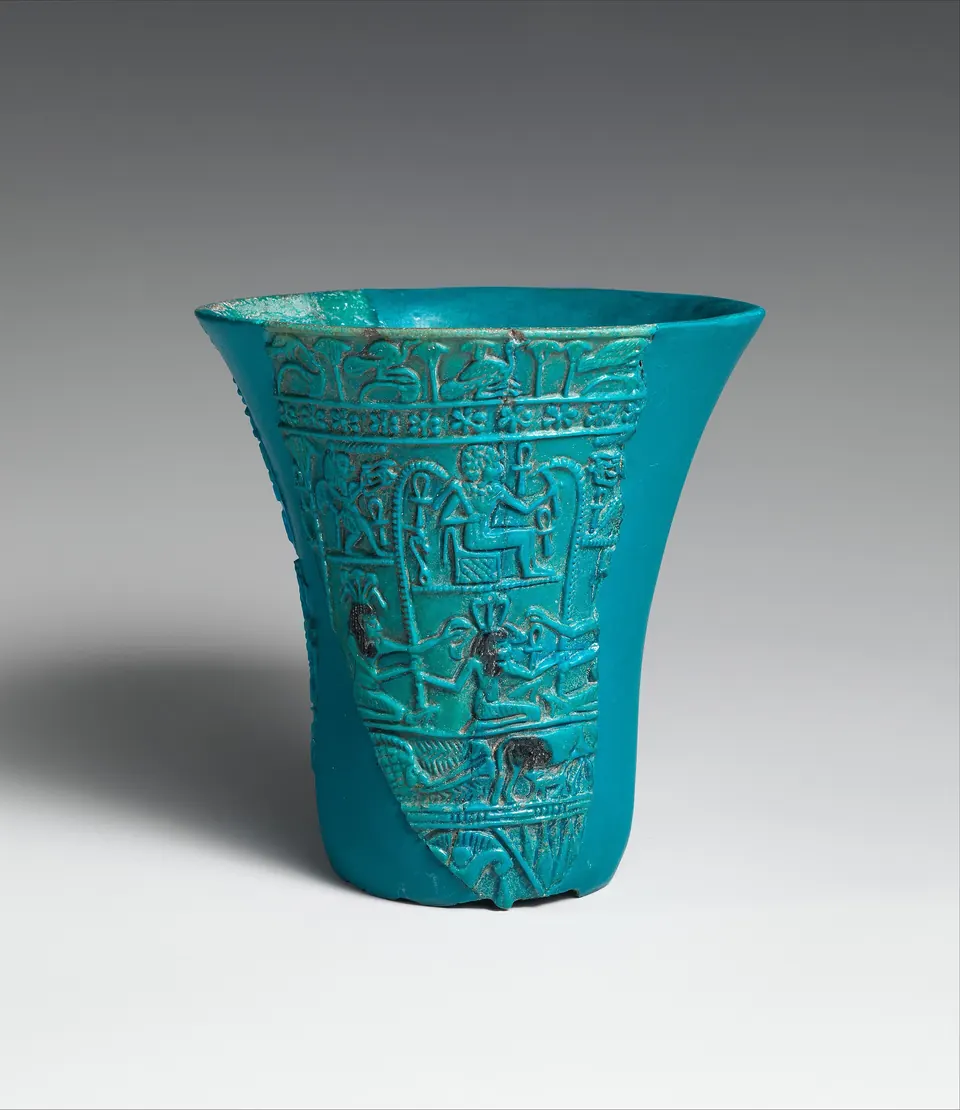
Lotus-shaped chalice (reconstructed from fragments)

c. 1080–664 BC (Third Intermediate Period or later)FaienceFound: ThebesThe Metropolitan Museum of Art, New YorkInv. 26.7.979

A drinking cup in the form of the blue water-lily (lotus), whose flower opens each morning.

What it shows

The petals are moulded in relief and glazed in turquoise blue.

Why it matters

The lotus was a symbol of rebirth: it closes at night and opens again at sunrise.

Connects to the book

Sources & dating

Dates are approximate and follow the sources below.

Photo: Unknown author · CC0 · source

Photo: Unknown author · CC0 · source

EG-IV.06

Canopic jars

Old Kingdom to PtolemaicStone or pottery (photo: travertine, 522–343 BC; scan: limestone)Found: EgyptThe Metropolitan Museum of Art, New York (photo: jar of Heriheb); Musée d’art et d’histoire, Geneva (3D scan)Inv. Met 21.5a (photo); MAHG D 499 (3D)

Four jars that held the embalmed lungs, liver, stomach and intestines of the dead.

What it shows

From the New Kingdom, the lids often show the four Sons of Horus: human-headed Imsety, baboon Hapy, jackal Duamutef, falcon Qebehsenuef. The 3D scan is a jackal-headed Duamutef jar.

Why it matters

They show the care of mummification, in which organs were preserved separately from the body.

Connects to the book

Sources & dating

Dates are approximate and follow the sources below.

Photo: Unknown author · CC0 · source

3D scan of the real object: Rama · CC BY-SA 3.0 fr · source

Photo: Unknown author · CC0 · source

EG-IV.07

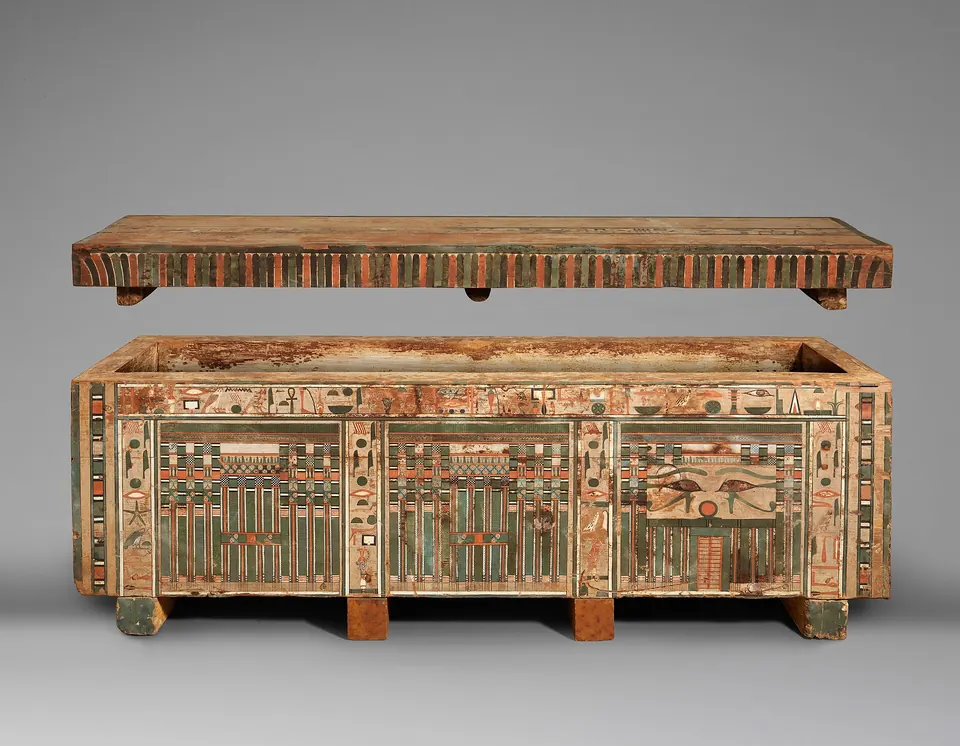
Coffin of Khnumhotep

c. 1981–1802 BC (Middle Kingdom, 12th Dynasty)Painted woodFound: Probably Meir (Khashaba excavations, 1910)The Metropolitan Museum of Art, New YorkInv. 12.182.131a, b

The box coffin of an estate manager named Khnumhotep.

What it shows

A pair of painted eyes on the side let the dead look out toward the rising sun; bands of hieroglyphs carry offering prayers.

Why it matters

Middle Kingdom coffins often carried the Coffin Texts, spells that bridge the Pyramid Texts and the Book of the Dead.

Connects to the book

Sources & dating

Dates are approximate and follow the sources below.

Photo: Unknown author · CC0 · source

Photo: Unknown author · CC0 · source

EG-IV.08

Shabti figures

c. 1290–1224 BC (19th Dynasty)Painted limestoneFound: Tomb of Sennedjem (TT 1), Deir el-Medina, Thebes (cleared 1885–86)The Metropolitan Museum of Art, New YorkInv. 86.1.18

Small figures placed in tombs to do the farm work the dead might be called to do in the afterlife.

What it shows

Many carry Spell 6 of the Book of the Dead: when called to labour, “here I am”, the figure answers. The figure shown was made for Khabekhnet and Iineferty, of the family of Sennedjem, and comes from his tomb (see Hall II).

Why it matters

Wealthy burials could hold hundreds — sometimes one for each day of the year with overseers.

Connects to the book

Sources & dating

Dates are approximate and follow the sources below.

Photo: Unknown author · CC0 · source

Photo: Unknown author · CC0 · source

EG-IV.09

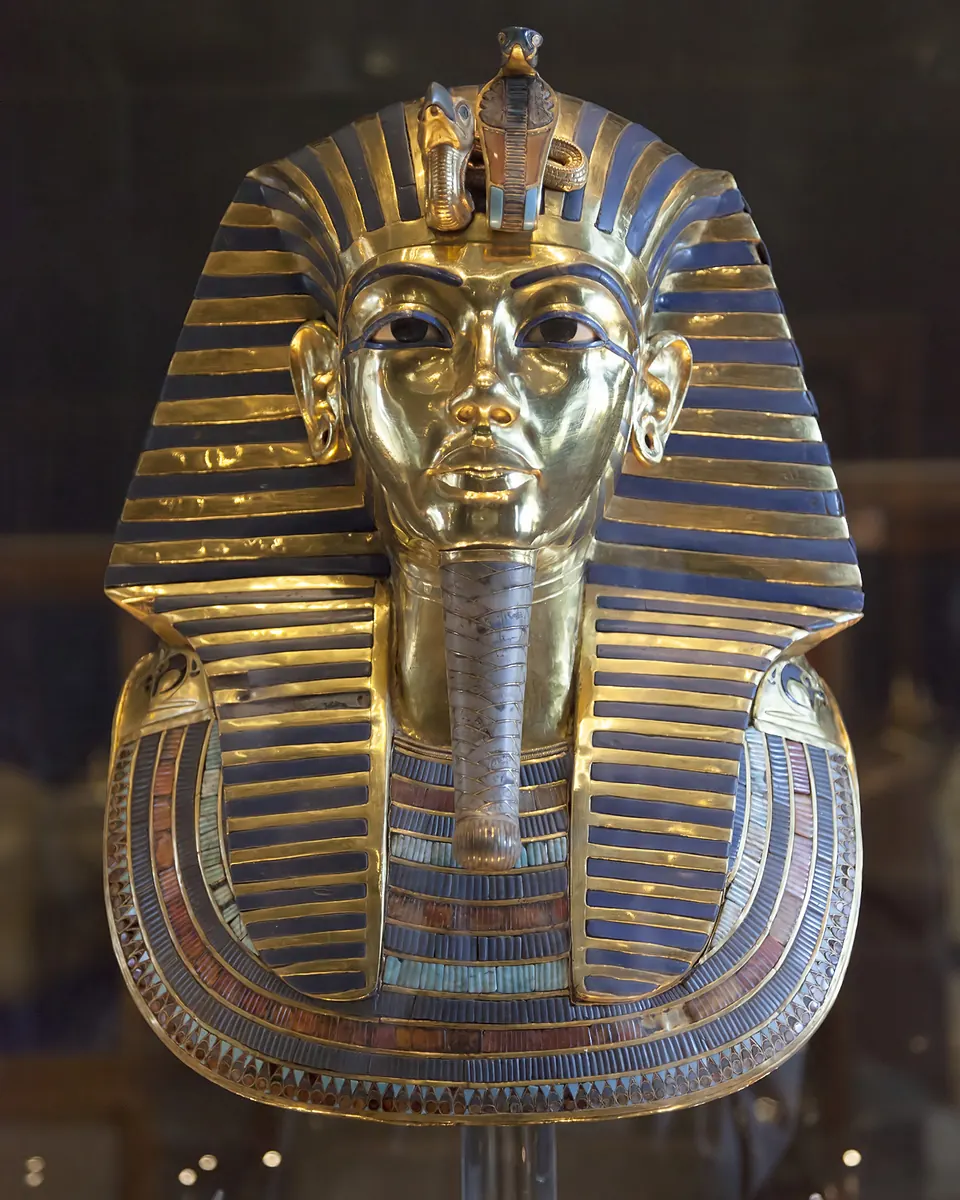
The gold mask of Tutankhamun

c. 1323 BC (18th Dynasty)Gold, glass, lapis lazuli, obsidian, carnelian, faience and quartzFound: Tomb KV62, Valley of the Kings (opened 1922)Grand Egyptian Museum, Giza (moved from the Egyptian Museum, Cairo, in October 2025; photo taken in Cairo, 2016)Inv. JE 60672; GEM 8

The funerary mask that covered the head of the mummy of Tutankhamun.

What it shows

More than 10 kilograms of gold inlaid with stones and glass; Spell 151 of the Book of the Dead is inscribed on its back.

Why it matters

It is among the most famous works of art in the world. Tutankhamun’s tomb was found largely intact by Howard Carter in November 1922.

Connects to the book

Sources & dating

Dates are approximate and follow the sources below.

Photo: Roland Unger · Public domain · source

Photo: Roland Unger · Public domain · source

EG-IV.10

Tutankhamun’s golden throne

c. 1330 BCWood covered in gold and silver, inlaid with glass and stonesFound: Tomb KV62Grand Egyptian Museum, Giza (Tutankhamun collection transferred in 2025; photos taken in the Egyptian Museum, Cairo)Inv. JE 62028

A gilded throne found in the antechamber of Tutankhamun’s tomb.

What it shows

On the back panel, Queen Ankhesenamun touches the king’s shoulder under the rays of the sun disc, the Aten.

Why it matters

The rays of the Aten and the original forms of the royal names reflect the Amarna period in which Tutankhamun grew up.

Connects to the book

Sources & dating

Dates are approximate and follow the sources below.

Photo: EditorfromMars · CC BY-SA 4.0 · source

Photo: Djehouty · CC BY-SA 4.0 · source

Photo: EditorfromMars · CC BY-SA 4.0 · source

EG-IV.11

The bust of Nefertiti

c. 1345 BC (Amarna period)Painted limestone and stuccoFound: Workshop of the sculptor Thutmose, Amarna (found 1912)Neues Museum, BerlinInv. ÄM 21300

A painted bust of Queen Nefertiti, wife of Akhenaten, found by the German excavation of Ludwig Borchardt in 1912.

What it shows

Her flat-topped blue crown, a broad collar and a calm, symmetrical face; the left eye was never inlaid.

Why it matters

It was probably a sculptor’s model. Egypt has asked for its return.

Connects to the book

Sources & dating

Dates are approximate and follow the sources below.

Photo: Ywpark2003 · CC0 · source

3D scan of the real object: Scan The World (MyMiniFactory) community scan; original sculpture attributed to the workshop of Thutmose, c. 1345 BC · CC0 · source

Photo: Ywpark2003 · CC0 · source

EG-IV.12

Khafre enthroned

c. 2558–2532 BC (4th Dynasty)GneissFound: Valley temple of Khafre, Giza (found 1860)Egyptian Museum, CairoInv. JE 10062 / CG 14

A seated statue of King Khafre, builder of the second pyramid at Giza, found by Auguste Mariette.

What it shows

The falcon god Horus spreads his wings behind the king’s head.

Why it matters

It is one of the masterpieces of Old Kingdom royal sculpture.

Connects to the book

Sources & dating

Dates are approximate and follow the sources below.

Photo: A. Parrot · CC0 · source

Photo: Djehouty · CC BY-SA 4.0 · source

Photo: A. Parrot · CC0 · source

EG-IV.13

Fayum mummy portrait

c. AD 120–130 (this portrait); the genre 1st–3rd century ADEncaustic (wax) paint on woodFound: Antinoöpolis (Antinoë), Middle Egypt; “Fayum portraits” is the name for the whole genreMusée du Louvre, Paris (portrait shown)Inv. MND 2047

Portraits painted on wood and bound over the faces of mummies in Roman-period Egypt.

What it shows

Real people of Egypt’s many-cultured society, painted with startling realism.

Why it matters

They are among the only bodies of painted portraiture to survive from the classical world.

Connects to the book

Sources & dating

Dates are approximate and follow the sources below.

Photo: Carole Raddato from FRANKFURT, Germany · CC BY-SA 2.0 · source

Photo: Carole Raddato from FRANKFURT, Germany · CC BY-SA 2.0 · source

EG-IV.14

Heart Scarab of Manhata

ca. 1479–1425 BCEGold, green schistFound: Wadi Gabbanat el-Qurud, Wadi D, Upper Egypt, Thebes, Egypt (Tomb of the Three Foreign Wives of Thutmose III)The Metropolitan Museum of Art, New YorkInv. Met 26.8.144

Heart Scarab of Manhata: gold, green schist, dated ca. 1479–1425 BCE in the museum’s record.

What it shows

The Met catalogues it as New Kingdom, Dynasty 18, reign of Thutmose III; place in the record: Wadi Gabbanat el-Qurud, Wadi D, Upper Egypt, Thebes, Egypt (Tomb of the Three Foreign Wives of Thutmose III). Size: L. 5.6 cm (2 3/16 in); W. 3.8 cm (1 1/2 in); Th. 1.9 cm (3/4 in); L. wire and scarab 32.6 cm (12 13/16 in). Fletcher Fund, 1919.

Why it matters

A heart scarab, inscribed with the spell that asks the heart not to testify against its owner at judgement.

Connects to the book

Sources & dating

Dates are approximate and follow the sources below. Evidence status: CONFIRMED

Photo: The Metropolitan Museum of Art · CC0 (The Met Open Access) · source

Photo: The Metropolitan Museum of Art · CC0 (The Met Open Access) · source

EG-IV.15

Cartouche Plaque of Hatshepsut

ca. 1473–1458 BCEFaienceFound: possibly Deir el-Bahri, Upper Egypt, ThebesThe Metropolitan Museum of Art, New YorkInv. Met 89.2.409

Cartouche Plaque of Hatshepsut: faience, dated ca. 1473–1458 BCE in the museum’s record.

What it shows

The Met catalogues it as New Kingdom, Dynasty 18, Joint reign of Hatshepsut and Thutmose III; place in the record: possibly Deir el-Bahri, Upper Egypt, Thebes. Size: L. 2.8 × W. 1.7 × D. 0.7 cm (1 1/8 × 11/16 × 1/4 in.). Gift of Joseph W. Drexel, 1889.

Why it matters

Hatshepsut’s name in a cartouche on a faience plaque.

Connects to the book

Sources & dating

Dates are approximate and follow the sources below. Evidence status: CONFIRMED

Photo: The Metropolitan Museum of Art · CC0 (The Met Open Access) · source

Photo: The Metropolitan Museum of Art · CC0 (The Met Open Access) · source

EG-IV.16

Cartouche of Amenhotep III

ca. 1386–1347 BCEFaienceFound: West Valley of the Kings, Upper Egypt, Thebes, Egypt (Carnarvon/Carter excavations, 1915, Tomb of Amenhotep III (WV 22))The Metropolitan Museum of Art, New YorkInv. Met 26.7.1087

Cartouche of Amenhotep III: faience, dated ca. 1386–1347 BCE in the museum’s record.

What it shows

The Met catalogues it as New Kingdom, Dynasty 18, reign of Amenhotep III; place in the record: West Valley of the Kings, Upper Egypt, Thebes, Egypt (Carnarvon/Carter excavations, 1915, Tomb of Amenhotep III (WV 22)). Size: H. 2.3 × W. 1.1 × Th. 0.2 cm (7/8 in. × 7/16 in. × 1/16 in.). Purchase, Edward S. Harkness Gift, 1926.

Why it matters

Amenhotep III’s name in a cartouche, the oval ring that marks a royal name.

Connects to the book

Sources & dating

Dates are approximate and follow the sources below. Evidence status: CONFIRMED

Photo: The Metropolitan Museum of Art · CC0 (The Met Open Access) · source

Photo: The Metropolitan Museum of Art · CC0 (The Met Open Access) · source

EG-IV.17

Scarab with Hieroglyphs

ca. 1850–1640 B.C.Bright blue glazed steatiteFound: Lisht North, Memphite Region, Egypt (MMA excavations, 1920–22, Cemetery, debris)The Metropolitan Museum of Art, New YorkInv. Met 22.1.362

Scarab with Hieroglyphs: bright blue glazed steatite, dated ca. 1850–1640 B.C. in the museum’s record.

What it shows

The Met catalogues it as Middle Kingdom, late Dynasty 12–13; place in the record: Lisht North, Memphite Region, Egypt (MMA excavations, 1920–22, Cemetery, debris). Size: L. 1.6 × W. 1.1 × H. 0.7 cm (5/8 × 7/16 × 1/4 in.). Rogers Fund and Edward S. Harkness Gift, 1922.

Why it matters

A scarab inscribed with hieroglyphs, used as a seal and an amulet.

Connects to the book

Sources & dating

Dates are approximate and follow the sources below. Evidence status: CONFIRMED

Photo: The Metropolitan Museum of Art · CC0 (The Met Open Access) · source

Photo: The Metropolitan Museum of Art · CC0 (The Met Open Access) · source

EG-IV.18

Model of a Scribe's Palette Inscribed for Amenhotep

ca. 1386–1347 BCETravertine (Egyptian alabaster)Found: Saqqqara, Memphite AreaThe Metropolitan Museum of Art, New YorkInv. Met 37.2.1

Model of a Scribe's Palette Inscribed for Amenhotep: travertine (egyptian alabaster), dated ca. 1386–1347 BCE in the museum’s record.

What it shows

The Met catalogues it as New Kingdom, Dynasty 18, reign of Amenhotep III; place in the record: Saqqqara, Memphite Area. Size: L. 44.5 cm (17 1/2 in); w. 8 cm (3 1/8 in). Rogers Fund, 1937.

Why it matters

A stone model of a scribe’s palette inscribed with a name, for a burial.

Connects to the book

Sources & dating

Dates are approximate and follow the sources below. Evidence status: CONFIRMED

Photo: The Metropolitan Museum of Art · CC0 (The Met Open Access) · source

Photo: The Metropolitan Museum of Art · CC0 (The Met Open Access) · source

Hall V · 13 objects

The Sculpture Court

Walk around the statue. Every object in this court is a real three-dimensional scan, shared under an open licence by the museum or photographer named on its label. Drag to turn it, pinch or scroll to zoom.

EG-V.01

Mask of Thuya

c. 1390 BC (18th Dynasty)Gilded cartonnageFound: Tomb of Yuya and Thuya, KV46 (found 1905)Egyptian Museum, Cairo (where the scan was recorded, May 2026)

The gilded mummy mask of Thuya, mother of Queen Tiye and grandmother of Akhenaten.

What it shows

A textured photogrammetry scan (ArchaeoArchive AA-006): the colour comes from photographs taken in the gallery, so glass reflections and lighting can tint it. The scale has not been checked against a measurement.

Why it matters

The tomb of Yuya and Thuya was one of the richest found in the Valley of the Kings before Tutankhamun’s.

Connects to the book

Sources & dating

Dates are approximate and follow the sources below. Evidence status: CONFIRMED

3D scan of the real object: Omar Atabany (OmarElAtabany). Mask of Thuya (AA-006). ArchaeoArchive · CC BY 4.0 · source

3D scan of the real object: Omar Atabany (OmarElAtabany). Mask of Thuya (AA-006). ArchaeoArchive · CC BY 4.0 · source

EG-V.02

The Colossus of Ramesses II at Memphis

c. 1279–1213 BCLimestoneFound: Memphis (Mit Rahina)Open-air museum, Mit Rahina

A colossal limestone statue of Ramesses II, about 10 metres long even with its legs broken, lying in its own museum hall at Memphis.

What it shows

Walk around it: the cartouches with the king’s names are carved on his shoulder, chest and belt.

Why it matters

Memphis was the capital of Egypt for much of its history — the city the Bible calls Noph.

Connects to the book

Sources & dating

Dates are approximate and follow the sources below.

3D scan of the real object: Dejp3 · CC BY 4.0 · source

3D scan of the real object: Dejp3 · CC BY 4.0 · source

EG-V.03

Statue of a scribe holding a papyrus

New Kingdom (the gallery label, as photographed, is partly blurred)Diorite, per the gallery label (unverified)Found: Karnak (per the scan record)National Museum of Egyptian Civilization, Cairo (per the scan record)

A statue of a scribe named Hapi associated with Karnak, according to the scan’s published record of the gallery label.

What it shows

The scribe sits holding an unrolled papyrus.

Why it matters

Scribes were often shown with the tools of their office; this is the Scribes’ Hall made solid.

Connects to the book

Sources & dating

Dates are approximate and follow the sources below. Evidence status: NOTED

3D scan of the real object: Omar Atabany (OmarElAtabany). Hapi the Scribe (AA-010). ArchaeoArchive · CC BY 4.0 · source

3D scan of the real object: Omar Atabany (OmarElAtabany). Hapi the Scribe (AA-010). ArchaeoArchive · CC BY 4.0 · source

EG-V.04

Statue of Amun-Re

New Kingdom, 18th Dynasty (per the gallery label)DioriteFound: Karnak (per scan record)National Museum of Egyptian Civilization, Cairo (per the scan record)

A statue of Amun-Re, king of the gods, chief god of Thebes.

What it shows

The god wears his crown with two tall plumes.

Why it matters

Amun was also the great god of Kush: the Kushite kings worshipped him at Jebel Barkal and called it his “Pure Mountain”.

Connects to the book

Sources & dating

Dates are approximate and follow the sources below. Evidence status: NOTED

3D scan of the real object: Omar Atabany (OmarElAtabany). Amun-Ra, King of the Gods (AA-007). ArchaeoArchive · CC BY 4.0 · source

3D scan of the real object: Omar Atabany (OmarElAtabany). Amun-Ra, King of the Gods (AA-007). ArchaeoArchive · CC BY 4.0 · source

EG-V.05

Statue of Khonsu

New Kingdom (the museum label attributes it to Tutankhamun’s reign from the face)GraniteFound: Temple of Khonsu, Karnak (per scan record)National Museum of Egyptian Civilization, Cairo (per the scan record)

A statue of the moon god Khonsu, son of Amun and Mut in the Theban triad.

What it shows

He is shown as a young god holding the crook and flail.

Why it matters

The museum label dates the statue to Tutankhamun’s reign because the face resembles his; that is a stylistic attribution, not an inscription.

Connects to the book

Sources & dating

Dates are approximate and follow the sources below. Evidence status: NOTED

3D scan of the real object: Omar Atabany (OmarElAtabany). Khonsu (AA-011). ArchaeoArchive · CC BY 4.0 · source

3D scan of the real object: Omar Atabany (OmarElAtabany). Khonsu (AA-011). ArchaeoArchive · CC BY 4.0 · source

EG-V.06

Seated statue of Thutmose III

18th Dynasty (label range 1550–1295 BC); reign of Thutmose III c. 1479–1425 BCBlack graniteFound: Karnak (per scan record)National Museum of Egyptian Civilization, Cairo (per the scan record)

A seated statue of Thutmose III, the warrior king who led many campaigns into the Levant.

What it shows

The king wears the royal headcloth (nemes).

Why it matters

Thutmose III also built in Nubia; the first great temple of Amun at Jebel Barkal dates to his reign.

Connects to the book

Sources & dating

Dates are approximate and follow the sources below. Evidence status: NOTED

3D scan of the real object: Omar Atabany (OmarElAtabany). King Thutmose III (AA-012). ArchaeoArchive · CC BY 4.0 · source

3D scan of the real object: Omar Atabany (OmarElAtabany). King Thutmose III (AA-012). ArchaeoArchive · CC BY 4.0 · source

EG-V.07

Statue of Re-Horakhty

New Kingdom, 19th Dynasty (per the gallery label)GranodioriteFound: San el-Hagar (Tanis), per the scan recordNational Museum of Egyptian Civilization, Cairo (per the scan record)

A statue of Re-Horakhty, the falcon-headed sun god (“Re, Horus of the Two Horizons”).

What it shows

The falcon head and the sun disc of the sun god.

Why it matters

He embodies the rising sun, a constant image in Egyptian temples and tombs.

Connects to the book

Sources & dating

Dates are approximate and follow the sources below. Evidence status: NOTED

3D scan of the real object: Omar Atabany (OmarElAtabany). Ra-Horakhty (AA-016). ArchaeoArchive · CC BY 4.0 · source

3D scan of the real object: Omar Atabany (OmarElAtabany). Ra-Horakhty (AA-016). ArchaeoArchive · CC BY 4.0 · source

EG-V.08

Statue of Pen-Menkh, governor of Dendera

1st century BC (time of Cleopatra VII and the Roman conquest, per the gallery label)Granite and sandstone (per the gallery label)Found: Dendera (per scan record)National Museum of Egyptian Civilization, Cairo (per the scan record)

A standing statue of Pen-Menkh, a governor and priest at Dendera in the time of Cleopatra VII.

What it shows

A late Egyptian official in the traditional striding pose with a back pillar.

Why it matters

The old style of Egyptian sculpture continued under Greek and Roman rule.

Connects to the book

Sources & dating

Dates are approximate and follow the sources below. Evidence status: NOTED

3D scan of the real object: Omar Atabany (OmarElAtabany). Pen-Menkh, the Governor of Dendara (AA-015). ArchaeoArchive · CC BY 4.0 · source

3D scan of the real object: Omar Atabany (OmarElAtabany). Pen-Menkh, the Governor of Dendara (AA-015). ArchaeoArchive · CC BY 4.0 · source

EG-V.09

Sekhmet

c. 1390–1352 BC (reign of Amenhotep III), per the collection recordGranodioriteFound: Precinct of Mut, Karnak (Thebes)Musée d’art et d’histoire, GenevaInv. MAHG 20926

A statue of Sekhmet, the lion-headed goddess of war and healing.

What it shows

The lioness head crowned with a sun disc.

Why it matters

Hundreds of Sekhmet statues were set up in Thebes by Amenhotep III.

Connects to the book

Sources & dating

Dates are approximate and follow the sources below.

3D scan of the real object: Rama · CC BY-SA 3.0 fr · source

3D scan of the real object: Rama · CC BY-SA 3.0 fr · source

EG-V.10

Priest Hor (Neferibre-men) carrying Osiris

c. 6th century BC (26th Dynasty)GreywackeFound: ThebesMusée d’art et d’histoire, GenevaInv. Eg 9

A statue of a priest named Hor holding a figure of the god Osiris before him.

What it shows

The priest presents the god, a classic pose of devotion.

Why it matters

Statues like this placed the owner forever in the temple, near the god.

Connects to the book

Sources & dating

Dates are approximate and follow the sources below.

3D scan of the real object: Rama · CC BY-SA 3.0 fr · source

3D scan of the real object: Rama · CC BY-SA 3.0 fr · source

EG-V.11

Ibis coffin

Late Period – PtolemaicWood, plaster, bronze and goldFound: Hermopolis, city of ThothMusée d’art et d’histoire, GenevaInv. MAHG 20148

A container for a mummified ibis, sacred to Thoth, god of writing and wisdom.

What it shows

The bird in profile with its long curved beak.

Why it matters

Thoth was the patron of scribes; millions of ibis mummies were dedicated to him.

Connects to the book

Sources & dating

Dates are approximate and follow the sources below.

3D scan of the real object: Rama · CC BY-SA 3.0 fr · source

3D scan of the real object: Rama · CC BY-SA 3.0 fr · source

EG-V.12

Corn mummy

Late Period – PtolemaicGrain and earth in a mummy-shaped case, with a silver maskFound: EgyptMałopolska Virtual Museums (scan)

A small figure of Osiris made of grain and earth, wrapped like a mummy and placed in a falcon-headed coffin.

What it shows

The open coffin and its Osiris figure.

Why it matters

As the grain sprouted, it symbolised Osiris rising from death — a hope for new life.

Connects to the book

Sources & dating

Dates are approximate and follow the sources below.

3D scan of the real object: RDW MIC, Małopolska’s Virtual Museums project · CC0 · source

3D scan of the real object: RDW MIC, Małopolska’s Virtual Museums project · CC0 · source

EG-V.13

Funerary mask

Roman period, c. 2nd–3rd century AD (per collection record)Stucco (plaster)Found: EgyptMusée d’art et d’histoire, GenevaInv. MAHG 7059

A funerary mask that once covered the face of a mummy.

What it shows

A calm, idealised face with wide eyes.

Why it matters

The mask gave the dead a perfected, eternal face.

Connects to the book

Sources & dating

Dates are approximate and follow the sources below.

3D scan of the real object: Rama · CC BY-SA 3.0 fr · source

3D scan of the real object: Rama · CC BY-SA 3.0 fr · source

Hall VI · Timeline of discovery

The Discoverers

How the world rediscovered ancient Egypt: soldiers, scholars, quarrymen and excavators, from the Rosetta Stone in 1799 to the papyri of Wadi al-Jarf.

  1. 1799

    French soldiers find the Rosetta Stone at Rashid.

  2. 1822

    Champollion’s Lettre à M. Dacier sets out the sound values of hieroglyphs.

  3. 1850–51

    Auguste Mariette rediscovers the Serapeum of Saqqara; the Seated Scribe is found nearby in 1850.

  4. 1860

    Mariette’s workers find the statue of Khafre in the valley temple at Giza.

  5. 1862

    Edwin Smith buys the surgical papyrus at Luxor.

  6. 1873–74

    Georg Ebers acquires the medical papyrus that bears his name.

  7. 1881

    The royal mummies of the Deir el-Bahari cache (TT320) are brought to Cairo.

  8. 1896

    Flinders Petrie finds the Merneptah Stele at Thebes.

  9. 1897–98

    Quibell and Green find the Narmer Palette at Hierakonpolis.

  10. 1905

    The tomb of Yuya and Thuya (KV46) is opened.

  11. 1912

    Borchardt’s team finds the bust of Nefertiti at Amarna.

  12. 1922

    Howard Carter finds the tomb of Tutankhamun (KV62).

  13. 1954

    Khufu’s dismantled cedar boat is found in a pit beside the Great Pyramid.

  14. 1964–68

    Abu Simbel is cut into blocks and rebuilt above the rising waters.

  15. 1977–80

    The temples of Philae are moved to Agilkia Island.

  16. 1990s

    John and Deborah Darnell record the early alphabetic inscriptions of Wadi el-Hol.

  17. 2013

    Pierre Tallet’s team finds the papyri of Merer at Wadi al-Jarf — the oldest inscribed papyri known, from Khufu’s reign.

Take it home

The book these galleries support, free to read online or download.

Keep exploring

Learn to read hieroglyphs with the guided tours, or step into the 3D halls.

Image & 3D credits

All photographs are self-hosted copies of openly licensed or public-domain files from Wikimedia Commons, resized to WebP. Follow each “source” link for the original file and full licence. Full list: credits.json.

Atrium photograph — Photo: KennyOMG · CC BY-SA 4.0 · source

  1. 240911_CvZ-Palermo-stone.jpg — CvZ, CC BY-SA 4.0 · source
  2. A_page_from_the_Ebers_Papyrus,_written_circa_1500_B.C._Wellcome_M0008455.jpg — Unknown author, CC BY 4.0 · source
  3. Abu Simbel, façade of the Great Temple (6201194723).jpg — Arian Zwegers from Brussels, Belgium, CC BY 2.0 · source
  4. BD_Weighing_of_the_Heart.jpg — Photographed by the British Museum; original artist unknown, Public domain · source
  5. Ba`alat.jpg — unknown Uploaded by Kwamikagami at en.wikipedia, Public domain · source
  6. Bent_Pyramid_曲折金字塔_-_panoramio.jpg — lienyuan lee, CC BY 3.0 · source
  7. By ovedc - Egyptian Museum (Cairo) - 020.jpg — Ovedc, CC BY-SA 4.0 · source
  8. By ovedc - Egyptian Museum (Cairo) - 022.jpg — Ovedc, CC BY-SA 4.0 · source
  9. CairoEgMuseumTaaMaskMostlyPhotographed.jpg — Roland Unger, Public domain · source
  10. Canopic jar of Heriheb MET 21.5ab front.jpg — Unknown author, CC0 · source
  11. Closeup of the Merenptah Stele, mentioning ysrỉꜣr ("Israel").jpg — Darer101, CC BY-SA 4.0 · source
  12. Coffin and Mummy of the Estate Manager Khnumhotep MET DP342608.jpg — Unknown author, CC0 · source
  13. Colossi_of_Memnon_May_2015_2.JPG — MusikAnimal, CC BY-SA 4.0 · source
  14. Couteau_de_Gebel_el-Arak_-_Musée_du_Louvre_Antiquités_égyptiennes_E_11517_-_recto_verso.jpg — Shonagon, CC0 · source
  15. Decorated ware jar depicting boats MET DP248671.jpg — Unknown author, CC0 · source
  16. Deir_el-Medina-08-Grab_1-Sennedjem-18.-20.Dyn-1982-gje.jpg — Gerd Eichmann, CC BY-SA 4.0 · source
  17. Demotic ostracon with a 'temple oath', clay - Museo Egizio (Turin) S 12685 p01.jpg — Unknown author, CC0 · source
  18. Edwin_Smith_Papyrus_v2.jpg — Jeff Dahl, Public domain · source
  19. Funerary stela of Christopher, in Coptic, sandstone - Museo Egizio, Turin S 18158 p01.jpg — Unknown author, CC0 · source
  20. Great_Pyramid_of_Giza_-_Pyramid_of_Khufu.jpg — Douwe C. van der Zee, CC BY-SA 4.0 · source
  21. Great_Sphinx_with_Stelae.jpg — Chanel Wheeler, CC BY-SA 2.0 · source
  22. Hieratic Ostracon with the beginning of "The Wisdom of Amenemope" MET LC-26 3 165 EGDP027774.jpg — Unknown author, CC0 · source
  23. Il_cosiddetto_'Papiro_dei_Re_o_Liste_dei_Re'_2_C1874vs_3.tif — Unknown author, CC0 · source
  24. Incense trees transport. Punt relief. Mortuary Temple of Hatshepsut, Deir el-Bahari.jpg — Ismoon (talk) 22:02, 2 March 2020 (UTC), CC BY-SA 4.0 · source
  25. Jean-François Champollion, by Léon Cogniet.jpg — Léon Cogniet, Public domain · source
  26. KV17,_the_tomb_of_Pharaoh_Seti_I_of_the_Nineteenth_Dynasty,_Valley_of_the_Kings,_Egypt_(49846343021).jpg — Carole Raddato from Frankfurt, Germany, CC BY-SA 2.0 · source
  27. Karnak Tempel Obelisk Hatshepsut 09.jpg — Olaf Tausch, CC BY 3.0 · source
  28. Khafre Enthroned, near-front view.JPG — A. Parrot, CC0 · source
  29. King List of the Seti I Temple at Abydos (I).jpg — isawnyu, CC BY 2.0 · source
  30. Le_Scribe_accroupi_-_Musée_du_Louvre_Antiquités_égyptiennes_E_3023.jpg — Shonagon, CC0 · source
  31. Lettre à M. Dacier (1822).jpg — Librairie Firmin Didot, Public domain · source
  32. Luxor Temple Pylon of Rameses II and Obelisk (9794848586).jpg — Gary Todd from Xinzheng, China, CC0 · source
  33. Luxor, Egypt, Karnak, Great Hypostyle Hall.jpg — Vyacheslav Argenberg, CC BY 4.0 · source
  34. Mastaba of Ti 06.JPG — Einsamer Schütze, CC BY-SA 3.0 · source
  35. Merneptah_Steli_(cropped).jpg — 𐰇𐱅𐰚𐰤, CC BY-SA 4.0 · source
  36. Nefertiti Bust Neues Museum Berlin.jpg — Ywpark2003, CC0 · source
  37. Obelisco_inacabado,_Asuán,_Egipto,_2022-04-01,_DD_153.jpg — Diego Delso, CC BY-SA 4.0 · source
  38. Osireion at Abydos (I).jpg — isawnyu, CC BY 2.0 · source
  39. Papyrus Berlin 3033 (columns VI-IX) (recto).tif — Unknown author, CC BY-SA 4.0 · source
  40. Portrait of a woman, known as "L'Européenne", AD 120-130, from Antinoöpolis (Antinoë), Egypt, Louvre Museum (21978934493).jpg — Carole Raddato from FRANKFURT, Germany, CC BY-SA 2.0 · source
  41. Pyramid Texts in Unas’ Pyramid 2017.jpg — Aidan McRae Thomson, CC BY-SA 2.0 · source
  42. Pyramids_of_the_Giza_Necropolis.jpg — KennyOMG, CC BY-SA 4.0 · source
  43. Reconstructed lotiform chalice MET DP325053.jpg — Unknown author, CC0 · source
  44. Respaldo del trono de oro de Tutankamón.jpg — Djehouty, CC BY-SA 4.0 · source
  45. Rhind_Mathematical_Papyrus.jpg — unknown (c. 2000 B.C), Public domain · source
  46. Rosetta Stone.JPG — Hans Hillewaert, CC BY-SA 4.0 · source
  47. Rote_Pyramide_(Dahschur)_04.jpg — Olaf Tausch, CC BY 3.0 · source
  48. SFEC_AEH_-ThebesNecropolis-2010-RamsesII-021.jpg — Steve F-E-Cameron, CC BY 3.0 · source
  49. Saqqara, Pyramid of Djoser, Ancient Egypt.jpg — Vyacheslav Argenberg, CC BY 4.0 · source
  50. Scribe's Palette MET DP307883.jpg — Unknown author, CC0 · source
  51. Serabit sphinx (EA41748).png — Onceinawhile, CC BY-SA 4.0 · source
  52. Serapeum_gate.jpg — Happa, CC BY 3.0 · source
  53. Shabaka_Stone_at_the_British_Museum.jpg — Sanjay ach, CC BY-SA 4.0 · source
  54. Shabti_of_Khabekhnet_and_Iineferty_MET_DT202025.jpg — Unknown author, CC0 · source
  55. Shoshenq I by Rosellini.jpg — Ippolito Rosellini (1800-1843), Public domain · source
  56. Sphinx_with_the_third_pyramid.jpg — Hesham Ebaid, CC0 · source
  57. Squat lugged stone vessel MET 2872.jpg — Unknown author, CC0 · source
  58. Standing Hippopotamus MET DP248993.jpg — anonymous, CC0 · source
  59. Temple of Seti I, Hieroglyphs art of Ancient Egypt, Abydos, Egypt.jpg — Vyacheslav Argenberg, CC BY 4.0 · source
  60. Temple_Edfou_Egypte.jpg — Patrick.reb, CC BY-SA 3.0 · source
  61. Templo de Ramsés II, Abu Simbel, Egipto, 2022-04-02, DD 74-76 HDR.jpg — Diego Delso, CC BY-SA 4.0 · source
  62. Templo_funerario_de_Hatshepsut,_Luxor,_Egipto,_2022-04-03,_DD_13.jpg — Diego Delso, CC BY-SA 4.0 · source
  63. Templo_funerario_de_Ramsés_III,_Luxor,_Egipto,_2022-04-03,_DD_22.jpg — Diego Delso, CC BY-SA 4.0 · source
  64. The Temple of Isis from Philae, First pylon, Lake Nasser, Egypt.jpg — Vyacheslav Argenberg, CC BY 4.0 · source
  65. Théodule Devéria (French - (Close-up View of Hieroglyphic Inscriptions and Sculptures (List of the Defeated Nations), Karnak) - Google Art Project (6800731).jpg — Théodule Devéria (French, 1831 - 1871) (1831 - 1871) – photographer (French) Det, Public domain · source
  66. TombofNebamun-2.jpg — Unknown author, Public domain · source
  67. Tutankhamun chair, 18th dynasty, Cairo museum.jpg — EditorfromMars, CC BY-SA 4.0 · source
  68. Unas Pyramidentexte.jpg — Brooklyn Museum, Public domain · source
  69. V dinastia, mastaba di ti, 2400 ac ca. 07 navigazione sul nilo.JPG — Sailko, CC BY 3.0 · source
  70. Valley of the Kings panorama (450021688).jpg — Endlisnis, CC BY 2.0 · source
  71. Wadi_el-Hol_inscriptions_II_drawing.jpg — Drawing by Marilyn Lundberg, West Semitic Research, Public domain · source
  72. Zodiaque_de_Dendéra_-_Musée_du_Louvre_Antiquités_Egyptiennes_D_38_;_E_13482.jpg — Shonagon, CC0 · source
  73. met-544302.jpg — The Metropolitan Museum of Art, CC0 (The Met Open Access) · source
  74. met-544347.jpg — The Metropolitan Museum of Art, CC0 (The Met Open Access) · source
  75. met-544692.jpg — The Metropolitan Museum of Art, CC0 (The Met Open Access) · source
  76. met-544694.jpg — The Metropolitan Museum of Art, CC0 (The Met Open Access) · source
  77. met-544813.jpg — The Metropolitan Museum of Art, CC0 (The Met Open Access) · source
  78. met-544847.jpg — The Metropolitan Museum of Art, CC0 (The Met Open Access) · source
  79. met-545113.jpg — The Metropolitan Museum of Art, CC0 (The Met Open Access) · source
  80. met-545194.jpg — The Metropolitan Museum of Art, CC0 (The Met Open Access) · source
  81. met-545241.jpg — The Metropolitan Museum of Art, CC0 (The Met Open Access) · source
  82. met-545286.jpg — The Metropolitan Museum of Art, CC0 (The Met Open Access) · source
  83. met-545445.jpg — The Metropolitan Museum of Art, CC0 (The Met Open Access) · source
  84. met-545766.jpg — The Metropolitan Museum of Art, CC0 (The Met Open Access) · source
  85. met-545799.jpg — The Metropolitan Museum of Art, CC0 (The Met Open Access) · source
  86. met-547646.jpg — The Metropolitan Museum of Art, CC0 (The Met Open Access) · source
  87. met-548344.jpg — The Metropolitan Museum of Art, CC0 (The Met Open Access) · source
  88. met-548596.jpg — The Metropolitan Museum of Art, CC0 (The Met Open Access) · source
  89. met-550820.jpg — The Metropolitan Museum of Art, CC0 (The Met Open Access) · source
  90. met-551976.jpg — The Metropolitan Museum of Art, CC0 (The Met Open Access) · source
  91. met-554341.jpg — The Metropolitan Museum of Art, CC0 (The Met Open Access) · source
  92. met-554362.jpg — The Metropolitan Museum of Art, CC0 (The Met Open Access) · source
  93. met-554407.jpg — The Metropolitan Museum of Art, CC0 (The Met Open Access) · source
  94. met-554676.jpg — The Metropolitan Museum of Art, CC0 (The Met Open Access) · source
  95. met-554792.jpg — The Metropolitan Museum of Art, CC0 (The Met Open Access) · source
  96. met-555544.jpg — The Metropolitan Museum of Art, CC0 (The Met Open Access) · source
  97. met-556622.jpg — The Metropolitan Museum of Art, CC0 (The Met Open Access) · source
  98. met-556772.jpg — The Metropolitan Museum of Art, CC0 (The Met Open Access) · source
  99. met-558556.jpg — The Metropolitan Museum of Art, CC0 (The Met Open Access) · source
  100. met-558590.jpg — The Metropolitan Museum of Art, CC0 (The Met Open Access) · source
  101. met-561427.jpg — The Metropolitan Museum of Art, CC0 (The Met Open Access) · source
  102. met-561623.jpg — The Metropolitan Museum of Art, CC0 (The Met Open Access) · source
  103. met-562008.jpg — The Metropolitan Museum of Art, CC0 (The Met Open Access) · source
  104. met-577325.jpg — The Metropolitan Museum of Art, CC0 (The Met Open Access) · source
  105. met-685330.jpg — The Metropolitan Museum of Art, CC0 (The Met Open Access) · source
  106. Ägyptisches Museum Kairo 2016-03-29 Chephren 01.jpg — Djehouty, CC BY-SA 4.0 · source

3D models

  1. Amun-Ra, King of the Gods (AA-007), textured photogrammetry GLB — ArchaeoArchive archival model, decimated to ≤60k triangles with a 2048 px WebP texture for the web — 3D scan of the real object: Omar Atabany (OmarElAtabany). Amun-Ra, King of the Gods (AA-007). ArchaeoArchive · CC BY 4.0 · source
  2. Corn mummy.stl — 3D scan of the real object: RDW MIC, Małopolska’s Virtual Museums project · CC0 · source
  3. Duamutef-canopic jar-MAHG D 499-High poly.stl — 3D scan of the real object: Rama · CC BY-SA 3.0 fr · source
  4. Funerary mask-MAHG 7059-High poly-001.stl — 3D scan of the real object: Rama · CC BY-SA 3.0 fr · source
  5. Hapi the Scribe (AA-010), textured photogrammetry GLB — ArchaeoArchive archival model, decimated to ≤60k triangles with a 2048 px WebP texture for the web — 3D scan of the real object: Omar Atabany (OmarElAtabany). Hapi the Scribe (AA-010). ArchaeoArchive · CC BY 4.0 · source
  6. Priest Hor Neferibremen carrying Osiris-Eg 9-High poly.stl — 3D scan of the real object: Rama · CC BY-SA 3.0 fr · source
  7. Ibis coffin-MAHG 20148-Low poly-001.stl — 3D scan of the real object: Rama · CC BY-SA 3.0 fr · source
  8. Khonsu (AA-011), textured photogrammetry GLB — ArchaeoArchive archival model, decimated to ≤60k triangles with a 2048 px WebP texture for the web — 3D scan of the real object: Omar Atabany (OmarElAtabany). Khonsu (AA-011). ArchaeoArchive · CC BY 4.0 · source
  9. (built for this museum) — Geometric reconstruction (not a scan): Ham's Legacy, from published measurements (base 440 royal cubits ≈ 230.3 m, original height 280 royal cubits ≈ 146.6 m) · CC0 (this museum) · source
  10. Bust of Nefertiti at the Neues Museum, Berlin.stl — 3D scan of the real object: Scan The World (MyMiniFactory) community scan; original sculpture attributed to the workshop of Thutmose, c. 1345 BC · CC0 · source
  11. Pen-Menkh, the Governor of Dendara (AA-015), textured photogrammetry GLB — ArchaeoArchive archival model, decimated to ≤60k triangles with a 2048 px WebP texture for the web — 3D scan of the real object: Omar Atabany (OmarElAtabany). Pen-Menkh, the Governor of Dendara (AA-015). ArchaeoArchive · CC BY 4.0 · source
  12. Ra-Horakhty (AA-016), textured photogrammetry GLB — ArchaeoArchive archival model, decimated to ≤60k triangles with a 2048 px WebP texture for the web — 3D scan of the real object: Omar Atabany (OmarElAtabany). Ra-Horakhty (AA-016). ArchaeoArchive · CC BY 4.0 · source
  13. Colossal sculpture of Ramesses II.stl — 3D scan of the real object: Dejp3 · CC BY 4.0 · source
  14. Sekhmet-MAHG 20926-High poly-001.stl — 3D scan of the real object: Rama · CC BY-SA 3.0 fr · source
  15. King Thutmose III (AA-012), textured photogrammetry GLB — ArchaeoArchive archival model, decimated to ≤60k triangles with a 2048 px WebP texture for the web — 3D scan of the real object: Omar Atabany (OmarElAtabany). King Thutmose III (AA-012). ArchaeoArchive · CC BY 4.0 · source
  16. Mask of Thuya (AA-006), textured photogrammetry GLB — ArchaeoArchive archival model, decimated to ≤60k triangles with a 2048 px WebP texture for the web — 3D scan of the real object: Omar Atabany (OmarElAtabany). Mask of Thuya (AA-006). ArchaeoArchive · CC BY 4.0 · source