GOD'S TRUE AND PRESERVED HISTORY

The record was never lost.
It was written down.

A book-length study tracing Cush, Mizraim (Kemet), Put, and Canaan — the sons of Ham — through Scripture, archaeology, and genetics. Not a new revelation. A return to what God already recorded, tested against three independent witnesses.

By Charles Anthony Shaw · 18 chapters · Scripture · Archaeology · Genetics

God's True and Preserved History
HAM'S
LEGACY
Cush · Mizraim (Kemet) · Put · Canaan
One Bloodline. One Family. One God.

↑ Click the cover to open the book

EVERYTHING, ONE CLICK AWAY

THE AUTHOR’S EDITION

The author’s free edition

The author’s free edition of Ham’s Legacy in God’s Word, by Charles Anthony Shaw. The same text as the site.

Download the PDF

INSIDE THE BOOK

Eighteen chapters, front to back

From the Table of Nations to the melanin record — the full case, chapter by chapter.

Read it however suits you: expand any chapter below to read it in full with its receipts beside it, open the whole book as one scrolling page, or open chapters one at a time as their own pages — and press "Listen" anywhere to hear it read aloud.

01  One Origin, One God, One Record +

1 min read · Open in the full-book e-reader →

02  Cush Through the Eyes of God +

1 min read · Open in the full-book e-reader →

03  Ham and His Sons: The Record God Kept +

1 min read · Open in the full-book e-reader →

04  The Curse: What God Actually Said +

1 min read · Open in the full-book e-reader →

05  God Named, Defended, and Used These People +

1 min read · Open in the full-book e-reader →

06  What God Declared Over These Nations +

1 min read · Open in the full-book e-reader →

07  Isaiah 18 — The Full Hebrew and Historical Record +

1 min read · Open in the full-book e-reader →

08  Jesus the Nazarene: Born in the Land of Ham's Descendants +

1 min read · Open in the full-book e-reader →

09  The Name They Gave It — Correcting the Map +

1 min read · Open in the full-book e-reader →

10  Ham's Descendants Built the Foundation of Human Civilization +

1 min read · Open in the full-book e-reader →

11  The Royal Record — Genesis Through Revelation +

1 min read · Open in the full-book e-reader →

12  Acts 13:1 — How Paul Was Ordained by Men of African Descent +

1 min read · Open in the full-book e-reader →

13  The Unbroken Guardianship — How Cush Preserved the Scriptures +

5 min read · Open in the full-book e-reader →

14  Summary of the Case +

1 min read · Open in the full-book e-reader →

15  Twenty Indisputable Biblical Truths +

1 min read · Open in the full-book e-reader →

16  Complete First-Principles Review and Validation +

2 min read · Open in the full-book e-reader →

17  The Melanin Record +

9 min read · Open in the full-book e-reader →

18  One House, Four Brothers, One Pathway +

7 min read · Open in the full-book e-reader →

Each chapter above opens to the author's complete text, word for word, with its own Listen button and its receipts beside it. The Full Book reader above carries the same unabridged text, Introduction through the Closing Declaration, as one scrolling page. Chapters 1 and 2 are also live as standalone pages; the rest of the set will follow the same format.

SEE IT FOR YOURSELF

The archaeology locker

The book cites these objects; this web version lets you go straight to the institution that holds each one — catalogue number included — so you can verify the claim yourself rather than take anyone's word for it, including ours.

Visit the Kush Digital Museum → · Ancient Egypt Writing museum → · 3D halls → · Walk the real sites →

Evidence films

Photo & media credits →
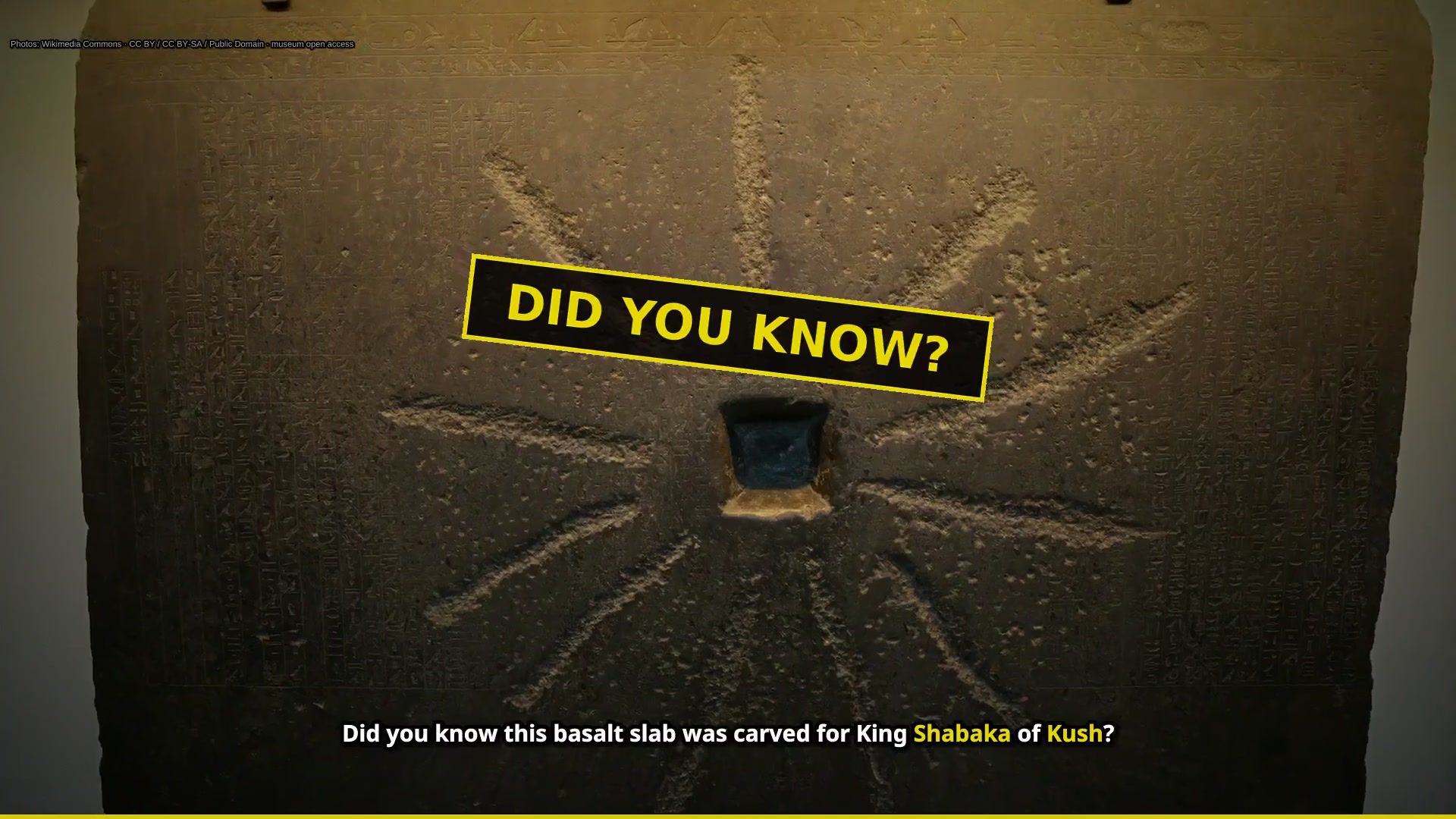
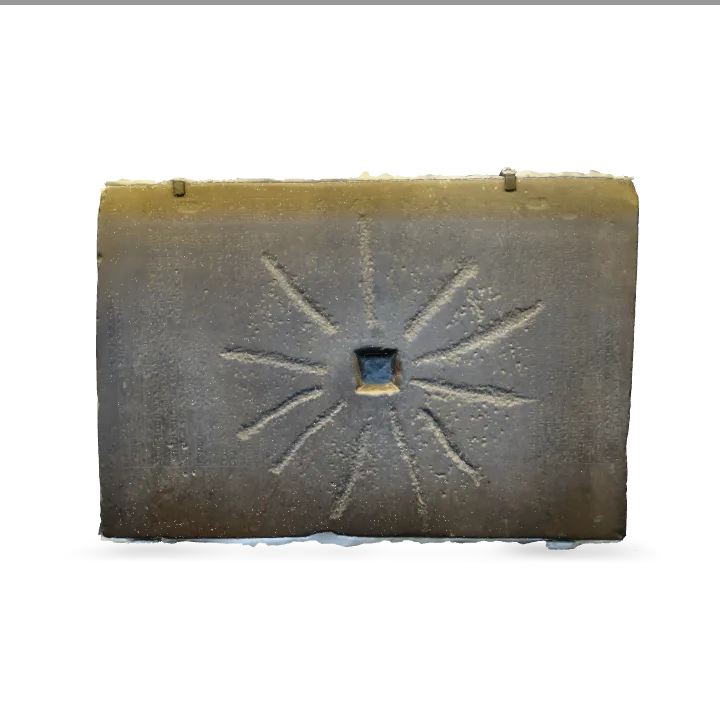
The Shabaka Stone, British Museum EA498 1:41

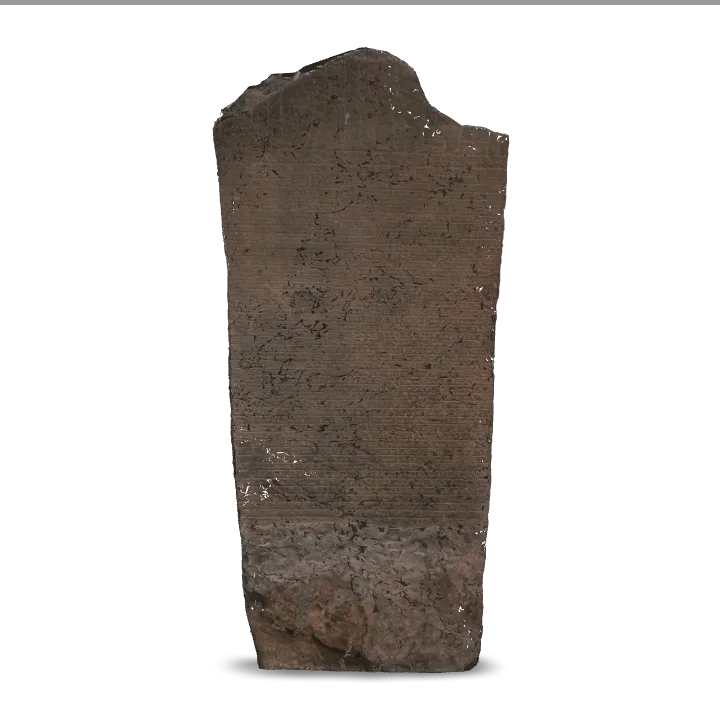
THE SHABAKA STONE · BRITISH MUSEUM · EA498 · c. 710 BC

Who Was the Kushite King Who Carved Egypt's Creation Story in Stone?

The Shabaka Stone

Did you know this stone slab was inscribed for King Shabaka of Kush — today Sudan — the first Kushite king to rule all of Egypt? Stone, statues, Karnak treasury, El-Kurru: then verify BM EA498 below.

British Museum EA49825th Dynasty, c. 716–702 BC

Summary

The Shabaka Stone and surviving likenesses of Shabaka (Munich, British Museum, Louvre, Met), his treasury at Karnak and his burial at El-Kurru.

Correction note: the film calls the stone basalt and Shabaka the dynasty’s first ruler. The British Museum lists the stone as conglomerate. Piye is usually counted as the dynasty’s founder; Shabaka was the first to rule all of Egypt.

Transcript (from the film’s own captions)

Loading transcript…

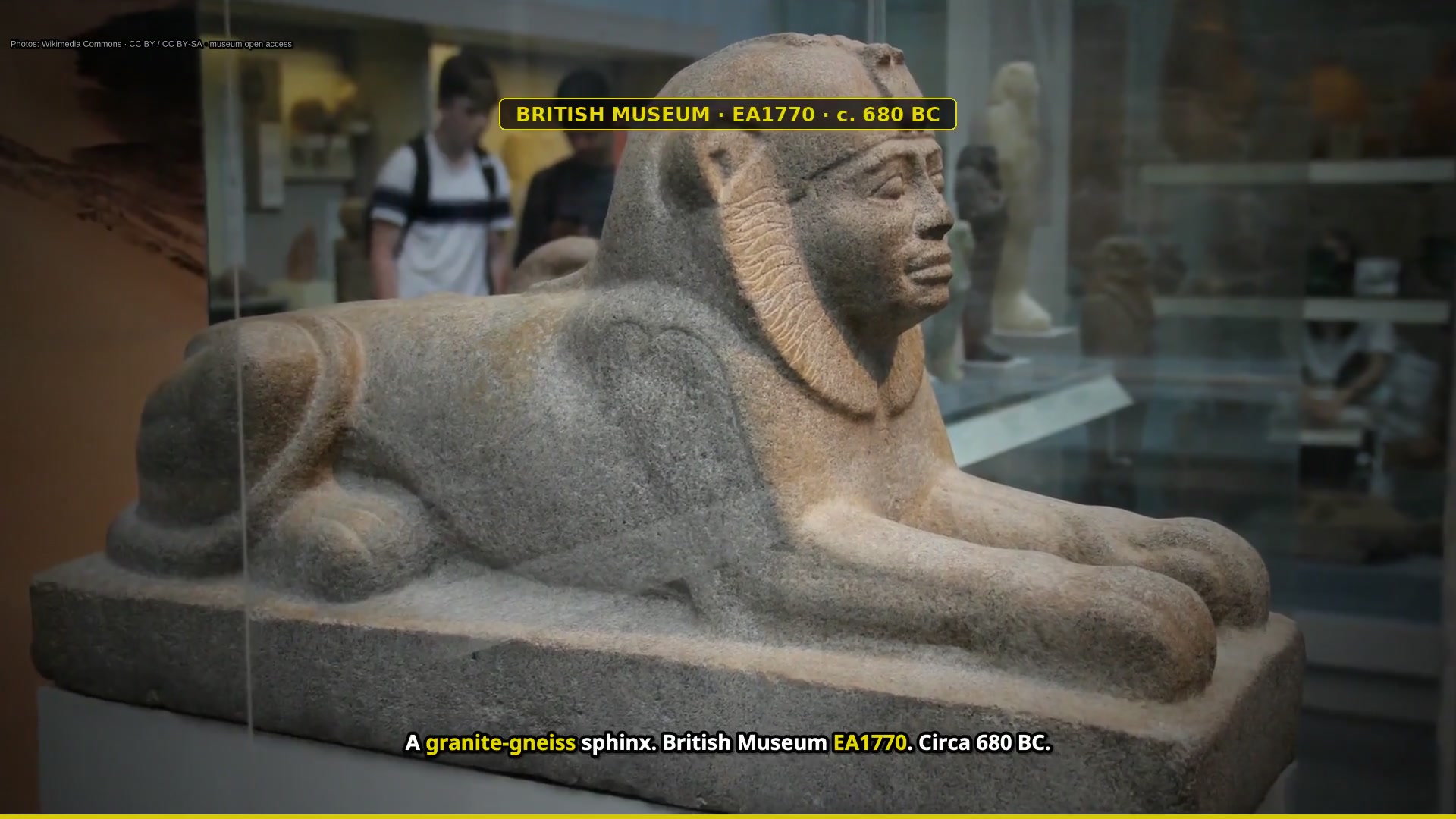
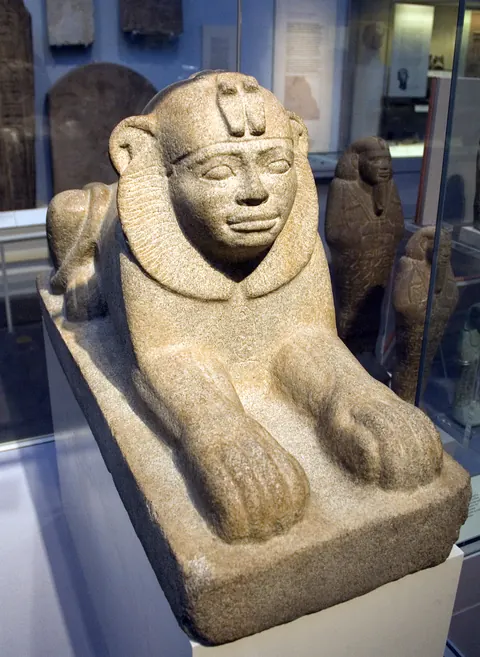
Sphinx of Taharqo, British Museum EA1770 1:39

SPHINX OF TAHARQO · BRITISH MUSEUM · EA1770 · c. 680 BC

The African Pharaoh Named in the Bible — and His Surviving Sphinx

Sphinx of Taharqo

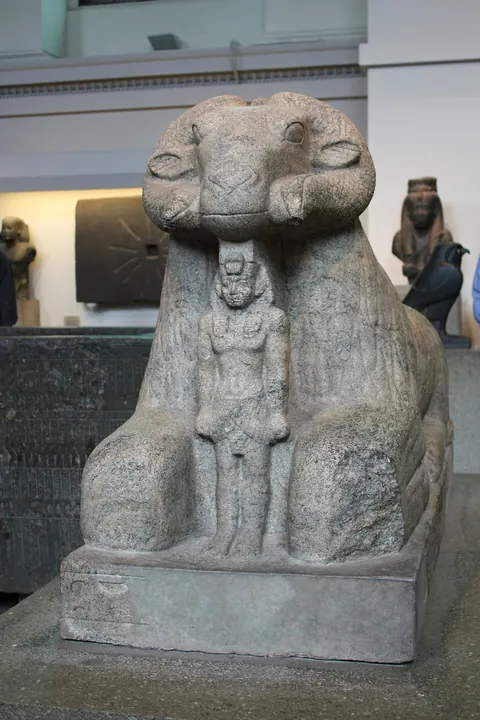
Did you know British Museum EA1770 bears the face of Taharqa — 2 Kings 19:9 — excavated at Kawa? Sphinx, statues, Karnak column, Nuri pyramid: verify below.

British Museum EA177025th Dynasty, Taharqa c. 690–664 BC

Summary

The Kawa sphinx of Taharqa (2 Kings 19:9) with related statues, the Karnak column and his Nuri pyramid.

Transcript (from the film’s own captions)

Loading transcript…

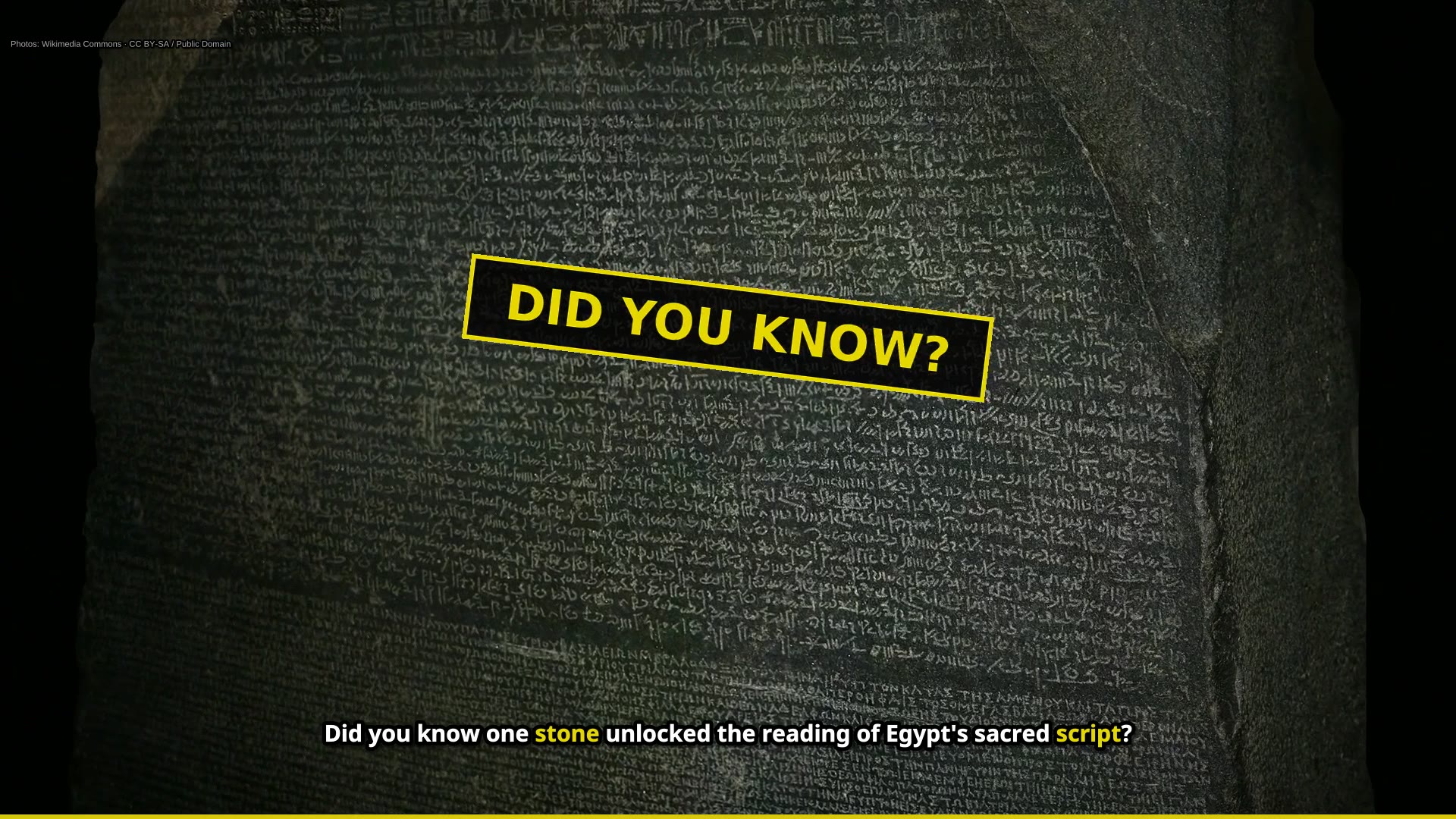
The Rosetta Stone, British Museum EA24 1:51

THE ROSETTA STONE · BRITISH MUSEUM · EA24 · 196 BC

How Did One Stone Unlock Egypt's Sacred Script?

The Rosetta Stone

Did you know one stone unlocked Egypt's sacred script? Watch a worked Ptolemy cartouche, then Young, Champollion, and Philae — verify British Museum EA24 below.

British Museum EA24Ptolemaic, 196 BC

Summary

Finding the stone in 1799; Young’s Ptolemy cartouche; Champollion’s 1822 breakthrough checked against Cleopatra’s cartouche at Philae.

Transcript (from the film’s own captions)

Loading transcript…

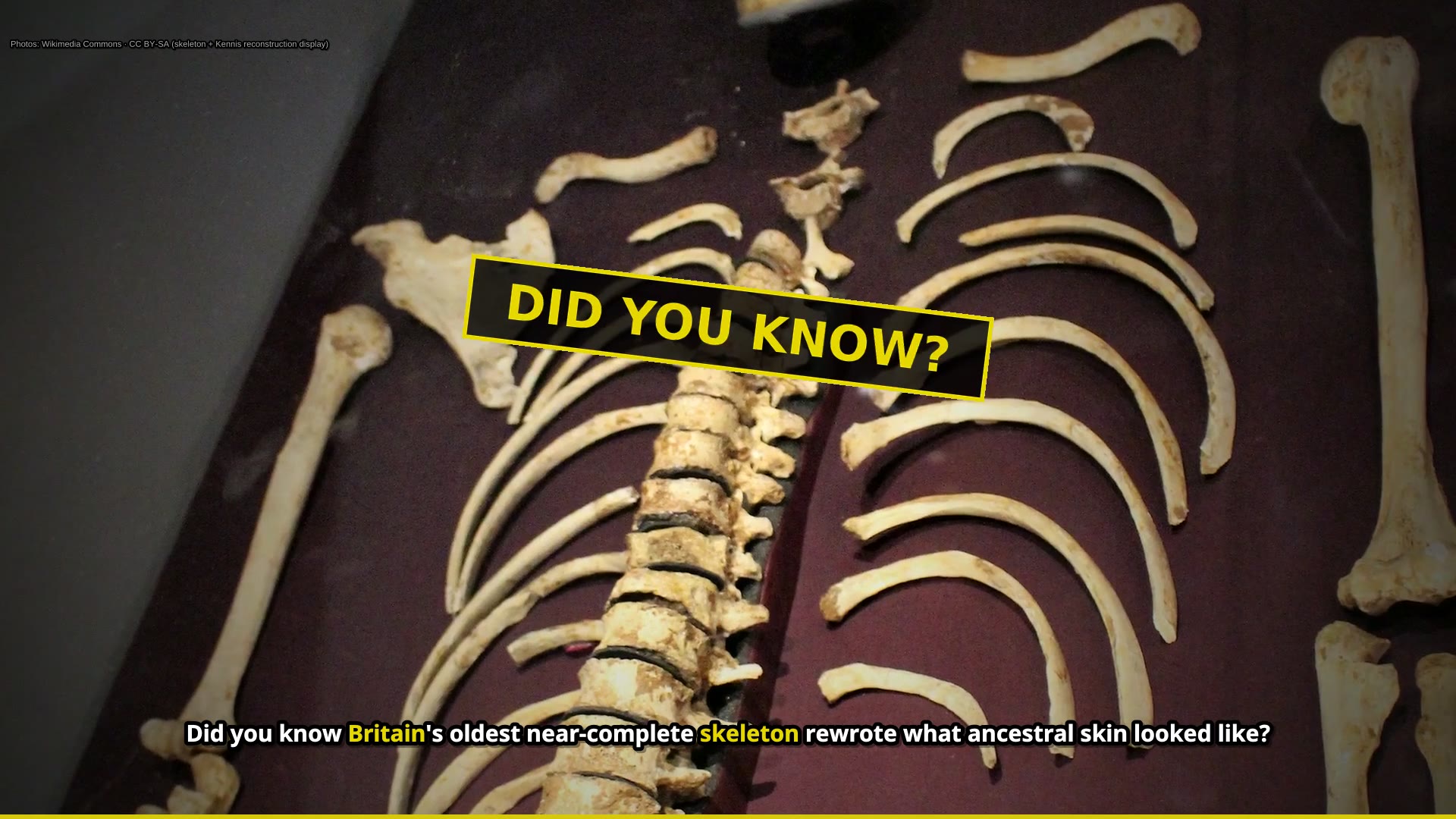
Cheddar Man reconstruction 1:55

CHEDDAR MAN · NATURAL HISTORY MUSEUM, LONDON · 2018

What Do DNA Estimates Suggest About Skin Color 10,000 Years Ago?

Cheddar Man

About 10,000 years ago — DNA-based estimates of dark to black skin and blue eyes, plus Loschbour, La Braña, and Villabruna. Not a photograph from the past. Verify the NHM account.

Natural History Museum, London (2018)Mesolithic Britain, c. 7100 BC

Summary

Cheddar Man’s genome estimate (dark to black skin, blue eyes) with Loschbour, La Braña and Villabruna. DNA-based estimates, not a photograph.

Transcript (from the film’s own captions)

Loading transcript…

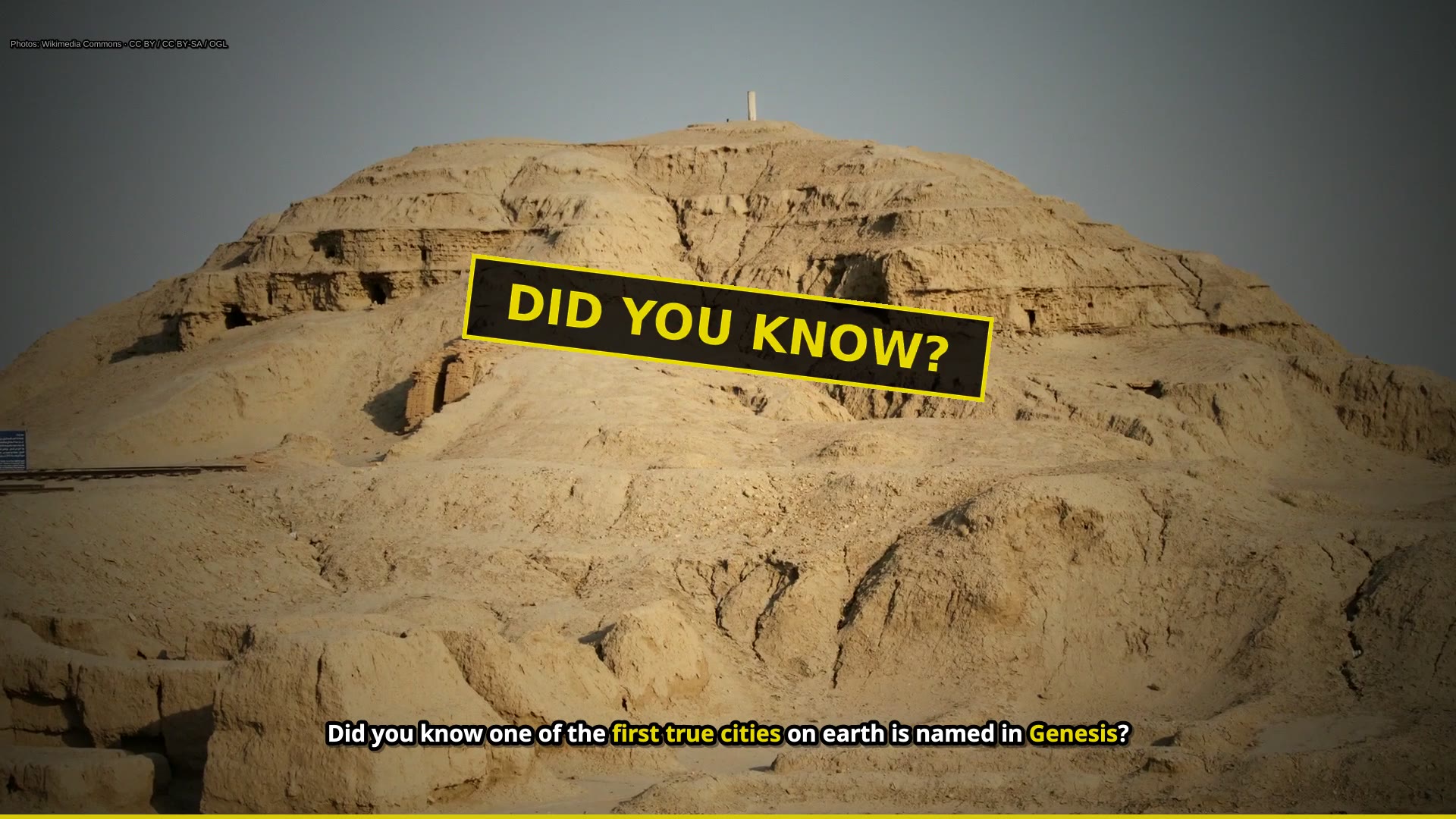
Ruins of Uruk 1:14

URUK (BIBLICAL ERECH) · UNESCO · ARCHAEOLOGICAL CITY

Genesis Names One of the World's Earliest Cities — Here Are Its Ruins

Uruk (biblical Erech)

Warka in southern Iraq — UNESCO 2016, German digs since 1912, Eanna and early writing. Genesis 10:10 names it Erech. Verify below.

UNESCO 1481Uruk, 4th millennium BC onward

Summary

Warka (Uruk) in southern Iraq: UNESCO inscription in 2016, German excavations since 1912, the Eanna precinct and early writing; Genesis 10:10’s Erech.

Transcript (from the film’s own captions)

Loading transcript…

CHRONOLOGY GUARDRAIL · TWO DIFFERENT ERAS

Genesis 10’s family origins and the Kushite dynasty’s peak are centuries apart. This site never folds them together.

  1. c. 3300–3100 BCUruk (Erech): early cities and proto-cuneiformEarly Bronze Age setting for Genesis 10’s ‘beginning’ in Shinar
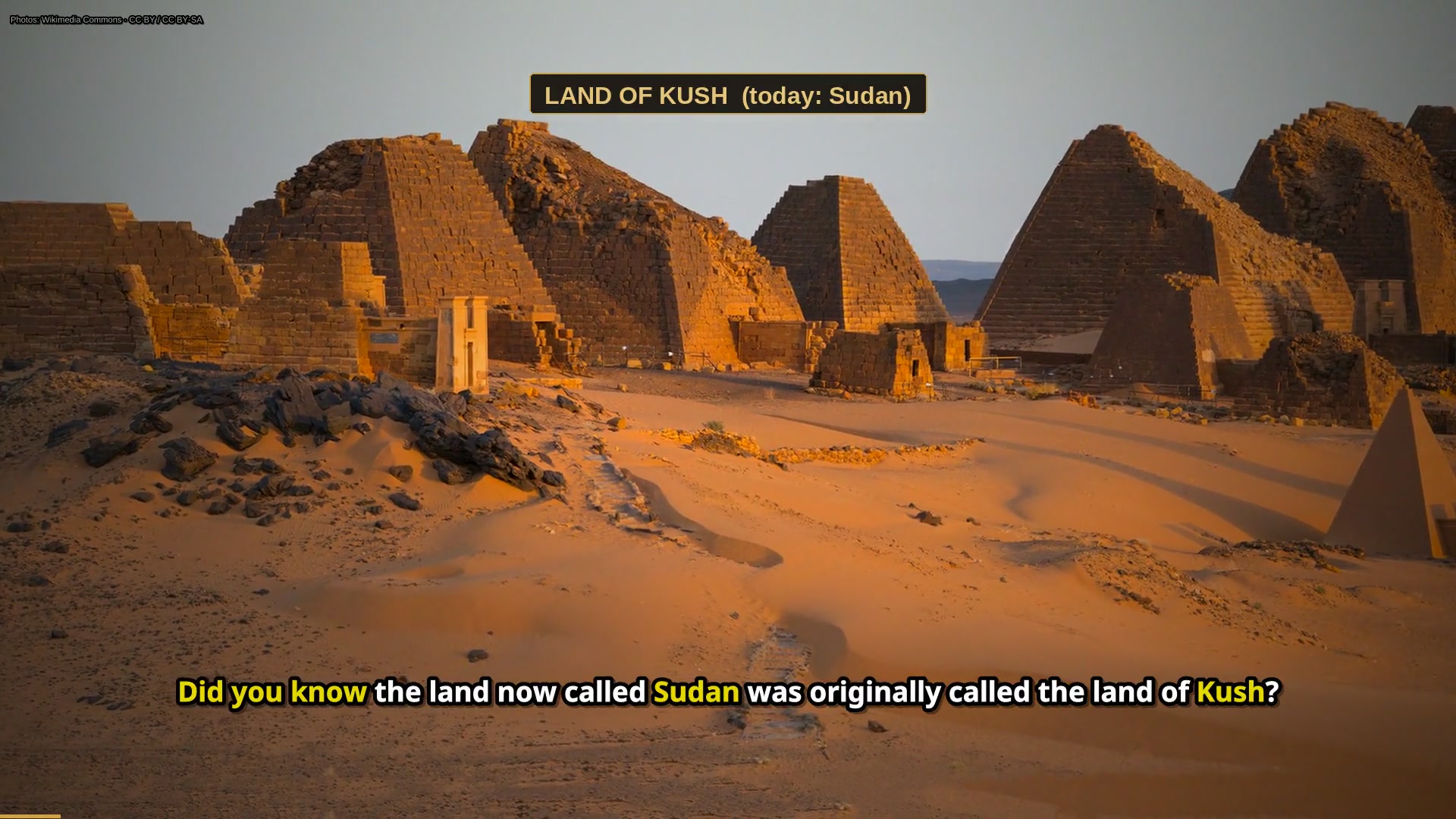
  2. c. 2500–1500 BCKerma: first kingdom of Kush (Egyptian texts call it Kush)Bronze Age
  3. c. 1208 BCMerneptah Stele names Israel in CanaanLate Bronze Age
  4. c. 744–656 BC25th (Kushite) Dynasty: Piye’s campaign (c. 728–725), Shabaka rules all Egypt (c. 716), Taharqa (c. 690–664)Iron Age
  5. 701 BCSennacherib’s campaign against Judah (Taylor Prism, written 691 BC); 2 Kings 19:9Iron Age
  6. c. 300 BC – AD 350Meroë: the later Kushite kingdom (Candace of Acts 8:27)Classical era

NOW OPEN

The Kingdom of Kush Museum

Kings, kandakes, Meroitic writing and the pyramids of Kush, from the museum’s own collection.

  • 65exhibits
  • 6halls
  • 7in 3D
  • 9site walking tours

Tours: Giza · Nuri · El-Kurru · Meroë · Jebel Barkal · Kerma · all 9 · Pyramids and Kings of Kush on this page

3D scan of The Shabaka Stone
KU-II.06 · 3D SCANThe Shabaka Stonec. 710 BC · British Museum · Inv. EA 4983D scan of the real object: “The Shabako Stone” by Daniel Pett (danielpett) (Sketchfab) · CC BY 4.0 · Sketchfab page

From the galleries exhibits

THE ORIGINAL TEXT · ON THIS SITE · FREE

Read every verse in the language it was written in

Look up any verse from Genesis to Revelation and see the original Hebrew or Greek beside the translation you choose. Every word is explained: pronunciation, dictionary form, meaning, Strong’s number and grammar. Built for researchers and for anyone opening the Bible for the first time.

39 BOOKS · GENESIS → MALACHI · LENINGRAD CODEX

Old Testament in Hebrew

The Hebrew Tanakh word by word, with your translation alongside: English, Spanish, French, German, Portuguese and more.

Start with: Genesis 10:6 · Genesis 9:25 · Isaiah 18:2 · Song of Songs 1:5 · Jeremiah 38:7 · Genesis 10 on Sefaria (external)

27 BOOKS · MATTHEW → REVELATION · NA/SBL + TEXTUS RECEPTUS

New Testament in Greek

The Greek New Testament word by word, with every word that differs between the Textus Receptus (KJV) and modern critical texts clearly marked.

Start with: Acts 8:27 · Acts 17:26 · Acts 13:1 · Matthew 2:15 · Revelation 7:9 · Acts 13 interlinear on Bible Hub (external)

The Scripture library

The book's whole translation argument rests on one thing: what the Hebrew and Greek actually say, before English translators made their choices. These are real, freely accessible libraries where you can open the original-language text yourself and set it beside a modern English Bible line by line.

Cross-check any verse in independent libraries

Pick any of all 66 books, a chapter, and (optionally) a verse. This isn't limited to what's discussed in the book — cross-check anything in the Bible against the original Hebrew or Greek.

📖

THE OLDEST SURVIVING GREEK BIBLE

Codex Sinaiticus (4th century AD)

The actual handwritten pages of the oldest, most complete Greek Bible in existence — digitally reunited from the British Library, Leipzig University, the National Library of Russia, and St. Catherine's Monastery. View real manuscript images, not a description of them.

View the manuscript pages →
✟

ETHIOPIAN GE'EZ MANUSCRIPT · c. 5TH–7TH CENTURY

The Garima Gospels

The manuscript record behind Chapter 13's "unbroken guardianship" — among the earliest illuminated Gospel books on earth, held at the Abba Garima Monastery in Ethiopia and written in Ge'ez, radiocarbon-dated far earlier than once believed.

View the manuscript catalogue record →
🔤

MODERN ENGLISH, LINED UP AGAINST THE HEBREW

See the translation happen, verse by verse

Bible Hub's parallel view sets the Hebrew text of Genesis 10 directly beside the KJV, BSB, NASB, and other modern English translations — so you can watch "Cush" become "Ethiopia" and "Mizraim" become "Egypt" for yourself, translation by translation.

Compare Genesis 10 across translations →

Nothing above is filtered through this book or this site — these are the primary-source libraries and institutions themselves. Read the Hebrew, read the Greek, read the manuscripts, then decide for yourself whether the English translation carries what the original actually says.

Hebrew & Greek text, morphology and lexicons: STEPBible / Tyndale House, Cambridge (CC BY 4.0). Translations: eBible.org (public domain; Swahili CC BY-SA). Hosted on this site, with no trackers.

THE METHOD

Three independent witnesses, one conclusion

Every major claim in this book is tested against more than one source before it is called confirmed.

WITNESS ONE

Scripture

The Hebrew and Greek text itself: what Genesis, the historical books, the prophets, and the New Testament directly say about Cush, Mizraim, Put, and Canaan — read in the language it was written in, not through centuries of assumption layered onto the English translation.

WITNESS TWO

Archaeology

Museum-held artifacts and excavated sites — the Shabaka Stone, the Sphinx of Taharqa, the City of David cisterns, Uruk, Karnak — cross-checked against the biblical narrative and dated by established institutions, not by the book's own say-so.

WITNESS THREE

Genetics

What population genetics has actually measured about human origins in Africa, the inheritance of pigmentation genes, and the ancestral, high-eumelanin human condition — read alongside the genealogy of Genesis 10, with inference clearly labeled as inference.

Scripture · Archaeology · Genetics — three independent witnesses, one truth.

EVIDENCE RECORDS · SCRIPTURE · ARCHAEOLOGY · GENETICS · HISTORY

What the evidence confirms

Ten claims from the book, each broken into its parts and matched with the Scripture, artifacts, studies and records that support or clarify it. Where a popular idea is a misreading the book corrects, it is marked plainly as a misconception. Readings of the text are labelled as interpretations. This layer sits beside the book; it never changes the author’s text. Copy Receipt cites the primary sources, not the book.

What the labels mean
  • Stated in the text itself
  • Independently supported by sources outside the text
  • Partly supported
  • Interpretation
  • Misconception — not in the text

The curse of Canaan · Undated (Genesis)

Genesis 9:25 curses Canaan, not Ham or Africa

The curse in Genesis 9:25 names Canaan only; the text never places it on Ham, Cush, Mizraim or Put.

Confidence: Strong. The wording is plain in the Hebrew.

What the record shows

  • Stated in the text itself The curse names Canaan: ʾārûr Kenāʿan, “Cursed be Canaan.”
  • Stated in the text itself The words are Noah’s, spoken when he woke (Gen 9:24–25). The text does not present them as God’s speech.
  • Stated in the text itself The text never extends the curse to Cush, Mizraim or Put.
  • Misconception — not in the text The so-called “curse of Ham” tied to skin colour and slavery is a later misreading. Genesis 9:25 does not say it.Goldenberg (2003) traces where this misreading came from: later Jewish, Christian and Islamic interpreters, not the Hebrew text.
Witnesses (2) and what each establishes

In the book: Chapter 4: The Curse: What God Actually Said · Introduction: The Hidden Teaching and the Plain Record · Chapter 14: Summary of the Case

Ham’s four sons · Undated (Genesis)

Cush, Mizraim, Put and Canaan as peoples and lands

Genesis 10:6 lists four sons of Ham whose names match known lands: Kush, Egypt, (probably) Libya and Canaan.

What the record shows

  • Stated in the text itself Genesis 10:6 names Cush, Mizraim, Put and Canaan as Ham’s sons.
  • Independently supported by sources outside the text Cush matches the Nile kingdom of Kush (Sudan), named kꜣš in Egyptian texts.
  • Independently supported by sources outside the text Mizraim is Egypt.
  • Independently supported by sources outside the text Canaan is the southern Levant.
Witnesses (3) and what each establishes

In the book: Chapter 3: Ham and His Sons: The Record God Kept · Chapter 14: Summary of the Case · Chapter 18: One House, Four Brothers, One Pathway

Cush in Eden · Undated (Genesis)

Is the Cush of Genesis 2:13 the same as Ham’s son?

The Gihon “compasseth the whole land of Cush” (Gen 2:13). The book reads this Cush as the same land as Ham’s son in Genesis 10:6.

What the record shows

  • Stated in the text itself Genesis 2:13 says the Gihon surrounds the whole land of Cush.
  • Interpretation This Cush is the same land as in Genesis 10:6.The same Hebrew word, כּוּשׁ, names the land in both verses.
Witnesses (2) and what each establishes

In the book: Chapter 2: Cush Through the Eyes of God · Chapter 14: Summary of the Case

Mizraim is Egypt · Bronze Age

Mizraim = Egypt

Mizraim (Gen 10:6) is the Hebrew name for Egypt, and Isaiah 19:25 calls Egypt “my people.”

Confidence: Strong. The identification is secure.

What the record shows

  • Independently supported by sources outside the text Miṣrayim is Egypt; it matches Akkadian Miṣri/Muṣur and Arabic Miṣr.
  • Stated in the text itself Isaiah 19:25 says “Blessed be Egypt my people.”
Witnesses (3) and what each establishes

In the book: Chapter 6: What God Declared Over These Nations · Chapter 14: Summary of the Case

Nimrod and Shinar · Bronze Age

Nimrod, son of Cush, and the cities of Shinar

Genesis 10:8–12 says Nimrod, son of Cush, began his kingdom at Babel, Erech, Accad and Calneh in Shinar.

What the record shows

  • Stated in the text itself Genesis 10:8–10 names Nimrod son of Cush and the cities Babel, Erech, Accad and Calneh in Shinar.
  • Independently supported by sources outside the text Erech (Uruk), Accad (Akkad) and Babel (Babylon) were real Mesopotamian cities.
Witnesses (2) and what each establishes

In the book: Chapter 10: Ham's Descendants Built the Foundation of Human Civilization · Chapter 9: The Name They Gave It — Correcting the Map

Taharqa and 701 BC · 25th Dynasty

Tirhakah king of Cush and Sennacherib’s campaign

2 Kings 19:9 (Isaiah 37:9) says Tirhakah king of Cush came out against Sennacherib during his campaign against Hezekiah (701 BC).

What the record shows

  • Stated in the text itself The Bible names Tirhakah king of Cush in the account of Sennacherib’s campaign.
  • Independently supported by sources outside the text Sennacherib campaigned against Judah in 701 BC and shut Hezekiah in Jerusalem.
  • Independently supported by sources outside the text Assyria fought Egyptian kings and the chariotry of the king of Meluhha (Kush) at Eltekeh.
Witnesses (4) and what each establishes

In the book: Chapter 5: God Named, Defended, and Used These People · Chapter 11: The Royal Record — Genesis Through Revelation

Isaiah 18 · 25th Dynasty

Isaiah 18: the land beyond the rivers of Cush

Isaiah 18 addresses a people “beyond the rivers of Cush” and ends with their gift brought to Mount Zion.

What the record shows

  • Stated in the text itself The people are described as memushshāk ū-môrāṭ, “drawn out and polished” (tall and smooth-skinned / scattered and peeled).Translation range shown in full.
  • Interpretation The oracle belongs to the 25th-Dynasty period (c. 715–701 BC).The majority scholarly reading of the oracle’s setting.
  • Interpretation Verse 7 echoes Deuteronomy’s “place of the Name.”
  • Independently supported by sources outside the text Kushite kings ruled Egypt in this period.
Witnesses (3) and what each establishes

In the book: Chapter 7: Isaiah 18 — The Full Hebrew and Historical Record · Chapter 16: Complete First-Principles Review and Validation

Ebed-Melech the Cushite · Iron Age

Ebed-Melech the Cushite rescues Jeremiah

Ebed-Melech the Cushite, a court official, rescues Jeremiah, and God promises to save him “because thou hast put thy trust in me.”

Confidence: Strong. For what the text says.

What the record shows

  • Stated in the text itself Jeremiah 38:7–13: Ebed-Melech the Cushite, a sārîs, pulls Jeremiah from the cistern.
  • Stated in the text itself Jeremiah 39:15–18 gives him a promise “because thou hast put thy trust in me.”
  • Interpretation He was a dark-skinned African.“Cushite” names his origin in Cush; Jeremiah 13:23 speaks of the Cushite’s skin as a known, unchanging trait.
Witnesses (1) and what each establishes

In the book: Chapter 15: Twenty Indisputable Biblical Truths

Skin-tone genetics · Undated (Genesis)

Light and dark skin variants are old in Africa

Most light- and dark-skin variants studied were already present in Africa before modern humans arose.

Confidence: Strong. For the genetic findings; the book’s reading is labelled as such.

What the record shows

  • Independently supported by sources outside the text Most variants studied (MFSD12, DDB1, OCA2, HERC2 and others) predate modern humans (~300,000 years).
  • Independently supported by sources outside the text The light SLC24A5 allele reached East Africa through later gene flow from non-Africans.
  • Partly supported Early Homo sapiens had dark skin.Supported by UV-adaptation models (Jablonski & Chaplin 2000).
  • Interpretation One ancestral family could carry the potential for the whole range of human skin tones.The book’s reading of these findings.
Witnesses (4) and what each establishes

In the book: Chapter 17: The Melanin Record · Chapter 1: One Origin, One God, One Record · Chapter 16: Complete First-Principles Review and Validation

The term “Middle East” · Modern

Who named the “Middle East”, and what did it divide?

Alfred Thayer Mahan popularised “Middle East” in 1902. The book argues that modern labels split a family of nations that Genesis 10 treats as connected.

What the record shows

  • Independently supported by sources outside the text Mahan used “Middle East” in The National Review, September 1902.
  • Independently supported by sources outside the text Mahan’s “Middle East” meant the region between Arabia and India, around the Persian Gulf.
  • Interpretation Modern labels artificially split a family belt that Genesis 10 treats as connected.The book’s argument.
Witnesses (3) and what each establishes

In the book: Chapter 9: The Name They Gave It — Correcting the Map · Chapter 18: One House, Four Brothers, One Pathway

BEFORE ANYTHING ELSE

The names, restored

The single most important fact in this study: the word changed languages twice, but the people God named never changed. Reading the Bible in its original language recovers the names God actually used.

Hebrew (Scripture)Greek / Later LabelEnglish BibleWhat it means
CushAithiopia ("land of the burnt-faced people")"Ethiopia / Ethiopian"Son of Ham; the dark-skinned African nations south of Kemet — Sudan, the Nile interior, the Horn.
MizraimAígyptos"Egypt / Egyptian"Son of Ham; the people's own name for their land was Kemet, "the Black Land."
Ham—"Ham"Root meaning "hot / burnt"; Psalm 105:23 and 106:22 use "the land of Ham" as a direct parallel for Egypt.
Canaan—"Canaan"Son of Ham; the Levant — Jebusites, Phoenicians, Hittites descend from this line.
Shinar (Nimrod, son of Cush)Babylonia / Mesopotamia"the land of Shinar"Babel, Erech (Uruk), Accad, Calneh — among the first cities on earth.
— (region, not a Bible word)popularized 1902, A. T. Mahan"the Middle East"A 20th-century label laid over Canaan, Shinar, and neighboring lands God had already named.

STUDY TOOL · MIZRAIM (EGYPT), GENESIS 10:6

Mizraim’s land wrote in hieroglyphs. Read its own words: take the free guided tours (royal names, the offering formula, the sound signs, reading direction, and the names Kemet and Kush), then browse the Hieroglyph Library, with every Unicode sign and 16,379 sentences edited by the Thesaurus Linguae Aegyptiae. These are study tools, not proof of anything in this book.

HEBREW & SEPTUAGINT · NAME TABLE

How the names crossed into Greek

The Septuagint (the Greek Old Testament) often keeps the Hebrew name in Genesis 10 and switches to a Greek regional word elsewhere. That is where “Cush” starts turning into “Ethiopia.” Tap a Strong’s number to see the verse in Hebrew.

Hebrew name → Strong’s → Septuagint (Greek Old Testament) → modern region
HebrewTransliterationStrong’sSeptuagint (LXX)Meaning / modern regionReceipt
כּוּשׁKûš (Cush)Χους (Gen 10:6–8) · usually Αἰθιοπία / Αἰθίοψ
Gen 2:13; Isa 18:1; Jer 13:23
Kush: Nubia / northern Sudan and the upper Nile; in wider use, the lands south of Egypt
מִצְרַיִםMiṣrayim (Mizraim)Μεσραιν (Gen 10:6) · usually Αἴγυπτος
Gen 12:10; Isa 19:25
Egypt, the Nile Valley (Upper and Lower Egypt)
פּוּטPûṭ (Put)Φουδ (Gen 10:6) · Λίβυες in the prophets
Jer 46:9 (LXX 26:9); Ezek 27:10; 30:5; 38:5
Most scholars: Libya, west of Egypt
כְּנַעַןKənaʿan (Canaan)Χανααν
Gen 9:25; 10:6
The Levant: modern Israel, the Palestinian territories, Lebanon, western Jordan and Syria
שָׁחוֹרšāḥôr (shachor)μέλαινα (Song 1:5)
Song 1:5 “Μέλαινά εἰμι καὶ καλή”
A colour adjective, ‘black/dark’. Not a name of a people or a land
כּוּשִׁיKûšî (Cushite)Αἰθίοψ
Num 12:1; Jer 38:7; Amos 9:7
‘A Cushite’: a person from Kush

USAGE NOTE · KÛŠÎ

In the Hebrew Bible, Kûšî simply means ‘Cushite’, a neutral name of a people and a place. It is used of Moses’ wife (Num 12:1), of Ebed-Melech (Jer 38:7) and of a whole nation God compares with Israel (Amos 9:7). In modern Israeli Hebrew the word came to be used as a slur for Black people, and Israeli courts have ruled its insulting use defamatory. Read the Bible’s word in the Bible’s sense.

STUDY NOTES · HEBREW & HISTORY

Three passages, read closely

Short notes that sit beside Chapters 5, 7 and 10. Each keeps what the text says apart from what history can confirm.

Isaiah 18 — the Hebrew of ‘tall and smooth’

Isaiah 18:2 and 18:7 describe the people of Cush with two rare Hebrew words: מְמֻשָּׁךְ וּמוֹרָט, memushshāk ū-môrāṭ. Literally ‘drawn-out and polished’ (H4900 māšak, ‘to draw out’; H4803 māraṭ, ‘to polish, make smooth’). English versions translate them ‘tall and smooth’ (ESV), ‘tall and smooth-skinned’ (NIV) or ‘scattered and peeled’ (KJV).

Verse 7 brings that same people’s gift (שַׁי, shai) “to the place of the Name of the LORD of hosts, the mount Zion.” The words echo Deuteronomy’s ‘place the LORD will choose … to put his name there’ (Deut 12:5, 11). Most scholars set the chapter in the years when Kushite kings ruled Egypt (25th Dynasty, c. 715–701 BC).

Isaiah 18:2 · Isaiah 18:7 · Deuteronomy 12:5

Jeremiah 38–39 — the Cushite who acted

Judah’s princes ask for Jeremiah’s death and lower him into a cistern of mud (Jer 38:4–6). Ebed-Melech the Cushite, a court official (סָרִיס, sārîs) in King Zedekiah’s house, goes to the king in public and pulls the prophet out with thirty men (38:7–13).

God’s word to him: “I will surely deliver thee… thy life shall be for a prey unto thee: because thou hast put thy trust in me” (39:18). It is the same promise later given to Baruch, Jeremiah’s own scribe (45:5). The foreign official and the prophet’s closest companion are spared on the same terms.

Jeremiah 38:4 · Jeremiah 38:7 · Jeremiah 39:18 · Jeremiah 45:5

Nimrod and early Mesopotamia (Genesis 10:8–12)

Scripture says

Cush fathered Nimrod, “a mighty one in the earth.” The beginning of his kingdom was Babel, Erech, Akkad and Calneh in Shinar (Gen 10:8–10). Genesis 10:11 is read two ways: “from that land he went to Assyria and built Nineveh, Rehoboth-Ir, Calah and Resen” (most modern translations) or “out of that land went forth Asshur” (KJV). Micah 5:6 calls Assyria “the land of Nimrod.”

Archaeology shows

Uruk (Erech) is among the first true cities, with monumental temples and some of the earliest proto-cuneiform tablets (c. 3300–3100 BC). Ziggurats rise at Uruk and Ur. Akkad became the first Mesopotamian empire under Sargon (c. 2334 BC); Babylon rose to power much later (19th–18th centuries BC). Nineveh and Calah (Nimrud) became Assyrian royal cities.

Genesis 10:8 · Genesis 10:10 · Genesis 10:11 · Micah 5:6

HISTORICAL MAP · BIBLICAL NAMES · ANCIENT SITES · MODERN BORDERS

Where the names and the sites sit

Genesis 10 names peoples and lands, not borders. Here its names appear as approximate, hatched areas, ancient sites as points, and today’s borders on a separate layer. Each item carries a confidence label and its sources.

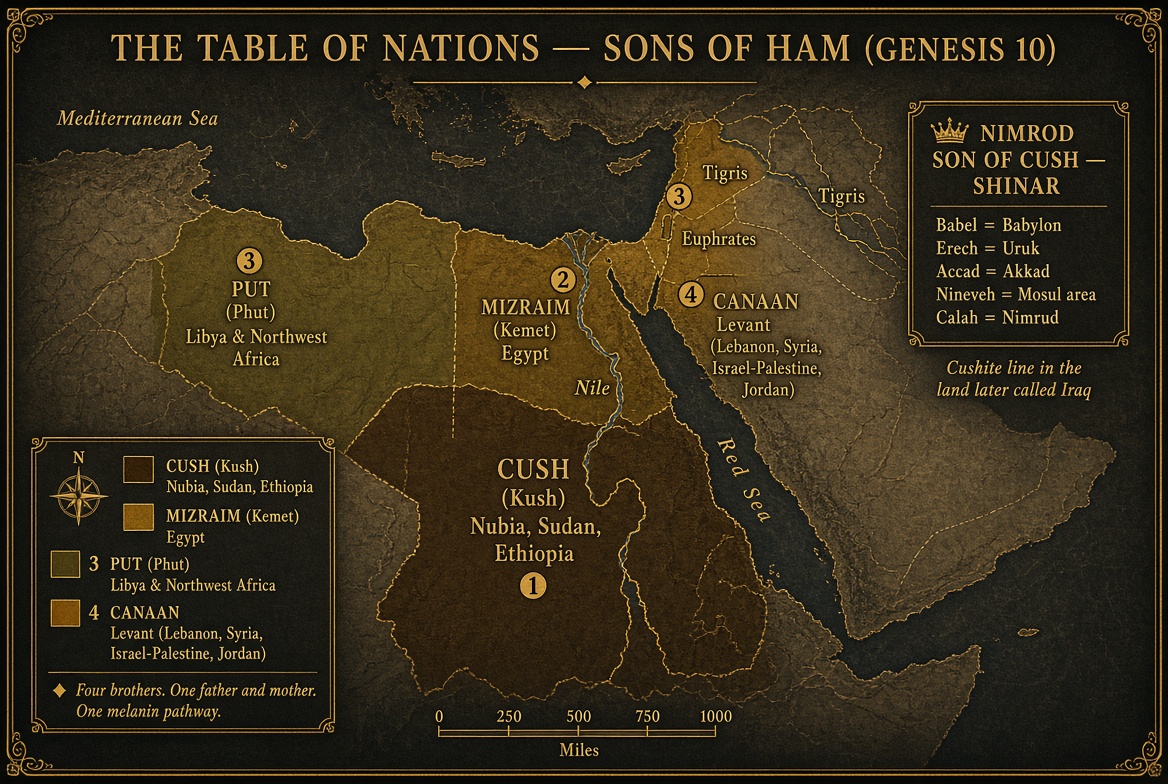
THE THREE MAPS FROM CHAPTER 18 · FROM THE BOOK

Map 1 — The Table of Nations: Sons of Ham (Genesis 10)
Map 1 — Genesis 10 settlement of Ham's four sons, with Nimrod's Shinar cities marked on the Cushite line.
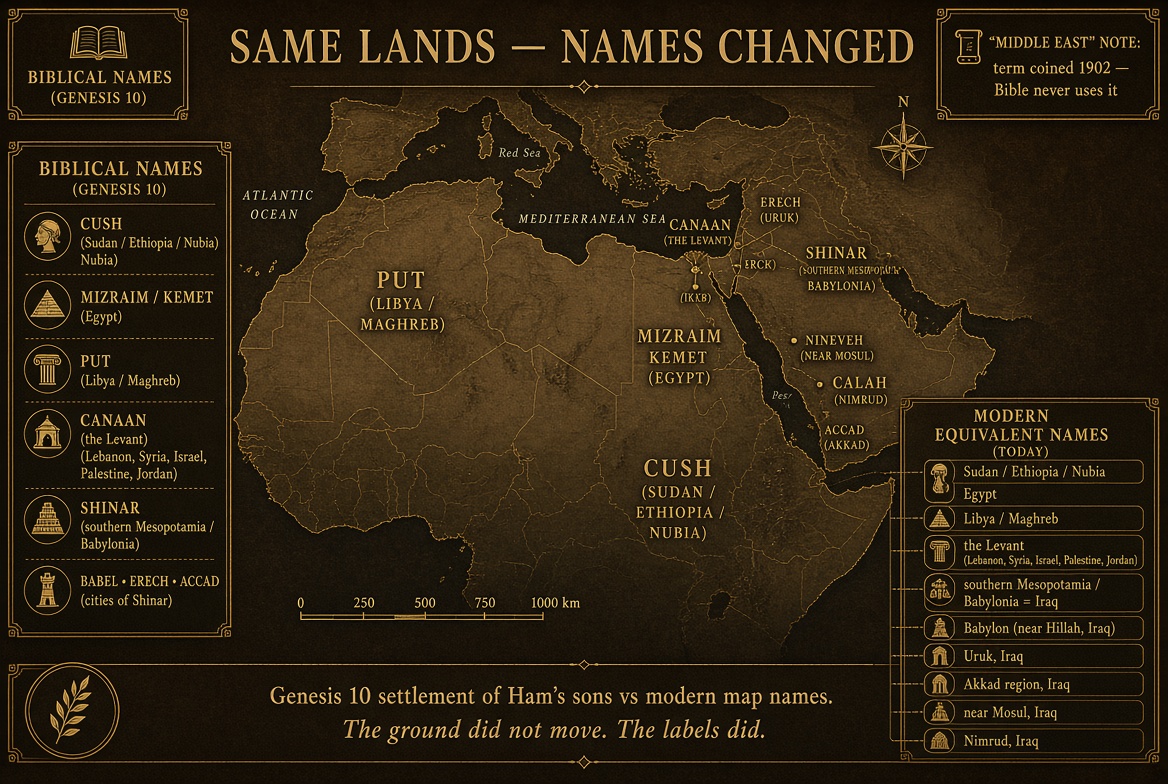
Map 2 — Same Lands, Names Changed
Map 2 — Same ground, later labels. The Bible's names are the left column. Today's atlas is the right column. The ground did not move. The labels did.
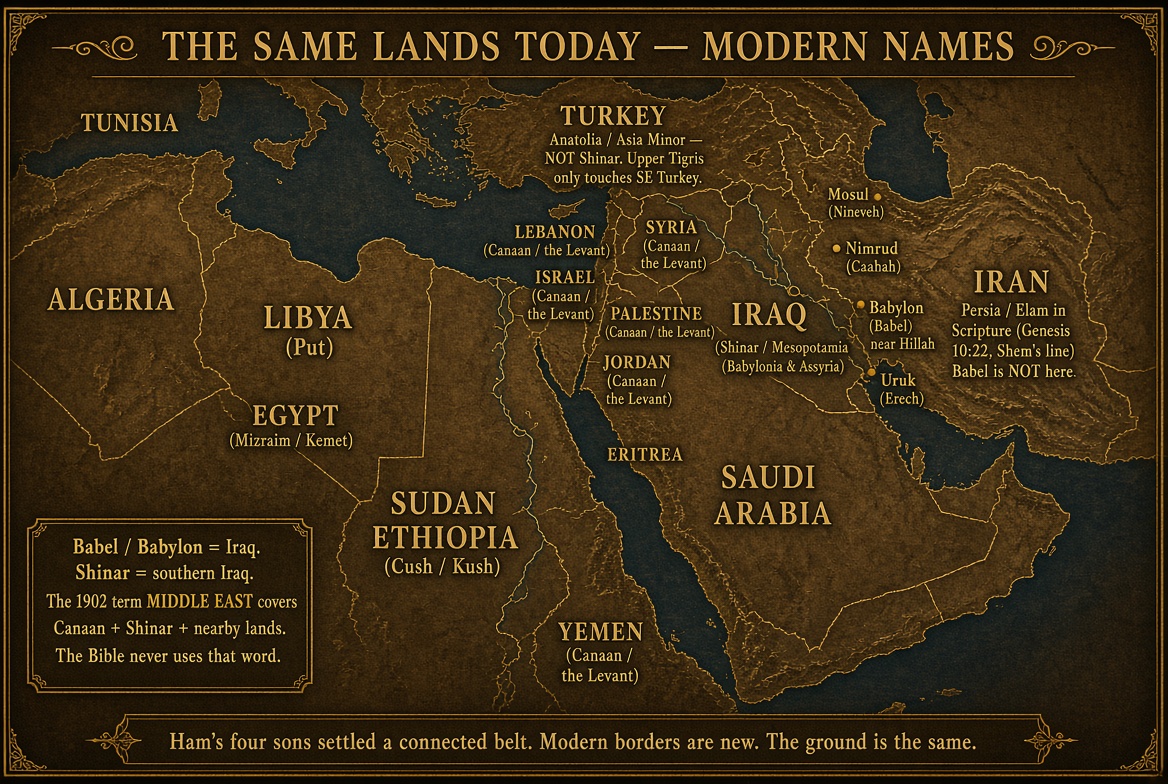
Map 3 — The Same Lands on Today's Atlas
Map 3 — Modern country names on the same ground. Yemen is southern Arabia, not Canaan. Babel / Babylon = Iraq. Iran is Persia / Elam in Scripture (Genesis 10:22, a son of Shem) — Babel is not there.

Genesis 10 gives no dates. Its names are shown beside the ancient sites of the same lands, across many centuries.

Historical map: approximate areas of the Genesis 10 names and dated ancient sitesYemenSyriaSudanSomalilandSaudi ArabiaLebanonJordanIsraelIraqEritreaEgyptChadMediterranean SeaRed SeaPersian GulfNileTigrisEuphratesCushMizraimPutCanaanShinarAsshurMemphisThebesAbusir el-MeleqKermaNapataEl-KurruNuriKawaMeroëJerusalemLachishEltekehNinevehBabelErech/UrukAccad?

Drag to pan when zoomed in · pinch or use +/− to zoom · in Compare, drag the divider or use the slider.

Confidence

  • Well attested
  • Probable
  • Approximate

Hatched shapes are approximate areas, not borders. Places whose location is unknown are listed below, not drawn.

Select a place for its confidence, era, note and sources.

Text list of every place on the map (22)
NameTypeConfidenceErasTodayNoteSources
Cush כּוּשׁRegion (approx.)ProbableBronze Age, Iron Age, 25th Dynastynorthern SudanUsually matched with the Nile kingdom of Kush (Egyptian kꜣš) in Sudan. Its extent changed over time; the hatched area is approximate.Hebrew Bible, Leningrad Codex (Westmin…, Thesaurus Linguae Aegyptiae (TLA), cor…, Gebel Barkal and the Sites of the Napa…
Mizraim מִצְרַיִםRegion (approx.)Well attestedBronze Age, Iron Age, 25th DynastyEgyptEgypt (Hebrew Miṣrayim; Egyptian km.t). The Nile valley and Delta.Hebrew Bible, Leningrad Codex (Westmin…, Thesaurus Linguae Aegyptiae (TLA), cor…, Merneptah Stela (“Israel Stela”)
Put פּוּטRegion (approx.)ApproximateBronze Age, Iron Age, 25th DynastyLibyaLibya, west of Egypt (the Septuagint renders Put as “Libyans” in the prophets).Hebrew Bible, Leningrad Codex (Westmin…, Septuagint (Greek Old Testament), Swet…
Canaan כְּנַעַןRegion (approx.)Well attestedBronze Age, Iron Age, 25th DynastyIsrael, Palestinian territories, Lebanon, W. JordanThe southern Levant, named by Egypt (Merneptah Stela) and in the Amarna letters.Hebrew Bible, Leningrad Codex (Westmin…, Merneptah Stela (“Israel Stela”)
Shinar שִׁנְעָרRegion (approx.)ProbableBronze Age, Iron Age, 25th Dynastysouthern IraqSouthern Mesopotamia (Babylonia/Sumer).Hebrew Bible, Leningrad Codex (Westmin…
Asshur / Assyria אַשּׁוּרRegion (approx.)Well attestedBronze Age, Iron Age, 25th Dynastynorthern IraqThe Assyrian heartland on the upper Tigris (Gen 10:11).Hebrew Bible, Leningrad Codex (Westmin…, The Taylor Prism (Sennacherib Prism)
Memphis נֹף (Noph)SiteWell attestedBronze Age, Iron Age, 25th DynastyMit Rahina, EgyptCapital of Egypt for much of its history.Thesaurus Linguae Aegyptiae (TLA), cor…
Thebes נֹא (No)SiteWell attestedBronze Age, Iron Age, 25th DynastyLuxor, EgyptSouthern capital; findspot of the Merneptah Stela.Merneptah Stela (“Israel Stela”)
Abusir el-MeleqSiteWell attestedBronze Age, Iron Age, 25th DynastyBeni Suef, EgyptMiddle Egypt; the one town sampled by Schuenemann et al. 2017 (c. 1388 BC–AD 426).Ancient Egyptian mummy genomes suggest…
KermaSiteWell attestedBronze AgeKerma, SudanCapital of the early Kushite kingdom (c. 2500–1500 BC).—
Napata / Gebel BarkalSiteWell attestedBronze Age, Iron Age, 25th DynastyKarima, SudanSacred mountain and Kushite royal centre; findspot of Piye’s Victory Stela.Gebel Barkal and the Sites of the Napa…, Victory Stela of Piye
El-KurruSiteWell attestedIron Age, 25th DynastyEl-Kurru, SudanRoyal cemetery of Piye and Shabaka.Gebel Barkal and the Sites of the Napa…
NuriSiteWell attested25th DynastyNuri, SudanPyramid field begun by Taharqa.Gebel Barkal and the Sites of the Napa…
KawaSiteWell attestedBronze Age, 25th Dynastynear Dongola, SudanTemple site; findspot of the Sphinx of Taharqa (BM EA1770).Sphinx of Taharqa, Kawa stelae of Taharqa (Kawa IV and V)
MeroëSiteWell attestedIron AgeMeroë, SudanLater royal city of Kush (after the 25th Dynasty).Archaeological Sites of the Island of …
Jerusalem יְרוּשָׁלַםִSiteWell attestedBronze Age, Iron Age, 25th DynastyJerusalemHezekiah was shut in Jerusalem in 701 BC (Taylor Prism).Hebrew Bible, Leningrad Codex (Westmin…, The Taylor Prism (Sennacherib Prism)
Lachish לָכִישׁSiteWell attestedBronze Age, Iron Age, 25th DynastyTel LachishBesieged by Sennacherib in 701 BC.Hebrew Bible, Leningrad Codex (Westmin…
Eltekeh אֶלְתְּקֵהSite (approx. area)Approximate25th Dynastycentral IsraelBattle of 701 BC against Egyptian and Kushite forces. Shown as an approximate area.The Taylor Prism (Sennacherib Prism)
Nineveh נִינְוֵהSiteWell attestedBronze Age, Iron Age, 25th DynastyMosul, IraqAssyrian capital; findspot of the Taylor Prism (Nebi Yunus).The Taylor Prism (Sennacherib Prism), Hebrew Bible, Leningrad Codex (Westmin…
Babel / Babylon בָּבֶלSiteWell attestedBronze Age, Iron Age, 25th DynastyHillah, IraqNamed first in Nimrod’s kingdom (Gen 10:10); a major city from c. 1900 BC.Hebrew Bible, Leningrad Codex (Westmin…
Erech / Uruk אֶרֶךְSiteWell attestedBronze Age, Iron AgeWarka, IraqOne of the first cities (4th millennium BC).Hebrew Bible, Leningrad Codex (Westmin…, The Ahwar of Southern Iraq: Refuge of …
Accad / Akkad אַכַּדSite (approx. area)ApproximateBronze Agecentral Iraq (unlocated)Capital of Sargon’s empire (c. 2334 BC). The hatched circle marks the area where it is usually placed.Hebrew Bible, Leningrad Codex (Westmin…

Not mapped:

  • Calneh (Gen 10:10): Location not yet identified.
  • Eden and the Gihon (Gen 2:10–14): Not drawn. Genesis 2:13 says the Gihon “compasseth the whole land of Cush.”
  • Resen, Rehoboth-Ir, Calah (Gen 10:11–12): Calah is Nimrud (Iraq); the other two are unlocated. Not drawn to keep the map uncluttered.

ABOUT THE LABELS

“Middle East” was popularised by U.S. naval strategist Alfred Thayer Mahan in September 1902 for the Persian Gulf region between Arabia and India (Mahan 1902, not yet verified against the original; see also Koppes 1976). The Bible never uses the term. The book’s argument, presented as the author’s reading, is that modern labels split a family of nations that Genesis 10 keeps together.

Base map: Natural Earth 1:50m vectors, public domain. CRS: WGS 84 geographic coordinates (EPSG:4326), drawn in an equirectangular projection with standard parallel 28°N. Modern coastlines and rivers; ancient ones differed. Feature data: map-features.json.

CATALOGUE RECORDS

Catalogue records

Each record below links to the institution that holds the object, catalogue number included.

𓋹

BRITISH MUSEUM · EA498 · c. 710 BC

The Shabaka Stone

A stone slab (the BM lists conglomerate) inscribed for King Shabaka of Kush, the first Kushite to establish firm control of all Egypt (reigned c. 716–702 BC), carrying the Memphite Theology. The stone says it copies a worm-eaten ancient original; the British Museum notes most scholars now think the text was composed in Shabaka’s own time. Surviving likenesses include Munich ÄS 4859, BM EA63833, a Louvre ushabti head (AF 6639), and Met bronzes bearing his name; standing architecture includes the Treasury of Shabaka at Karnak; burial at El-Kurru.

View the catalogue record →

🦁

BRITISH MUSEUM · EA1770 · c. 680 BC

Sphinx of Taharqo

British Museum EA1770 — a granite-gneiss sphinx bearing the face of Taharqa (2 Kings 19:9), excavated at the Temple of Amun at Kawa. Related relics: Louvre granite statue, Ny Carlsberg Glyptotek AEIN 1706, BM Amun ram from Kawa, shawabty figures, Kerma Museum portrait, Karnak Great Forecourt column, Jebel Barkal Mut reliefs, and his Nuri pyramid (~52 m a side).

View the catalogue record →

📜

BRITISH MUSEUM · EA24 · 196 BC

The Rosetta Stone

The trilingual decree (hieroglyphic, Demotic, Greek) that unlocked the modern reading of Egyptian hieroglyphs — including a worked cartouche reading of Ptolemy — the same script behind the Shabaka Stone and the Cush/Kemet inscriptions this book leans on.

View the catalogue record →

▸ Full evidence

In July 1799, French soldiers repairing a fort near the Nile Delta town of Rashid (known to Europeans as Rosetta) uncovered a broken granodiorite stela. The British Museum holds it today as catalogue EA24. The priestly decree of 196 BC is carved three times — hieroglyphic, Demotic, and Greek — which is why it became the key to reading Kemet's sacred script after that knowledge had been lost for centuries.

  • Thomas Young showed that some hieroglyphs on the stone wrote the sounds of a royal name — Ptolemy. On the cartouche, the signs map as p, t, o, l, m, y, s.
  • Jean-François Champollion announced in 1822 that hieroglyphs recorded the sound of the Egyptian language. His cross-check used Cleopatra's cartouche from the Philae obelisk — shared signs matched.
  • Some signs stand for sounds; others stand for ideas. Together they write a living language — the key that opened the Shabaka Stone and every other Cush/Kemet inscription this book leans on.
  • Kemet is the people's own name for the land now called Egypt — the Black Land. In the Bible: Mizraim.

Sources: British Museum EA24 · BM Rosetta overview · BM decipherment timeline

🧬

NATURAL HISTORY MUSEUM, LONDON · 2018

Cheddar Man

Britain's oldest near-complete skeleton (about 10,000 years old). 2018 NHM/UCL ancient-DNA work produced DNA-based estimates of "dark to black" skin pigmentation and blue eyes — estimates, not a photograph from the past — evidence that pale European skin is a late, derived trait, not the ancestral one.

Read the museum's own account →
▸ Full evidence

In 2018, scientists at the Natural History Museum and University College London sequenced ancient DNA from Cheddar Man — a Mesolithic hunter-gatherer skeleton found in 1903 at Gough's Cave, Somerset, dated to about 10,000 years ago (around 7100 BCE). About that time the Ice Age was ending and Britain was still joined to Europe by Doggerland. Using a forensic pigmentation tool on that genome, researchers estimated his skin was most likely in one of the two darkest of five categories ("dark" or "dark to black"), with blue eyes — and definitely not in the lightest categories. These are DNA-based estimates, not a photograph from the past; the museum notes facial reconstruction is part art and part science.

  • He was not alone: Loschbour (Luxembourg, ~8,000 years ago), La Braña 1 (Spain, ~7,000 years ago; Nature 2014), and Villabruna (Italy) show the same Western hunter-gatherer pattern of darker skin with lighter eyes.
  • Lighter skin spread later — with farmers around 4000 BCE, then steppe ancestry; Stonehenge about 3000 BCE.
  • Pale European skin is a late, derived trait — not the ancestral one.

Sources: NHM Cheddar Man · NHM FAQ · NHM on the Kennis reconstruction

🏛️

UNESCO WORLD HERITAGE · ARCHAEOLOGICAL CITY

Uruk (biblical Erech)

Widely treated by archaeologists as among the first true cities on earth — the city Genesis 10:10 assigns to Nimrod, son of Cush, in the land of Shinar.

Read the UNESCO record →
▸ Full evidence

Uruk (modern Warka) sits in southern Iraq. In 2016 it was inscribed as part of UNESCO's Ahwar of Southern Iraq World Heritage property — three Mesopotamian city sites plus the marsh wetlands. German excavations began in 1912–1913 under Julius Jordan for the Deutsche Orient-Gesellschaft; the German Archaeological Institute has held the licence since 1956 and continues work there.

  • The Eanna precinct (temple complex of Inanna) is among the city's earliest monumental cores; early cuneiform tablets come from this temple area.
  • UNESCO notes that the earliest literary text associated with the city is the Epic of Gilgamesh, which also describes Uruk's city wall.
  • On this site's biblical map: Erech = Uruk, Babel = Babylon — Genesis 10:10 places Erech among the first cities of Nimrod, son of Cush, in Shinar.

Sources: UNESCO Ahwar / Uruk · UNESCO Decision 40 COM 8B.16 (2016) · DAI Uruk project (since 1912) · Deutsche Orient-Gesellschaft on 1912/13

☀️

SMITHSONIAN · HUMAN ORIGINS PROGRAM

The African fossil & genetic record

The Smithsonian's own human-origins research center, tracing the fossil and genetic evidence for humanity's African origins — the broader field this book's genetics chapters draw on.

Explore the program →
🏛️

EGYPTIAN MUSEUM, CAIRO · JE 48862 (+ JE 47086–47089) · Year 21 of Piye; campaign c. 728–725 BC

Victory Stela of Piye (Piankhi)

Round-topped granite stela found at Gebel Barkal (Napata, Sudan). Piye records his campaign north against Tefnakht of Sais and the Delta princes, ending in his rule over Egypt, and his care for Egypt’s temples. A Kushite king writes in Egyptian, under Amun, as master of Mizraim.

Scripture: Genesis 10:6; Isaiah 18–19

View the catalogue record → Text record (TLA) →
🪨

EGYPTIAN MUSEUM, CAIRO · JE 31408 (= CG 34025) · Year 5 of Merneptah, c. 1208 BC

Merneptah Stele (‘Israel Stele’)

Granite stele from Merneptah’s mortuary temple at Thebes (found by Petrie, 1896). Line 27 names ‘Israel’ among peoples in Canaan — with Ashkelon, Gezer and Yanoam — and it is widely held to be the earliest mention of Israel outside the Bible. Mizraim writing about Canaan: the two brothers’ lands in one text.

Scripture: Genesis 10:6, 15–19

View the catalogue record →
🔶

BRITISH MUSEUM · 91032 (reg. 1855,1003.1) · Written 691 BC; records the 701 BC campaign

The Taylor Prism (Sennacherib’s Annals)

Sennacherib’s own account of his 701 BC campaign: Hezekiah ‘shut up like a caged bird’ in Jerusalem, and a relief army of Egyptian kings and the chariotry of the king of Meluhha (Kush) met at Eltekeh. 2 Kings 19:9 names the Kushite leader as Tirhakah ‘king of Cush’, the title he held as pharaoh from about 690 BC.

Scripture: 2 Kings 18–19; Isaiah 36–37

View the catalogue record →

Every link above opens the institution's own page for that object — not a summary, not a stock photo. If a claim in the book rests on an artifact, you can look at the artifact's own record before you decide what to think of the claim. Evidence films use only real licensed photographs of the sites; see media credits.

MORE PYRAMIDS THAN EGYPT ITSELF

The Pyramids and Kings of Kush

Sudan holds more pyramids than Egypt does — roughly 220 of them, built by the kings and queens of Kush at three sites along the Nile. This section lays out the count, the sites, the actual kings buried in them, and the verified links where you can see the primary evidence yourself.

Visit the Kush Digital Museum → · Ancient Egypt Writing museum → · 3D halls → · Walk the real sites →

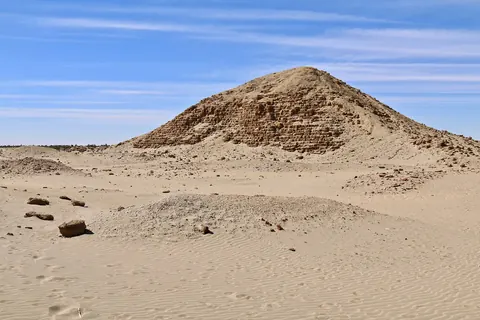
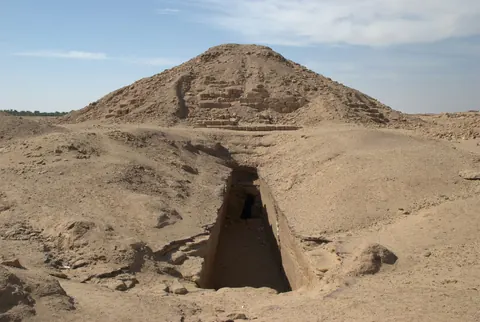
EL-KURRU

~720–650 BC

The first Kushite royal cemetery. Burial site of King Kashta and his son Piye — the king who conquered Egypt and founded the 25th Dynasty — plus Piye's successors Shabaka, Shebitku, and Tanutamani.

NURI

~664–310 BC

Established by Taharqa, who left El-Kurru to build his own pyramid here — at 52 m per side, the largest ever built by a Kushite king. Roughly 21 kings, 52 queens and princes are buried at this site over more than three centuries.

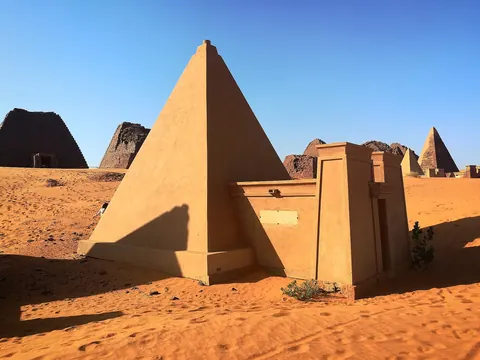
MEROË

~270 BC–AD 350

The royal cemetery after the capital moved south. Steeper, narrower pyramids than Egypt's — a distinct Kushite style. More than 40 kings and queens are buried here, including the warrior queens who fought Rome.

Kings and queens of Kush — the verified record

RulerPeriod / approx. reignBuried atKnown for
KashtaNapatan, c. 760–747 BCEl-KurruFirst Kushite king to claim authority in Upper Egypt; father of Piye.
Piye (Piankhi)25th Dynasty, c. 747–716 BCEl-KurruConquered Egypt and founded the 25th Dynasty; his victory is recorded on the Victory Stele (Cairo Museum).
Shabaka25th Dynasty, c. 716–702 BCEl-KurruCompleted the conquest of Egypt; commissioned the Shabaka Stone (British Museum EA498).
Shebitku25th Dynasty, c. 702–690 BCEl-KurruRuled during Assyria's rise as a regional threat.
Taharqa25th Dynasty, c. 690–664 BCNuri (his own, the largest Kushite pyramid)The king of 2 Kings 19:9; built the shrine at Kawa (Ashmolean Museum) and the sphinx now in the British Museum, EA1770.
Tanutamani25th Dynasty, c. 664–653 BCEl-KurruLast 25th Dynasty pharaoh; Assyria's conquest of Egypt ended Kushite rule there in 656 BC.
Atlanersa, Senkamanisken, Anlamani, AspeltaNapatan Period, c. 653–568 BCNuriContinued the dynasty inside Kush after Egypt was lost; Aspelta's Election Stela records his selection by the priesthood of Amun.
NastasenNapatan Period, late 4th century BCNuriLast king buried at Nuri before the royal cemetery moved to Meroë.
Arakamani (Ergamenes)Early Meroitic, c. 270 BCMeroëAssociated with shifting royal burial permanently to Meroë.
Amanirenas (Kandake)Meroitic, c. 40–10 BCMeroëLed Kush's army against Rome under Augustus — one of the warrior queens historically confirmed to have fought Rome to a negotiated peace.
Natakamani & AmanitoreMeroitic, c. 1st century ADMeroëCo-rulers and the era's great builders — major temple and pyramid construction at Meroë and Naqa.

This is the confirmed core list; roughly 40 additional Napatan and Meroitic rulers are buried across these three sites. The complete monarch-by-monarch record is maintained on Wikipedia's "List of monarchs of Kush," linked below alongside the primary institutional sources.

Verified sources — go see the evidence yourself

🏛️

UNESCO WORLD HERITAGE · INSCRIBED 2003

Gebel Barkal and the Sites of the Napatan Region

Five archaeological sites — Gebel Barkal, El-Kurru, Nuri, Sanam, and Zuma — officially recognized as testimony to the Napatan and Meroitic cultures of the second Kingdom of Kush.

View the UNESCO listing →
👑

UNESCO WORLD HERITAGE · INSCRIBED 2011

Archaeological Sites of the Island of Meroë

The royal city of the later Kushite kings, its pyramid fields, and the nearby religious centers of Naqa and Musawwarat es-Sufra — the heartland of Kush from the 8th century BC to the 4th century AD.

View the UNESCO listing →
📚

FULL MONARCH RECORD

List of Monarchs of Kush

The complete, continuously updated scholarly list of every known Napatan and Meroitic king and queen, with their burial site (El-Kurru, Nuri, or Meroë) cross-referenced against the archaeological record.

View the full list →
🗿

NUBIAN PYRAMIDS — THE COUNT, SITE BY SITE

~220 Pyramids vs. Egypt's ~120

The site-by-site breakdown of every Kushite pyramid field, including the fourteen built for queens — including the Kandakes (queens) of Meroë — Amanirenas fought Rome to a negotiated peace.

Read the full record →
🐏

BRITISH MUSEUM · EA1770 · c. 680 BC

Sphinx of Taharqa, from Kawa

Excavated at the Temple of Amun at Kawa in Nubia by Oxford's archaeological mission — the same Taharqa named in 2 Kings 19:9, portrayed with his own face on a classic Egyptian sphinx form.

View the catalogue record →

🏺

NATIONAL MUSEUM OF SUDAN, KHARTOUM

The Taharqa Statue & the Nubian Collection

Home to the largest Nubian archaeological collection on earth, including a 4-meter granite statue of Taharqa. Note: the museum was heavily damaged and looted during Sudan's 2023–present civil war — a live, ongoing threat to this physical record.

Read the museum's record →

WHY BROTHERS BUILT THE SAME WAY

One family, one architectural inheritance

This book's claim isn't just that Cush and Mizraim were brothers in a spiritual or symbolic sense — it's that the historical record shows exactly the transmission you'd expect between two brothers' bloodlines sharing one civilization. The pyramid form was already standing in Mizraim's land (Kemet/Egypt) for well over a thousand years — the Old Kingdom pyramids at Giza and Saqqara — before Kush ever built one. When Kashta's line, the kings of Kush, conquered and ruled Egypt as the 25th Dynasty, they did not encounter a foreign tradition. Archaeology and Egyptology agree this was already a deeply Egyptianized culture — worshipping Amun, using Egyptian writing and royal titles, per the British Museum's own account of the period. Ruling from both Napata and Memphis, the Kushite pharaohs absorbed the pyramid-building tradition directly, then did something Egypt itself had stopped doing for centuries: when they returned home to Kush after losing Egypt in 656 BC, they kept building pyramids — not a handful, but roughly 220 of them, nearly double Egypt's own total, sustained for another thousand years at El-Kurru, Nuri, and Meroë.

Read the way this book reads Genesis 10, that is not a coincidence needing an outside explanation. It is what two brothers' descendants do when one people's architectural, religious, and royal tradition is genuinely shared, inherited, and carried home by the other — literally, not just genetically. The pyramid itself becomes physical, standing evidence of the same brotherhood Genesis 10:6 names in words: Cush and Mizraim, sons of Ham, building in the same form, on the same river, for the same reason — to send their kings into eternity as gods.

BEYOND THE BOOK

The deep history behind the claim

Not everything fits in 18 chapters. This is the fuller historical context connecting biblical Cush to Nubia and Kush as archaeology and history know them — and why the identity link to African and African-American descendants matters.

Kerma — the first kingdom of Kush +

Centered south of Egypt on the Nile in what is now Sudan, the Kingdom of Kerma (c. 2500–1500 BC) is one of Africa's earliest urban civilizations outside Egypt, with monumental mudbrick temples (deffufas), royal tumulus burials, and its own distinct material culture. Egyptian texts of the era already call this southern neighbor and rival power Kush — the same name Genesis 10:6 and the rest of the Hebrew Bible use for Ham's firstborn son and his descendants.

Napata and the 25th Dynasty — when Kush ruled Egypt +

By the 8th century BC, kings from Napata in Kush — Piye, Shabaka, Shebitku, Taharqa, Tanutamun — conquered and ruled the whole of Egypt as its 25th Dynasty, the "Kushite" or "Black Pharaohs." This is the same dynasty and the same Taharqa named in 2 Kings 19:9 as the Cushite king who moved against Assyria during Sennacherib's siege of Jerusalem — a rare point where the biblical text, Assyrian records (the Taylor Prism), and Egyptian/Kushite monuments all describe the same episode from different angles.

Meroe — the kingdom that outlasted Rome's rise +

After losing Egypt, the Kushite kingdom's center shifted south to Meroe, which flourished for another 900 years (c. 300 BC – AD 350), developing its own alphabetic Meroitic script (still only partly deciphered), iron production, and over 200 pyramids — more than Egypt itself. This is very likely the kingdom of "Candace" behind the royal title in Acts 8:27, and the wider Nile-Sudan world the book calls "the rivers of Cush" in Zephaniah 3:10 and Isaiah 18:1.

How the name got buried +

Greek writers folded Kush, Nubia, and other dark-skinned peoples south of Egypt into the single broad label "Aithiopia." Later European scholarship, especially from the 18th and 19th centuries, layered racial hierarchies onto the Table of Nations and stretched Noah's curse on Canaan (Genesis 9:25) across all of Ham's line — a reading historians of the Bible's reception broadly regard as a post-biblical invention used to justify colonization and race-based slavery, not something the Hebrew text itself supports. The effect, across centuries, was to sever the historical memory of Kush, Kemet, and their descendants from the biblical record most familiar to the people descended from them.

Why this matters for identity today +

For African-American and African readers specifically, this history matters because it reattaches a severed thread: the same Scripture used to justify enslavement and erasure also names, in its own original language, the ancestors of the people it was used against — and does so with dignity, not shame. Reclaiming the Hebrew names (Cush, Kemet) alongside the archaeological record (Kerma, Napata, Meroe) is not a rewriting of history. It is a return to the names that were already there before later translation and later ideology covered them over.

CHECK THE SOURCES YOURSELF

Genetics — validated, and linked so you can verify it

The book's genetics chapters lean on published, peer-reviewed research. Here is that research named directly, with a link to the original publication or institution — not a paraphrase of a paraphrase.

Jablonski & Chaplin, "The Evolution of Human Skin Coloration," Journal of Human Evolution, 2000

The foundational study establishing that dark, high-eumelanin skin is the ancestral condition of modern humans, selected for protection against UV radiation near the equator, with lighter skin as a later adaptation at higher latitudes.

Read the abstract on PubMed →

Lamason et al., "SLC24A5, a Putative Cation Exchanger, Affects Pigmentation in Zebrafish and Humans," Science, 2005

The derived Thr111 allele of SLC24A5 (rs1426654) is near-fixed in Europeans and lightens skin; the ancestral allele goes with darker skin. It is rare in most sub-Saharan populations but present in East Africa through later gene flow from Eurasia (Crawford 2017). A documented case of a light-skin allele as the derived form.

View the publication record →

Natural History Museum, London — Cheddar Man genome analysis, 2018

Direct ancient-DNA sequencing of Britain's oldest near-complete skeleton (c. 10,000 years old), showing "dark to black" skin — a DNA-based estimate from a real, dated genome, consistent with the ancestral-dark / derived-light pattern.

Read the museum's write-up →

Smithsonian Institution, Human Origins Program

The Smithsonian's own public research hub on the fossil and genetic evidence for an African origin of Homo sapiens — the broader scientific consensus this book's Acts 17:26 / "one blood" argument is set alongside.

Visit the program site →

Primary study #3 — where light and dark skin variants came from

Nicholas G. Crawford, Derek E. Kelly, … Sarah A. Tishkoff (2017), “Loci associated with skin pigmentation identified in African populations,” Science 358(6365): eaan8433

Finding: In 2,000+ ethnically diverse Africans, variants in or near SLC24A5, MFSD12, DDB1, TMEM138, OCA2 and HERC2 are linked to skin colour. Most light- and dark-skin variants were already present in Africa before modern humans arose (~300,000 years ago by the paper’s clock). The exception: the light SLC24A5 variant entered East Africa later through gene flow from outside Africa.

Plain-English takeaway: East African Nilo-Saharan peoples are the most darkly pigmented in the world. Several of the dark-skin variants most common among them (at MFSD12 and near TMEM138) are ancient, far older than our species, and the same dark variants are shared by descent with South Asian and Australo-Melanesian peoples.

Inference (the book’s reading): If light and dark variants were already circulating in one African population long ago, a single family could carry the potential for the whole human range of skin tones. That fits the book’s reading of Genesis 10.

doi:10.1126/science.aan8433 →

Ancient DNA & the Y chromosome: what it shows

Verena J. Schuenemann, Alexander Peltzer, … Johannes Krause (2017), “Ancient Egyptian mummy genomes suggest an increase of Sub-Saharan African ancestry in post-Roman periods,” Nature Communications 8: 15694

Finding: 90 mitochondrial genomes and genome-wide data from 3 individuals, all from one cemetery at Abusir el-Meleq in Middle Egypt (c. 1400 BC – AD 400). These ancient Egyptians shared ancestry with Near Eastern and Levantine peoples, and the town showed genetic continuity through Persian, Greek and Roman rule.

Plain-English takeaway: At least in this northern Nile community, Egypt’s people were genetically tied to their Levantine neighbours. That fits Genesis 10’s picture of Mizraim and Canaan as one family of brothers.

Scope: The authors note the data come from a single site in Middle Egypt and call for more studies of ancient remains from southern Egypt and Sudan.

doi:10.1038/ncomms15694 →

Iosif Lazaridis et al. (2016), “Genomic insights into the origin of farming in the ancient Near East,” Nature 536: 419–424

Finding: Genomes of the Levant’s Natufian hunter-gatherers (c. 12,000–9,500 BC) and first farmers. Three of five Natufian men carried Y-chromosome lineages in haplogroup E1b1b, a branch of African origin.

Plain-English takeaway: Paternal lines of African origin were present in the Levant long before recorded history.

doi:10.1038/nature19310 →

Beniamino Trombetta et al. (2015), “Phylogeographic refinement and large scale genotyping of human Y chromosome haplogroup E provide new insights into the dispersal of early pastoralists in the African continent,” Genome Biology and Evolution 7(7): 1940–1950

Finding: Haplogroup E (E-M96) most likely arose in eastern Africa. Its E1b1b (E-M215) branch spread to the Horn, the Nile Valley, North Africa and the Levant; its E1b1a (E-M2) branch became the common West- and Central-African lineage.

Plain-English takeaway: One paternal family tree links peoples of the Horn, the Nile, North Africa and the Levant.

doi:10.1093/gbe/evv118 →

HAPLOGROUP E · PLAIN ENGLISH

Haplogroup E (E-M96) most likely arose in East Africa. Its E1b1b (E-M215) branch is common in the Horn, the Nile Valley and North Africa (the region tradition links with Put) and is also found in the Levant, including three of five Natufian men (c. 12,000–9,500 BC) sequenced by Lazaridis et al. Its E1b1a branch is the common West- and Central-African lineage.

METHODOLOGICAL NOTE ON TIMESCALES

Population-genetics papers measure divergence with molecular-clock models, often in tens of thousands of years, while Genesis gives patriarchal genealogies. This site cites those papers only for three empirical findings: (1) humanity is one family with African roots (Acts 17:26); (2) early Homo sapiens were darkly pigmented; (3) human populations dispersed through Northeast Africa and the Near East. Readers who hold a young earth and readers who hold an old earth can use the same evidence and stay together around the text.

This site keeps the same discipline the book does: inheritance mechanics (nuclear DNA, both parents, polygenic traits) are established science; "Cush's line inherited an already-existing pathway" follows logically from Genesis 10's genealogy.

ANCIENT EGYPT WRITING · MIZRAIM (GENESIS 10)

Ancient Egypt Writing — A Digital Museum

Then learn to read Mizraim’s own words: five short guided tours take you from your first sign to reading a real tomb stela. Then explore the full library: every Unicode hieroglyph and 16,379 ancient sentences with their published scholarly readings from the Thesaurus Linguae Aegyptiae.

Everything here comes from published scholarship: the Thesaurus Linguae Aegyptiae (Berlin-Brandenburg and Saxon Academies of Sciences, CC BY-SA 4.0) and the Unicode Standard. It is a study tool for Mizraim, not proof of the book’s argument.

FOR YOUR FIELD

One book. Four ways to use it.

Written to hold up under Hebrew lexical scrutiny and under a Sunday morning message alike. Choose the lens closest to you.

Churches & Bible study groups

Eighteen chapters organized for group study, each one anchored to specific, citable verses rather than inference alone. Use it as a teaching series on the Table of Nations, a Black History Month study, or a corrective to the "curse of Ham" teaching still repeated from some pulpits.

  • Chapter-by-chapter verdicts you can read aloud and discuss line by line.
  • A direct, sourced answer to the claim that Ham's whole line was cursed (Genesis 9:25 names Canaan only).
  • A "Twenty Indisputable Biblical Truths" chapter formatted for a discussion guide.
"Cursed be Canaan; a servant of servants shall he be unto his brethren."Genesis 9:25 — Noah names one son. Not Cush. Not Mizraim. Not Put.

Scholars & historians

Every claim is marked CONFIRMED, NOTED, or INFERENCE — never blurred together. Sources cited include Oxford scholarship, the British Museum's catalogued artifacts (EA 498, EA 1770, EA 24), the German Archaeological Institute on Uruk, and the standard population-genetics literature on human pigmentation.

  • Chapter 16 is a full first-principles audit: every claim in the book, re-tested and rated.
  • Radiocarbon and paleographic date ranges (Garima Gospels, Dead Sea Scroll fragments) are flagged for verification against primary lab publications rather than printed as settled fact.
  • Genealogy and genetics are kept in separate lanes — inheritance mechanics never dressed up as a sequenced ancient genome.
"The Hebrew text clearly signals that Ebed-Melech is of African heritage."Cited from Oxford University scholarship, Ch. 5

Education systems

A structured, footnote-style framework for teaching the Table of Nations (Genesis 10) alongside world history and geography — showing students how "Egypt," "Ethiopia," and "the Middle East" map onto the biblical names Mizraim, Cush, and Canaan, and why the modern regional label is barely a century old.

  • A ready-made then-and-now map: biblical name, ancient site, modern country.
  • Clear separation of what Scripture states, what history/archaeology support, and what is reasoned inference — a model for teaching source evaluation itself.
  • Cross-curricular: fits religious studies, world history, and biology/genetics units alike.
Babel = Babylon. Erech = Uruk. Nineveh = near Mosul.Ch. 18 — the biblical map, matched to today's atlas

Identity & heritage

For African-American and African readers who were taught the Bible had little to say about their ancestors: this book argues otherwise, from the text itself. Your bloodline is named. Your lands are named. God is recorded interacting directly with your ancestors — defending, promising, sending His own Son into their territory.

  • The real names first: Cush, not "Ethiopia" as a vague catch-all; Kemet, not just "Egypt."
  • Named individuals God used directly: the Cushite wife of Moses, Ebed-Melech, Tirhakah, the Ethiopian official of Acts 8, Simeon called Niger.
  • A genetics chapter tracing the ancestral, dark-skinned human condition back through Cush toward the first parents — inference, clearly labeled, never overclaimed.
"Are ye not as children of the Ethiopians unto me, O children of Israel? saith the LORD."Amos 9:7 — Ch. 6

SOURCE REGISTRY · 23 SOURCES

Every source, and how it was checked

19 of 23 sources were checked against the official record (museum database, DOI registry, UNESCO, the academies’ datasets) on 19 November 2026. The rest are marked “not yet verified” with the reason. This list works without JavaScript. Data: sources.json · claims.json.

Open the full source registry →

TALK WITH THE AUTHOR

Ask me anything

I'm Charles Anthony Shaw. Ask me about a chapter, a verse, an artifact in the locker above, the genetics sources, the deep history of Kush and Kemet — or bring me any other Bible question, or anything else on your mind. I'll answer as myself.

You're chatting live with an AI-powered version of the author. For questions about the book, answers reflect its actual arguments and sources — for citations and full context, read the book itself.

Contact the author

For an interview, extra reading, or a question about the book or the Bible, send a note. Charles reads each one.

Or write directly to hello@hamslegacy.org.